A History of Institutions for People with Disabilities: Neglect, Abuse, and Death

by James DeLano

What Are Institutions for People with Disabilities?

In this post, I focus on the institutions that were, and remain, facilities operating for the purpose of housing people with disabilities. The National Council for Disability (NCD) defines these institutions as “a facility of four or more people who did not choose to live together.” They summarize a report made by a consortium of self-advocacy organizations based on their experiences with institutionalization. The NCD list of criteria to define an institution, as synthesized from various self-advocacy groups, is that they:

  • Include only people with disabilities,
  • Include more than three people who have not chosen to live together,
  • Do not permit residents to lock the door to their bedroom or bathroom,
  • Enforce regimented meal and sleep times,
  • Limit visitors, including who may visit and when they may do so,
  • Restrict when a resident may enter or exit the home,
  • Restrict an individual’s religious practices or beliefs,
  • Limit the ability of a resident to select or remove support staff,
  • Restrict residents’ sexual preferences or activities,
  • Require residents to change housing if they wish to make changes in the personnel who provide their support or the nature of the support,
  • Restrict access to the telephone or Internet,
  • Restrict access to broader community life and activities.

Historically, these kinds of institutions have primarily included people struggling with mental health and people with intellectual or developmental disabilities.

What Were America’s First Institutions for People with Disabilities?

Mental institutions in America predate the reality of an American nation. The earliest hospital for the mentally ill, the Publick Hospital for Persons of Insane and Disordered Minds, was founded in Virginia in 1773. It was closer to a prison than what we would now call a hospital; patients were kept chained and shackled, physically abused, intentionally fed rotten food, and bathed in ice water. Inmates were rarely released. Many were placed or kept in prisons prior to or after their evaluation as being “insane.” This began to change in the 1840s; a new medical director attempted to use more humane approaches to treatment. Those included treatment that was consented to and largely removing chains and shackles.

The first modern institution for disabled people was founded by Samuel Gridley Howe in 1848 in Boston, Massachusetts. It was considered experimental, despite others’ previous endeavors taken elsewhere, but Howe had experience in a similar environment, having founded the Perkins Institution for the Blind twenty years earlier. A contemporary article sings praises of the institution. Despite that, the electronic catalog of annual reports by the institution, renamed the Walter E. Fernald State School, ends abruptly in 1973 with a report on identifying child abuse and neglect.
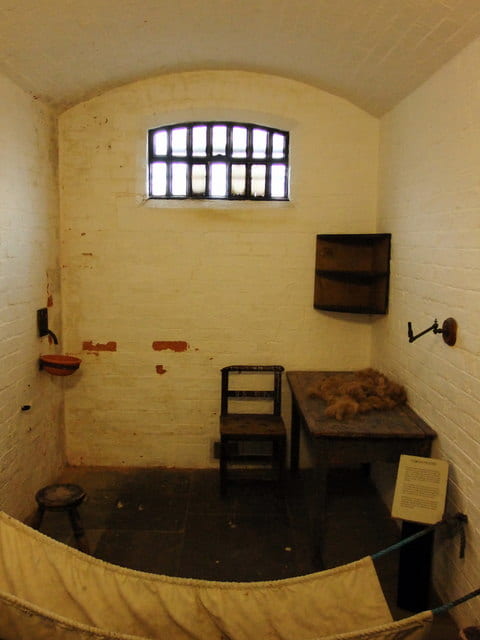
 

Small Victorian-era prison cell. Source: Yahoo Images

John F. Kennedy

John F. Kennedy (JFK) played an important role in the early reform of institutions for people with disabilities. Many people know that Kennedy’s sister, Rosemary, was lobotomized, leaving her permanently disabled and confined to a psychiatric institution. Lesser known is that Kennedy established the President’s Panel on Mental Retardation in 1961, the first government committee on the topic. The committee’s recommendations led to numerous regulations being changed and legislation being passed. One Panel member, Eunice Shriver, who was also Kennedy’s sister, went on to found the Special Olympics.

Institutions for People with Disabilities in Alabama

The first mental hospital in Alabama was the Alabama Insane Hospital, founded in 1859 and renamed to Bryce Hospital in 1900. Ricky Wyatt, at the time 15 years old, was committed by a court to Bryce in 1969. He was not mentally ill.

Wyatt’s institutionalization led to a widespread deinstitutionalization movement. His guardian, a former employee of the hospital, sued Bryce Hospital on his behalf. During the discovery process, Wyatt’s lawyers discovered numerous preventable deaths in the facility, as well as a complete lack of plans in case of a fire; there was no way to contact the Tuscaloosa fire department after 5:00 PM, and the fire hydrants on the property were decades old and incompatible with modern firefighting equipment.

That lawsuit, Wyatt v. Stickney (1972), was part of the beginning of a legal deinstitutionalization movement. It created a minimum standard for care at Alabama institutions for the mentally ill.

Willowbrook State School

Willowbrook was a state-funded institution in Staten Island from the 1940s until the late 1980s. The school was over its capacity in only a few years; in 1965, Robert Kennedy described Willowbrook as a “snake pit” with “rooms less comfortable and cheerful than the cages we put animals in a zoo.” The few changes that resulted from Kennedy’s visit were insubstantial and short-lived.

Another infamous incident in Willowbrook’s history was the hepatitis experiment conducted on the children in residence. The exact rate of hepatitis infection in children at Willowbrook is unknown; I have seen estimates ranging from 30% to 90% of children becoming infected during their time at Willowbrook. At the time, many specific details of hepatitis were unknown. Willowbrook had a local strain of hepatitis that was reputed to be less lethal than strains common elsewhere. Saul Krugman, funded in part by the U.S. Surgeon General’s Office, began conducting a study on hepatitis in Willowbrook – initially starting with an epidemiological focus, then shifting to a more involved study. Krugman intentionally infected 60 children at Willowbrook with the hepatitis virus by feeding them live samples of the hepatitis virus. Krugman “watched as their skin and eyes turned yellow and their livers grew bigger.”

Willowbrook left the public consciousness almost entirely until 1972, when Geraldo Rivera created a bombshell documentary that exposed the conditions at Willowbrook State School and institutions like it. In March 1972, residents’ parents filed a class-action lawsuit alleging violations of the constitutional rights of Willowbrook residents. Just three years later, as a result of the lawsuit, the Willowbrook Consent Decree created standards the institution would be Willowbrook open, however; Willowbrook State School formally closed “officially and forever” on September 17th, 1987.
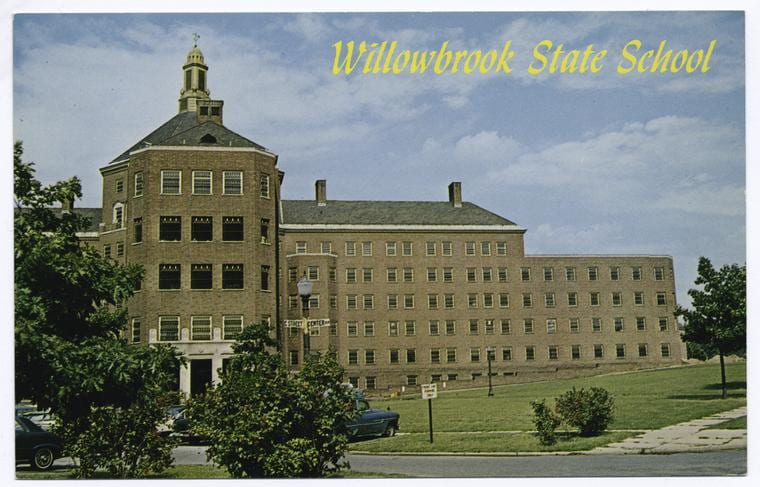
 

Postcard of Willowbrook with a yellow label stating "Willowbrook State School". Source: New York Public Library Digital Collection
Postcard of Willowbrook with a yellow label stating “Willowbrook State School”. Source: New York Public Library Digital Collection


Despite the promise made in the wake of the Willowbrook scandal, alumni are still mistreated today. In 2020, The New York Times published the results of an investigation conducted into recent abuses in a group home in New York where some Willowbrook alumni resided. They describe physical abuse and neglect, including injuries caused by scalding water, deaths caused by neglect, and ant infestations. The investigation made allegations against 13 employees, nine of whom still worked for the agency, and seven of those still worked in group homes at the time of the article’s publishing.

Institutions for People with Disabilities Today

In 2018, the Office of the Inspector General (OIG), along with other federal agencies, published a report on group homes, which have largely succeeded large institutions like Willowbrook or Bryce. They found that, in 49 states, health and safety procedures were not being followed.

“OIG found serious lapses in basic health and safety practices in group homes. OIG made multiple referrals to local law enforcement to address specific incidents of harm.”

Between 2004 and 2010, 1,361 people with disabilities died in Connecticut. 82 of those deaths were caused by neglect or abuse. The causes were found to be due to “abuse, neglect, and medical errors.” The OIG found that “State agencies did not comply with Federal waiver and State requirements for reporting and monitoring critical incidents.” These “critical incidents” include deaths, assaults, suicide attempts, and missing persons.
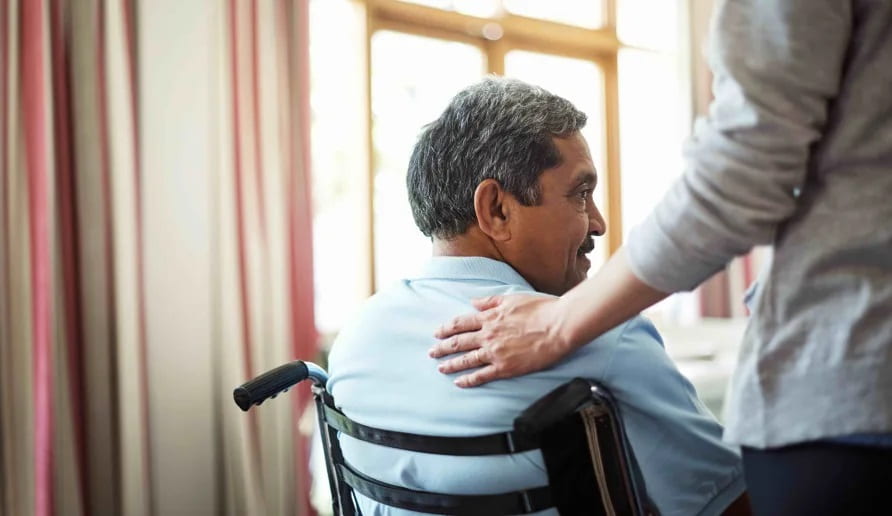
 

Older man in wheelchair being escorted by caregiver. Source: Yahoo Images
An older man in a wheelchair being escorted by a caregiver. Source: Yahoo Images


While we, as Americans, often like to think our country has advanced for people with disabilities, the reality is disappointing. Willowbrook alumni are still being abused forty years later. Group homes have been found to have widespread abusive and neglectful practices.

State Protection & Advocacy agencies exist as a legal protection for people with disabilities. In Alabama, the Alabama Disability Advocacy Program provides legal assistance to people with disabilities in cases involving civil rights violations and has the ability to investigate said cases in hospitals, group homes, schools, and any other facilities where abuse or neglect of people with disabilities occurs.
Hopeless Efforts at Release on Parole from Alabama Prisons

by Eva Pechtl 

“They see me trying to do right, but my past is my problem,” said Terry Townshend, an inmate resembling countless others denied release on parole from Alabama’s prisons at astounding rates.

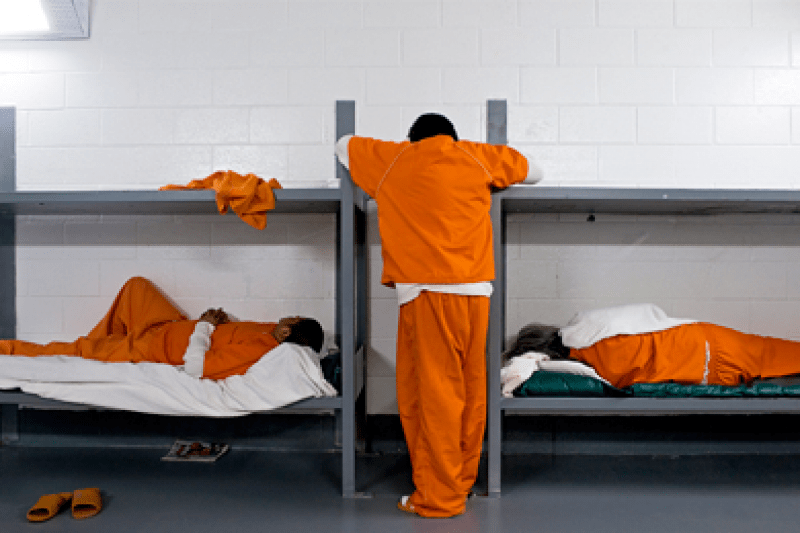
Two inmates sleep and one stands wearing prison uniforms. Some inmates will spend most of their time simply waiting, as not all prisons provide adequate opportunities for engagement in normal day-to-day activities.
An image of inmates waiting for the time to pass. Source: ProPublica via Yahoo Images


Before we begin, I encourage you to read Kala Bhattar’s posts on the extensive history and severity of the Alabama prison crisis concerning human rights. She offers valuable insights into the unique nature of the legal system in Alabama, and how its background connects to ever-present challenges in prisons today.

This post is going to explore the overwhelming decrease in parole rates being granted to prisoners by the Alabama Parole Board. The Alabama Bureau of Pardons and Paroles (ABPP) considers inmates eligible for parole after serving most of their sentence, allowing them to be released early from prison to reenter the community and complete service outside of prison walls. The declining rates of parole being granted are a barrier to the multifaceted issue of prison overcrowding pressed by understaffed facilities and increased prison violence. There are widely differing perspectives on the best strategies to calm the swelling chaos of prison overcrowding. To Alabama’s parole board, parole is not one of them.

It’s important to understand that parole is a privilege, not a right. Even if approved, inmates are released on strict conditions that may include reporting to a supervising officer, maintaining steady employment, not buying alcohol, or attending counseling to name a few. At any point, individuals can have their parole revoked and be reimprisoned. 

Parole hearings are conducted based on guidelines set forth by the ABPP. They are meant to consider whether an incarcerated person is likely to reoffend. The board considers the severity of an offender’s criminal history, risk assessments, reports of institutional behavior, participation in programs or treatment, and plans for navigating problems the offender is likely to face again during reentry. These guidelines have recently been criticized as flat-out ignored by the Parole Board, likely sparked following the consistently declining rate of parole actually being granted. According to the ABPP’s Monthly Statistical Reports, Alabama has gone from a grant rate of 54% in 2017 to 10% in 2022, and it reached as low as 2% in January of this year. 

A significant event sparking this change was Jimmy O’Neal Spencer, an inmate who was paroled in 2018 and, upon release, murdered three people. This tragic case led to tremendous pressure to keep inmates in prison and aligned with the sudden drop in grant rates beginning that year. When releasing convicted felons became understandably more controversial after Spencer’s release, the parole board’s actions were put under a microscope. The primary concern of the parole board seemed to shift to avoiding negative headlines.


Guidelines Being Overrun by Discretion

To be clear, the parole board ultimately has complete discretion over a decision, and the guidelines are meant to serve solely as an aid. Consequently, in May of 2023, the recommended 78% grant rate indicated by the guidelines was actually 18%. This raises questions about the disparities between parole guidelines and parole decisions. For one, why are the guidelines in place if they are consistently overlooked? This breach is represented by the conformance rate, which indicates the number of cases that matched the guidelines’ recommendation for grants or denials. It amounted to 23% in May, 14% in June, and 5% in July of 2023. This adds to years of disparities between recommended grant rates and actual grant rates present in Alabama. So, what is going on at parole hearings?

The precise reasons remain unclear. The parole board does not always articulate its reasons for approving or denying parole, even though they are required to by Alabama Code 15-22-26. Decisions were also commonly made based solely on the severity of an offense. Alabama determines the criteria for parole eligibility of certain offenses outlined in Section 15-22-27, but decisions are still weighed based on that information which the system has already approved. The point of having an additional hearing is to judge an inmate on who they are now.

Furthermore, race was an illuminated factor toward reentry this May, where 30% of decisions for White individuals conformed to the parole guidelines while 17% of decisions for Black applicants conformed to the same guidelines. However, I cannot comprehensively address the topic of race on reentry in this single blog.


The Power of Decision Makers

The drop in grant rates came promptly with Governor Kay Ivey’s appointment of Leigh Gwathney as the current board chair in 2019. Years later, Gwathney granted 2.4% parole of cases in the summer of 2023. Board members of the ABPP have tremendous discretion by law and have by no doubt used it to impact grant rates. Parole Watch documented a lack of attention toward the cases by the board and expanded on concerns about the three-chair system. A main takeaway from many perspectives on the hearing system is the influence the third seat can have on a hearing’s outcome. With two seats, the majority rule turns to a unanimous vote. When the board shrank to Gwathney’s seat, plus one, so did the grant rate from 13.2% in June to 4.1% in July. 

If parole is denied, the board determines an inmates’ set off date, or how long they will wait before being reconsidered for parole. Gwathney voted for the maximum set off date in 73.4% of denied cases in the summer of 2023, more than any other seat. What makes overcrowding a progressively hopeless matter is the fact that Alabama’s Department of Corrections has an opportunity to clear crowded and understaffed prisons of inmates that are eligible by the guidelines and obvious recommendation to leave. With an 80% decrease in parole grants from September 2019 to June 2020, the population in custody increased, even as custody admissions decreased. The impact of denying parole to so many is daringly increasing the pressure of prisons that are already way above full occupancy.

Parole hearings are open to the public, but unlike other states, Alabama does not allow offenders to represent themselves. Also, no rebuttal is allowed by supporters after opponents give the final word. Often, victims or advocates will misrepresent the facts leaving supporters of parole with no opportunity to correct them. According to Parole Watch’s observations, some representatives claimed to advocate for the victim but still opposed parole even if it supported the victim’s wishes. Opponents of parole like Victims of Crime and Leniency (VOCAL) and the Attorney General’s Office, proved to have a tremendous influence on the decisions of the parole board. Of the 78.3% of hearings this summer where VOCAL was present, 96.6% were denied. 

Inmates Are People Just Like Us

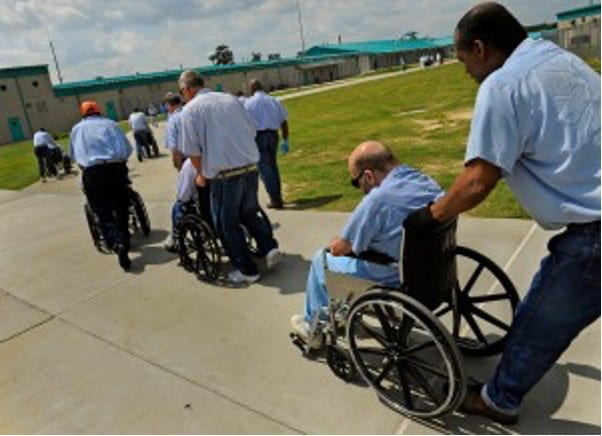
Aging inmates are pushed in wheelchairs outside by prison staff. The population of elderly inmates has risen dramatically in the past fifty years.
An image of aging inmates being pushed in wheelchairs outside by prison staff. Source: Yahoo Images via Unprison


71 year old Leola Harris, who has end-stage kidney failure, diabetes, and cannot walk or use the bathroom on her own, will likely die before her next hearing in 5 years. Having certification by the Department of Corrections for medical parole, testimonies by nursing home staff for a confirmed living plan, a successful lie detector test denying that she murdered the victim, and two decades of good behavior was not enough to get her out of prison for her remaining years.

This is reflected by many inmates who have numerous accomplishments to advocate for their improvement but are swiftly rejected. Terry Townshend has faced a life of drug addiction and resulting imprisonment, demonstrating fighting efforts to stay away from pills and crime. His release on parole failed when he got back into drugs after being given take-home narcotics after cancer surgery. Terry did everything he could to build personal responsibility from completing substance abuse treatment programs to earning a degree in trade school, and this in turn helped him understand his addiction and how to handle it without crime. However, like many, he was held down by his failures and rejected.

Timothy Bille, a now free man who was denied parole 4 times in 18 years, expressed that “They tell you to do all these prison programs to increase your chances for parole, but when they deny guys like Terry, it feels like a lie.” 

Finally, Frederick Bishop was denied parole at his hearing scheduled 10 days after he died in prison. Justice is not denying release to a corpse. His case demonstrates a lack of attention by the entire justice system toward informing relevant parties of an inmate’s status and judging them accordingly. 

The reality is that Alabama prisons have become more unsafe than the free world. Overcrowding in prisons is not as much due to new crime but to repeated declines of release for experienced inmates. Advocates for less violence and victimization in prison populations would agree that prisoners of minimal risk to their community, especially under careful supervision, should be granted freedom, and therefore safety. 

Jimmy O’Neal Spencer has been convicted, denied parole, and sentenced to death. It is time that thousands of others who are stuck in Alabama’s combusting, debilitating conditions deserve real chances at parole.

The Armenian and Azerbaijani Conflict: Attacks in the Nagorno-Karabakh Region

by Caitlin Cerillo

A Long History of Conflict

Since the late 1980s and early 1990s, Armenia and Azerbaijan have held political, economic, and territorial tensions. Prior to this, both countries were considered part of the Soviet Union after its formation in 1922. Nestled between the two countries is a region called Nagorno-Karabakh, which has been at the center of these strong tensions.


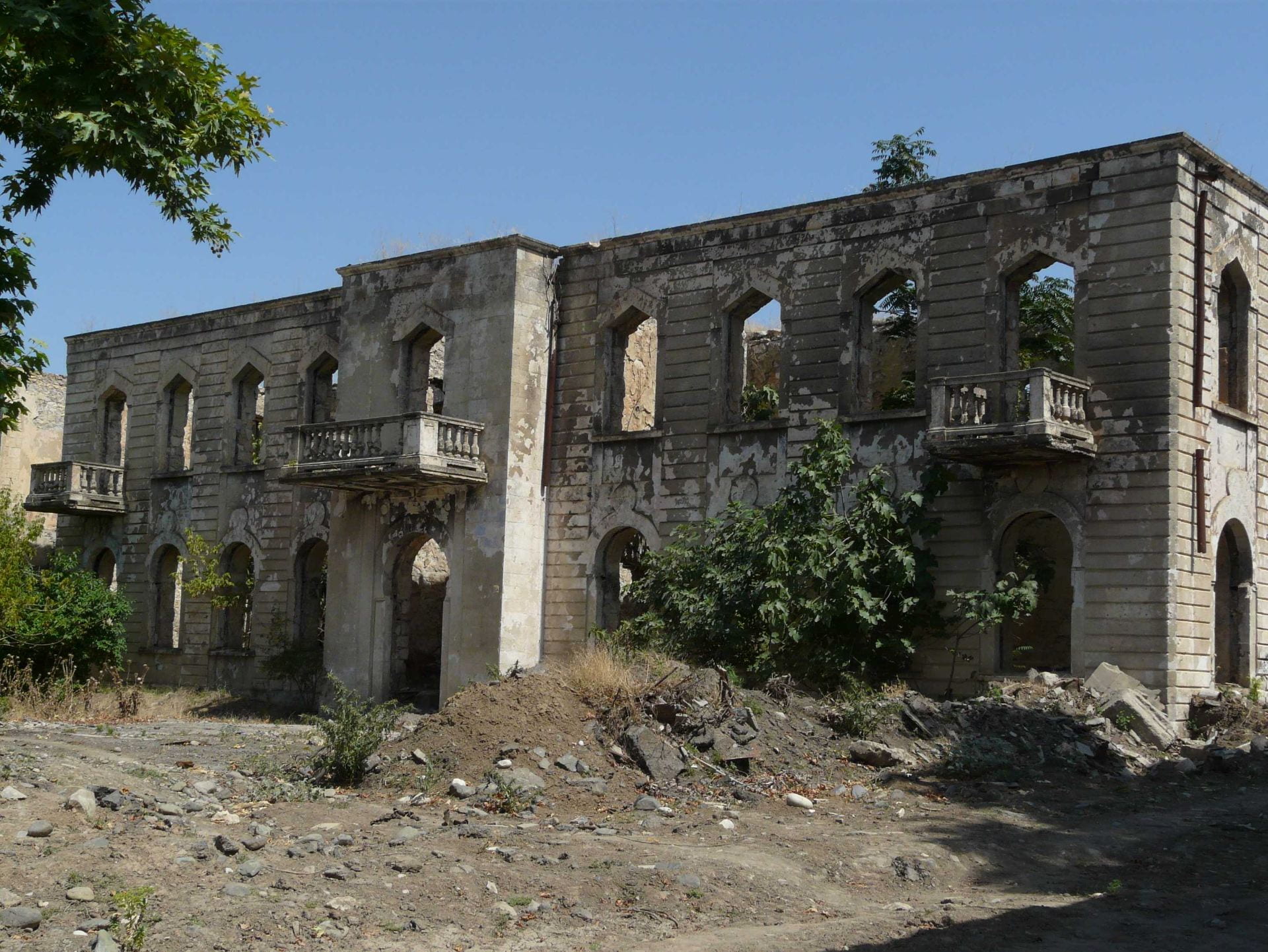
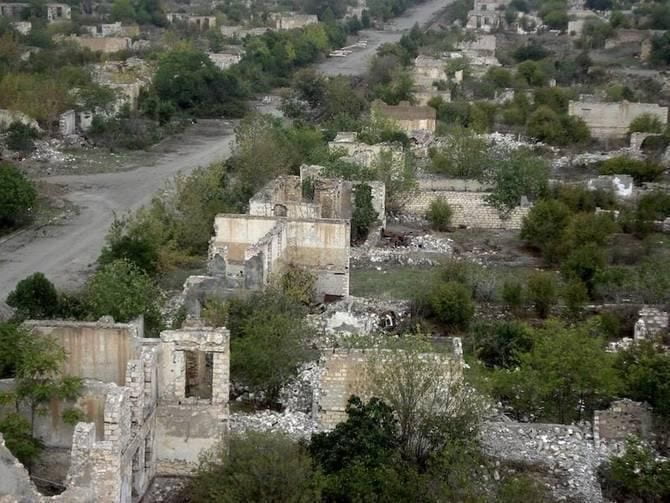
This image depicts a destroyed city in Nagorno-Karabakh from the first Armenia and Azerbaijani conflict.
Agdam, a deserted and destroyed city following the first Nagorno-Karabakh war fought between Armenia and Azerbaijan from 1988 to 1994. Source: Yahoo Images


With the region having an Armenian ethnic majority, it established a secessionist movement in 1988 with the goal of becoming part of the Armenian Republic. This movement was challenged on the basis of the Nagorno-Karabakh region geographically belonging to Azerbaijan and control of the area granted by the Soviets to the Azerbaijani government. Pushback against the region’s secessionist movement would lead to the first violent war fought between the two countries. This would result in a ceasefire, with Armenia maintaining territorial control in 1994.


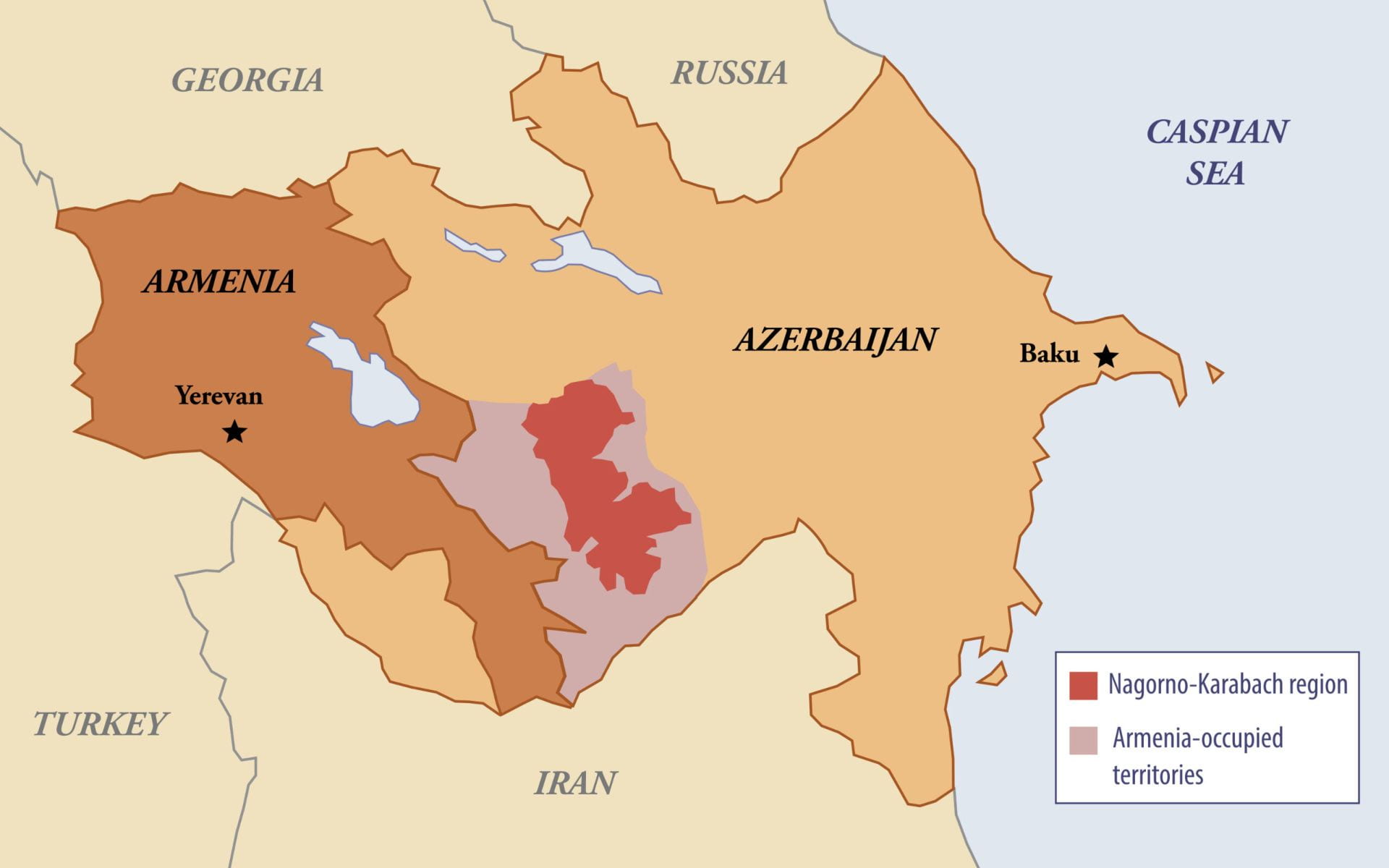
This image depicts a map of the involved countries/regions. Armenia on the left-most side, Azerbaijan on the right-most side, and the Nagorno-Karabakh region in the middle, highlighted in bright red.
Map of the involved countries/regions. Source: Yahoo Images

Tensions Rise Again

Three years ago, the conflict was provoked again, leading to the second Armenian and Azerbaijani War. Once again, these tensions broke out regarding the Nagorno-Karabakh region. Although the first war ended in Armenia’s favor, Azerbaijan claimed victory with the help of its Turkish allies. Similar to the result of the first war, a ceasefire was facilitated by Russia and the two countries. Azerbaijan was promised territorial control of the areas of the Nagorno-Karabakh region it captured in the war, with Armenia agreeing to release control of some areas it previously occupied.

Present-day Attacks in Nagorno-Karabakh

Even today, the conflict has continued to wage on. On December 12, 2022, the Azerbaijani government released troops in the Nagorno-Karabakh region due to a self-proclaimed “anti-terrorist military offensive.” Azerbaijan began by blockading the Lachin corridor, which is the only way Nagorno-Karabakh is connected to Armenia. This blockade weakened the import of food and other resources to the hundreds of thousands living in the region.


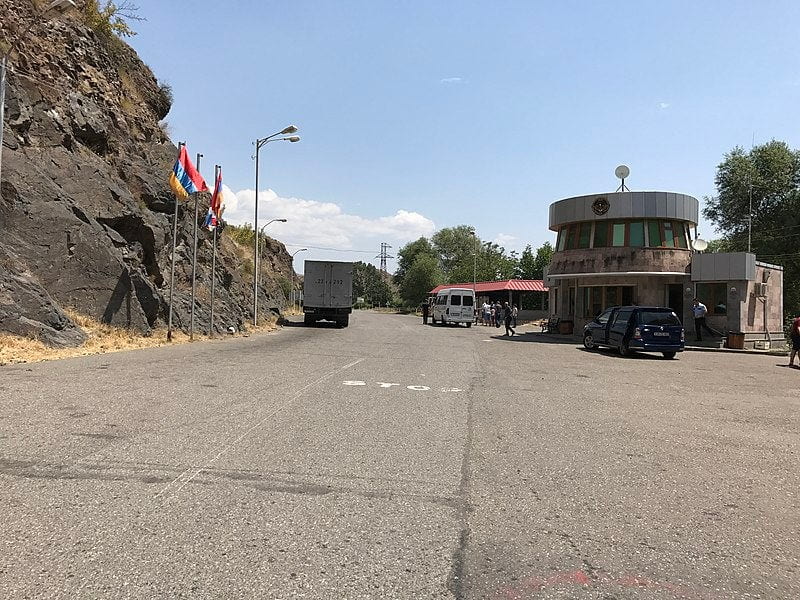
Photo of the Lachin Corridor which connects Nagorno-Karabakh to Armenia.
The Lachin Corridor, which was blockaded in December 2022 by the Azerbaijani government. The Lachin Corridor is the only connecting source between Nagorno-Karabakh and Armenia. Source: Yahoo Images


With the fear of attacks on loved ones and the reality of ethnic cleansing at the hands of the Azerbaijani government, tens of thousands of Armenians have fled to their home country as of September 2023. As defined by the United Nations, ethnic cleansing is the forced removal of an ethnically homogenous group through intimidation tactics and/or coercive practices. These practices can include—but are not limited to—murder, arrest, displacement or deportation, destruction of property, and severe physical injury to civilians.

Just one example of the devastating attacks of the Nagorno-Karabakh region occurred on September 19 in a village called Sarnaghbuyr. Citizens of the region have undergone extremely poor living conditions and food shortages for nine months due to the Lachin corridor blockage. Zarine Ghazaryan, a mother of four, witnessed explosions from Azerbaijan when searching for baby formula for her youngest child, Karen. Zarine was then told that one of her sons, Seyran, was wounded from the attack, and two, Nver and Mikayel, were killed. Nver and Mikayel were only ten and eight, respectively.

Along with the casualties of innocent civilians, many were witnesses to the murder of others. Arman, a fifteen-year-old, was around other children in the village when the attack occurred. He suffered wounds himself along with having to see the horrific sight of other children being killed and wounded. While the Azerbaijani government has asserted that the attacks were strictly for “neutralizing legitimate military targets,” it has left survivors and human rights experts calling the attack indiscriminate or carried out at random with a carelessness towards the safety of others.

The brutal attacks in the Nagorno-Karabakh region have violated several articles in the Universal Declaration of Human Rights. The rights of the lives of innocent civilians of the involved countries, especially those living in the Nagorno-Karabakh region have not been protected. Families who have chosen to flee to Armenia have undergone extreme hardship, with the Armenian border being backed up causing the postponing of the safe arrival of refugees. Human rights organizations, like Human Rights Watch, have called on the Azerbaijani government for the guarantee of those who have fled Nagorno-Karabakh’s return if they choose to do so. Human Rights Watch has also asserted that the Armenian language, culture, and education must be preserved and protected, without discrimination. Those who choose against returning to the region, should receive monetary reparations and the safe retrieval of any goods or property left after fleeing should be carried out as soon as possible.

Helping Nagorno-Karabakh

There have been several measures taken to help those affected. This includes humanitarian aid in the form of financial assistance, response plans, and more. In 2021, the United Nations created the Armenia Inter-Agency Response Plan. The purpose of this plan was to bring together humanitarian partners who were dedicated to helping the people of Nagorno-Karabakh. The plan outlined the highest priorities of aid and the ways in which the resources could be allocated the most efficiently. Through the Armenia Inter-Agency Response Plan, over 34,000 non-food resources were delivered to the region by UN agencies and over 11,000 school-age children were assisted in their education, among other things. In September 2023, the European Union funded 5 million euro to the Nagorno-Karabakh region, with an additional 4.5 million euro to help the displaced population and those who are still living in the region and vulnerable to violence and hostility.

Capital Punishment and the Right to Life

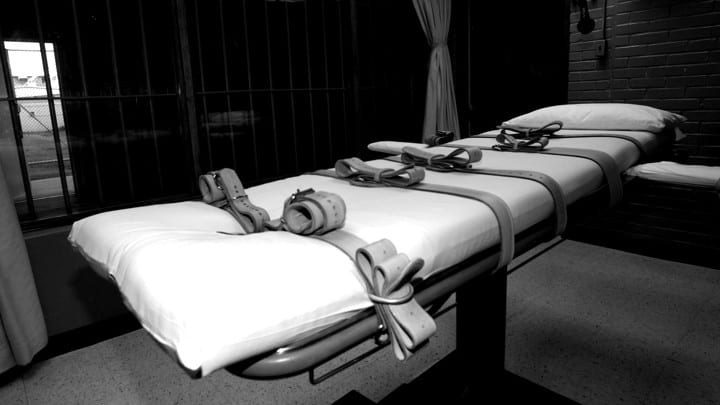
A black and white picture of a prison cot with five belts used to strap down inmates in order to give them a lethal injection.
While it may seem like a common practice throughout the world, only about 28% of countries still maintain the death penalty in both law and practice. Source: Yahoo! Images


Stay tuned for my next article, where I will explore how the process of the death penalty, as well as the methods used to end the lives of inmates, may bring up additional human rights concerns. That article will be posted in the upcoming weeks. 

October 10th is the World Day Against the Death Penalty. 

It was my eighth birthday. I had gotten home from school and after eating my snack, I sat down on the couch. My birthday is in January and my mom hadn’t gotten around to packing up the expensive nativity scene from my grandmother that was set out on the sofa table behind my head. I got bored with my show, as eight-year-olds do, so I turned around and started playing with the porcelain figurines. To me, they were no more than stiff, less fun Barbies. Little did I know all it took was one little high-five between Joseph and the wise man with the frankincense before *CRACK* Joseph lost a hand. 

I still remember my mother’s face when I told her what happened. This nativity scene from her mother-in-law meant so much to her and she was feeling so many emotions. I knew that I deserved to be punished in some way for my mistake. I sat in time out for a while, I got a “stern talking-to” when my dad got home, and I didn’t see my favorite (real) Barbie for weeks.

My eight-year-old, future-philosophy-student self couldn’t help but question why all of this was happening to me. It was my birthday; my parents were supposed to be nice to me that day, but I still got in trouble. I knew that I should’ve been more careful with the figurine, but I also knew that what I did was an accident. I knew as soon as it broke that I had caused a problem, but I almost immediately learned from it: this material is weaker than Barbie material so I would need to use gentler hands when holding it. But I still couldn’t figure out why my parents were doing this. As I grow up, this concern still follows me. What motivates society to punish people who break the law? How could our system of punishment improve to allow people to learn from their mistakes and to still participate in society?

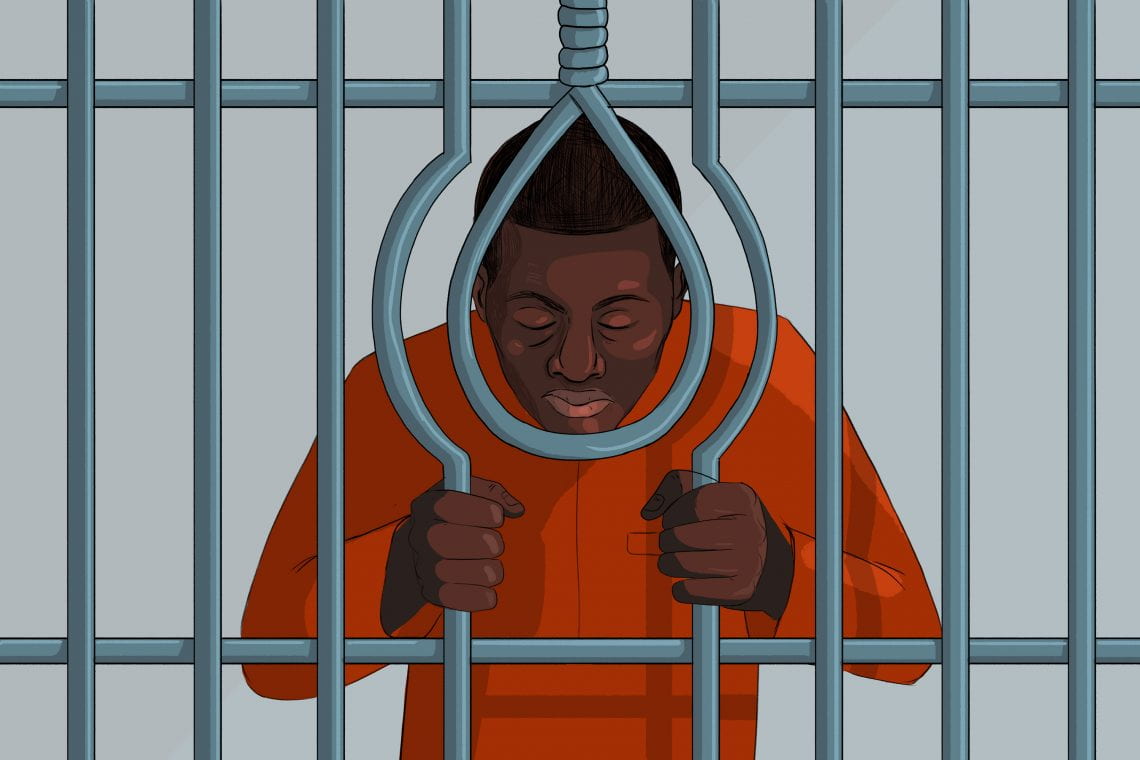
A drawing of a man in an orange jumpsuit with his head down standing behind metal bars. One of the bars makes the shape of a noose around his head.
Minorities, especially racial minorities, make up a disproportionate percentage of prisoners on death row. Source: Yahoo! Images

Theories of Punishment

Retribution 

The Retribution Theory of punishment holds that people who harm others deserve to be harmed and that the justice system should give them what they deserve. I like to call this the revenge theory or the “eye for an eye” theory. The arguments for this theory are, in my opinion, not very strong. Sure, it seems intuitive that when somebody wrongs us we want to wrong them back, but what good does that do? And should we really set up an entire justice system based on retribution when that only causes more harm to people, despite if they “deserve it?”

Deterrence

The Deterrence Theory of punishment holds that societies should punish moral failings in a way that when people hear about the punishment for a certain crime, it deters them from committing it. For example, people may not use drugs because they are afraid of what would happen if they got caught. If we want people to stop doing drugs, according to deterrence theory, we should inflict harsher punishments for those caught with drugs. The main critique of this theory is that it does not deter people from doing the thing, it only deters people from getting caught doing the thing, thus driving the whole crime farther and farther underground. 

Restoration

The Restoration, Humanitarian, or Utilitarian theory of punishment is based on the idea that after a harm occurs, we should avoid any further harm coming to anybody involved. This may entail rehabilitating people with addictions to live addiction free or mandating driving school and road safety courses for negligent drivers. This doesn’t just apply to low-level crimes though. This may mean a prison system similar to Norway’s, where even the most violent criminals are kept in a remote community where their rights and privileges are upheld. The average sentence is around 8 months, and after they’ve had time to reflect on their actions, they are allowed to return to society as usual. Click here to learn about what went into the design of one of Norway’s most famously humane prisons.  This theory is often criticized as being “soft on crime,” saying that if we don’t make going to prison incredibly unpleasant, criminals will not have any reason not to re-offend. 

A wooden electric chair against a dirty wall in the background.
The youngest person to be executed by electric chair in the 20th century was 14-year-old George Stinney Jr. His conviction was later vacated as an unfair trial. Source: Yahoo! Images

Pragmatically, when we are deciding which theory of punishment to ascribe to, we are balancing the weight of the government’s function that motivates law enforcement with the human rights of everybody involved in the crime. 

So what is the government function of capital punishment and does it outweigh the most fundamental human right, one’s right to one’s own life?

Government Function

It is widely agreed upon that the government’s most fundamental function is to protect the rights of people in its jurisdiction. This includes mediating conflicts in which a person impedes on another’s rights. In these terms, the crime of theft is when a perpetrator impedes on the victim’s right to own property. In this case, the government then has an obligation to interfere in some way to bring justice to the victim. Most of the time, this interference will constitute the government temporarily impeding on the rights of the perpetrator themselves. This may mean keeping them in jail until their trial, imposing a fine on them, or even sentencing them to prison time. 

Human Rights

The right to life is inarguably the most fundamental natural human right that exists. All humans have a fundamental right to live their bodies’ natural lifespan through to its end. It can even be argued that humans have the right to the best healthcare available to extend their lifespan as long as possible. Without the right to life, no other human rights of any kind can be realized. This is why the most widely recognized phrase about human rights lists life as the first. 

As the Declaration of Independence states, “We hold these truths to be self-evident: that all men are created equal and from that, they derive inalienable rights, among which are life, liberty, and the pursuit of happiness.” 

To take someone’s life is to take away that person’s most fundamental, widely-recognized human right.

Balancing Both

Does the governmental function of societal safety ever justify taking away the perpetrator’s number one human right? Especially when, given that life in prison is an alternative option, societal safety is not even at risk by keeping these people alive. Many people will argue that keeping them in prison requires too many resources whereas the death penalty is a quick and easy way to save resources for the rest of society. Not only does this completely dehumanize people who have committed crimes, but it also switches the governmental interest from public safety to the much less compelling governmental interest of distributing resources. The interest in these resources is not compelling enough to justify the deprivation of someone’s life. Even if you think it is okay to impede on a perpetrator’s rights to prevent them from causing more harm to society, it is unclear that the deprivation of life would achieve this goal when life in prison is an alternative. 

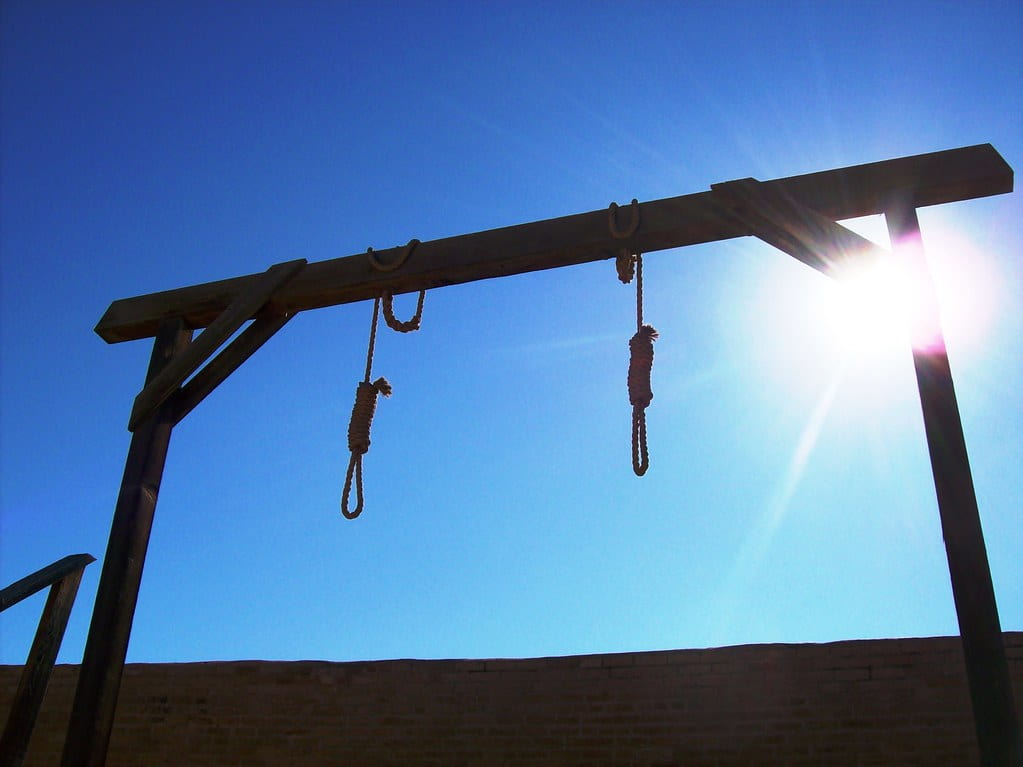
The sun shines behind a wooden gallows with two nooses hanging down.
Three states still allow hanging as a possible execution method. Source: Yahoo! Images

According to the Retribution theory, people who took another life deserve to be killed solely on the “eye-for-an-eye” principle. But something doesn’t sit right when we try to defend this principle without dehumanizing people convicted of crimes. As a society, is it a good thing that we think a certain group of people deserves to die, even if their qualification into that group was voluntary?

According to the Deterrence theory, the death penalty may actually be an effective deterrence for prospective criminals. If they knew that committing this crime may literally mean the end of their lives, they may not commit the crime. However, it is unclear that the deterrence factor of life in prison, essentially ending people’s lives as they know it, is so much less effective than the deterrence factor of the death penalty that it justifies taking lives. 

According to the Restoration theory, capital punishment stands no chance. This theory is based on the hope of rehabilitation for criminals, even if that means they are only ever restored insofar as to live a meaningful life in prison. This theory is considered to be the most humane approach to punishment, and as far as research can tell, the one compatible with the lowest recidivism (re-offending) rates. 

World Teacher’s Day: A Glimpse into the Persistent Opportunity Gap in America & How a Birmingham Startup is Trying to Close It

“I was always told that America is the land of the free, a land of opportunity. What no one told me was how difficult it was to achieve the American Dream itself. Perhaps that is why they call it a dream—realistic but out of reach. Every time you inch forward, you think you are getting closer to your goal when, in reality, you are getting closer to seeing your greatest hurdles with clarity.”

–Navin Mawani, my mother, an immigrant from Pakistan

Today, October 5th is World Teacher’s Day. Teachers are equivalent to front-line workers who continuously connect young people to opportunity in the forms of learning, employment, and emotional and physical health. So why are there policies in place that create opportunity gaps for teachers and students alike?  

I am a first-generation student in the United States, and I am fortunate that my family could afford to live in a zip code that did not discriminate against me. This article will expose you all to some information about opportunity gaps that prevent children from attaining a sufficient education and will speak about STRIVE Birmingham, an organization that is trying to mitigate the effects of social and economic policies that affect all people.  

A book and pen with leaves around it saying "World Teacher's Day"
A book and pen with leaves around it saying “World Teacher’s Day”; Source: Yahoo Images


The Problem 

In Birmingham and several other cities, the opportunity gap—the way social and economic factors result in lower rates of success in a variety of life aspirations—affects all people within society. I consider this limitation on opportunity to be a violation of the human right to attain an education and to sustain a livelihood. The Close the Gap Foundation defines this gap as “the way that uncontrollable life factors like race, language, economic, and family situations can contribute to lower rates of success in educational achievement, career prospects, and other life aspirations.” One example of an opportunity gap is the low reading proficiency among children in kindergarten to third grade within Birmingham City Schools. To combat this opportunity gap, the City of Birmingham established the Page Pals Reading Initiative, a volunteer opportunity for all to read and converse with third-graders at elementary schools.  

If the problem is starting as early as elementary school, there is a drastic need to close this gap. And if that is not convincing enough, these statistics do not lie: 

  • The Annie E. Casey Foundation’s 2012 study found that “while 6% of children who’ve never lived in poverty will drop out of high school, that number climbs to 22% for children who’ve lived in poverty, even temporarily during the time of the survey.” 
  • According to the U.S. Department of Education, high-poverty districts spend 15.6% less on each student than those in more affluent districts. This can result in less student retention, lower earning potential after graduation, and high poverty rates in adulthood. 
  • A 2020 survey by Global Strategy Group of college undergraduates revealed that 77% of students said they fear they will not be able to stay on track to graduate due to hardships caused by COVID-19. That is 3 in 4 college students fearing failure. 
A group of children smiling and hugging one another.
A group of children smiling and hugging one another; Source: Yahoo Images


What Creates These Opportunity Gaps?

Unfortunately, there are several factors that contribute to creating and encouraging opportunity gaps. As per the Learning Policy Institute, “these inequities result from growing income inequality over the past three decades and the failure of many states to invest equitably in schools that serve a diverse student population.” Providing equitable access to deeper learning opportunities is perhaps the major challenge of 21st-century education in the United States.

You might be asking yourself what does income inequality have to do with public education and opportunity gaps? According to extensive research conducted by the Economic Policy Institute, a child’s social class is “one of the most significant predictors—if not the single most significant predictor—of their educational success.” Socioeconomic gaps that originated in the 1980s still affect children today. Income inequality has not been reduced, which has kept the educational growth of multiple children stagnant and has widened the opportunity gap.

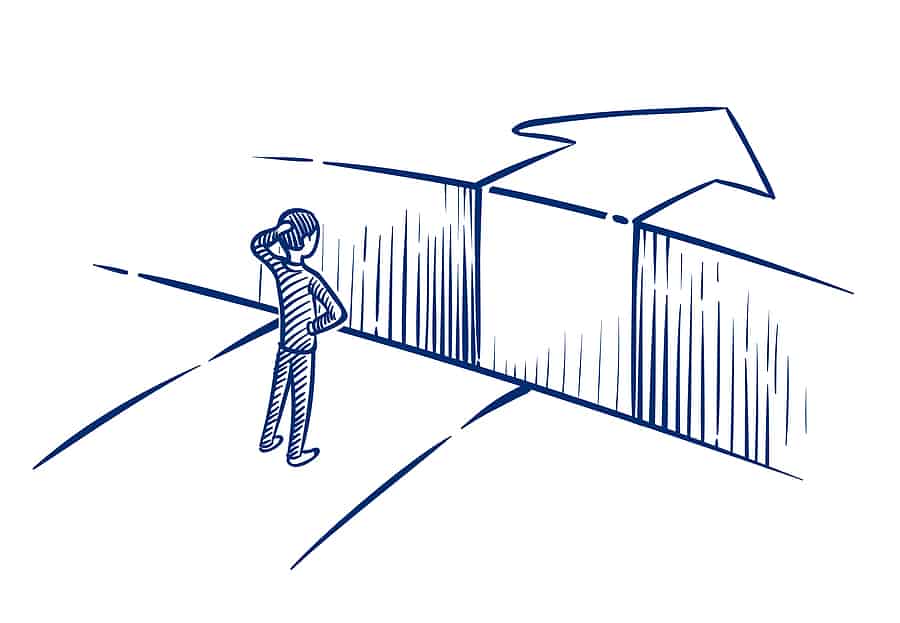
A person standing in front of a wall of a arrow
A person standing in front of a wall of a arrow; Source: Yahoo Images


Income inequality is also dictated by where you live. In a New York Times article in the “America We Need” series, multiple teachers from varying cities in the United States attest to how the opportunity gap is promoted by place of residence, starting with “pollution and the stresses of poverty and [extending] to economic segregation and inadequate school funding.” Not only do teachers have to work within these structural inequities that impede many students from achieving their potential, but they also have to accommodate their way of teaching and communicating knowledge in a way that gives the students the extra boost they need.

And the teachers are right: zip codes have too much influence on the success of students, who are the future leaders, innovators, and entrepreneurs of our world. So why is it okay for nonwhite school districts to get $23 billion less than white districts, despite saving the same number of students? Let me help you out here. It is not. It is unfortunate that even after landmark cases like Brown v. Board of Education (1954), racial and economic segregation created by gerrymandered school district boundaries continues to divide our communities and robs children of their right to a satisfactory education that helps them advance in life.


How is STRIVE Birmingham Helping Close this Opportunity Gap?

STRIVE Birmingham is a startup established in June 2023 that aims to bridge the opportunity gap by building a workforce and lifelong relationships. It helps those facing the toughest societal barriers to employment be able to access the training and support they need to build a career and escape social stratification.

STRIVE serves 92% of BIPOC (Black, Indigenous, People of Color), 41% of parents of minors, 44% of people who have been impacted by justice, 78% of people receiving public services, and 84% of formerly unemployed individuals. Since 1984, STRIVE has had more than 85,000 graduates and serves about 2,000 people annually at its locations in New York, Atlanta, and now Birmingham.

STRIVE Birmingham has partnerships within the Birmingham medical community and is able to get its students of all ages national certifications, has a 70% to 80% successful placement rate, and pledges a lifetime commitment to students. Once you are a part of STRIVE, you are able to receive professional development and essential employee skills, while having access to a network of professionals who are all rooting for your success.

A blue and white logo for STRIVE Birmingham
A blue and white logo for STRIVE Birmingham; Source: Yahoo Images


As a first-generation student, there is nothing more encouraging than knowing there are organizations like STRIVE Birmingham that exist to help bridge the opportunity gap that is so prevalent in communities like Birmingham’s through education. I am also comforted in knowing that there is no age limit on education; anyone can be an educator, and anyone can be a student.

As I reflect on who has influenced my educational journey on World Teachers’ Day, I am more aware of barriers to those who could not escape opportunity gaps. I am eternally grateful to my teachers and mentors for helping me excel, and I salute every teacher who has ever had to battle restrictions to their educational style because of policy-dictated opportunity gaps. Thank you, teachers, instructors, and mentors, for not giving up, even when the situations were not ideal. Thank you for not discriminating against your students, even if their ZIP code does.


Additional Information on the Opportunity Gap in Public Education

This TED Talk by Anindya Kundu summarizes the implications and other factors of the opportunity gap within U.S. public Schools, and I highly recommend it.

El Salvador Being Counter-Productive

When it comes to political corruption, the first countries that come to your mind are probably prominent ones that you have heard about in the news such as North Korea, Venezuela, Iraq, and countless many others. This article will concentrate on a smaller country that is having a more profound impact on the human rights of its citizens: El Salvador. It will be done by analyzing the leadership of its president, Nayib Bukele, and how he transformed the political and social landscape of Central America by going head-to-head with gangs and crime. His actions, rather than lowering crime in his country, have only exacerbated the crisis. While many Western citizens believe that taking the fight directly to the front is justified and right, it actually does not remedy the cause of the violence: a lack of socioeconomic stability and development.


The Problem

El Salvador is the tiniest country in Central America, but it was nicknamed the “murder capital” of the Western hemisphere because of the severely high homicide statistics in the world, excluding war zones. Gangs run rampant and have a staggering amount of control over the population as they facilitate the transfer of drugs and materials from the black market. For years, the previous government administrations ineffectively attempted to damper these issues, but they were unable to, which led to the rise of Nayib Bukele.


Who is Nayib Bukele?

With his rise to power as President of El Salvador in 2019, Nayib Bukele became the face of a new era of political aspirations for the people of his country. However, despite the pressures that came with him being the youngest governmental leader in Latin America at age forty-one, he faced the more daunting task of creating a government that would do away with the corrupt administrations prior to his own. By creating a political party under the name, “Nuevas Ideas”, with its English translation being “New Ideas,” while previously serving as the mayor of San Salvador, he advocated for change against the political establishment. He initially relied on the Frente Farabundo Martí para la Liberación Nacional (F.M.L.N.), a major political party that rose to power after the war between the guerrilla and government forces. The organization returned the favor years later by helping him win the office of mayor of San Salvador. However, it was his ability to form an independent party for his presidential campaign that caught the attention of the public. By becoming a political outsider, Bukele corruptly used this publicity and power of being the unheard-of candidate, and later incumbent president, to crack down on the gangs and rise in crime that have dominated the streets and consequently, which had a negative influence on the standard of living for all Salvadorans because the manner in which he did so was morally and legally wrong.


So far

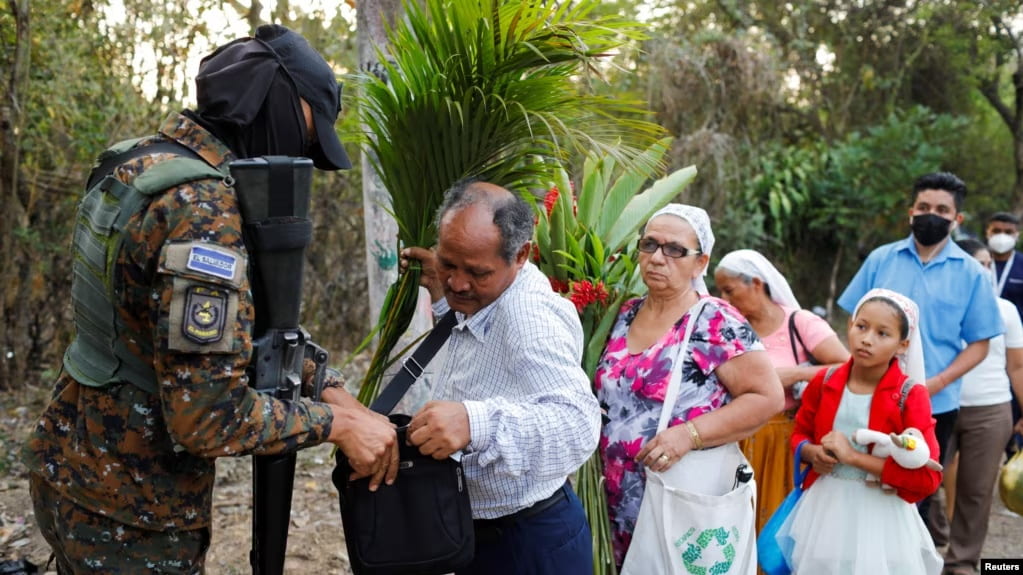
On June 1, while speaking to celebrate the beginning of his fourth year as president, he renewed his promise to construct a prison that would contain criminals and gangs. This prison, later named the Center for Confining Terrorism, was built with the idea of housing over forty thousand inmates together. Bukele, in order to present a strong front against gangs, temporarily removed constitutional rights within the country, enabling those even under suspicion for being a criminal or being a part of a gang to be arrested without any form of trial or due process. Policies that control and get rid of crime are necessary and should be implemented to the fullest extent that they can, but this course of action is not representative of a democracy but rather a dictatorship. By referencing himself as “the coolest dictator in the world,” he is recklessly enforcing a vision of control that directly disobeys the constitution of his country. Furthermore, Bukele has allowed tens of thousands of armed military personnel to roam the streets of various cities, which he then justified because it worked in one city. These measures, along with multiple drone flybys over cities and sudden detainments of any citizen, strip Salvadorans of their basic human right to live without fear of being wrongfully imprisoned. A government that rules with fear is one that does not properly rule at all because the purpose of government is to provide hope and help to people in ways that others cannot.

Image 1 – Source: Yahoo Images; The unnecessary torture of prisoners being for the public to witness and hopefully enact action.


Ending it once and for all?

Image 2 – Source: AmnestyUSA; An image of citizens taking to the streets to demonstrate how pressing of a matter it is.

Going forward, Human Rights Watch (HRW) has provided solutions for how to better solve issues with crime and gangs in El Salvador. They directly addressed various contributors to human rights violations, such as the Bukele administration, legislative body members, the attorney general, and other government officials. The most compelling course of action given to the Bukele administration was to confront why someone would want to join a gang, which would consist of resolving the economic and educational disparities that deprive citizens of having the chance to maintain a prosperous lifestyle. Putting people behind bars is seldom the answer to reducing crime because it does not address the issue at its core. For the legislative body, the HRW recommends that they immediately terminate the state of emergency that has allowed President Bukele to enforce soldiers in the streets and imprison any person with suspicion of being in a gang. Applying this course of action will be a challenge for the legislators because of their unicameral body that has typically leaned towards supporting Bukele.

Final Say

Image 3 – Source: AmnestyUSA; An image of family that represents plenty of other families that could be experiencing similar  hours.

The human rights violations that have exponentially grown in El Salvador are because of the discourse and leadership of President Nayib Bukele and his advocators. They believe that they are effectively getting rid of gangs and other forms of crime in their country, but the manner in which they are doing so has caused them to have a destructive aftermath on citizens who want no part in this war. Furthermore, the deterioration of conditions in prisons that are already housing an increasing number of inmates demands the attention of people from around the world as these atrocities deserve to be seen and heard so that its enablers are held accountable.


The Separation Between Human and Nature

A Philosophical Take on the Detrimental Climate Effects of European Colonization in North America

A Native American elder wearing a traditional headdress made of beads and feathers.
Much Indigenous cultural and epistemological wisdom is passed down by their Elders. Source: Yahoo! Images

I would like to begin by recognizing that the land I sit on while I write was stolen in cold blood by European colonizers. On a once flourishing forest valley now sits tons upon tons of concrete. On land once occupied and cared for by Creek and Choctaw peoples now sits freshly mowed yellow lawns painted blue, overflowing drainage pipes, and office buildings filled with tired, underpaid workers. It is with a heavy heart that I mourn the loss of Indigenous people and their cultures at the hands of greedy White supremacist colonizers. With this article, I do not wish to convey that climate effects are the only or the most detrimental result of European colonization and their genocide of Native peoples. Life, culture, language, and knowledge, to name a few, are some of the more immense losses. The purpose of this article is not to reduce this catastrophic event to solely how it affects the climate today but to bring attention and reverence to Indigenous philosophies, traditions, and ways of life that can inform our modern discussions of climate change. 

As a precursor to this article’s more philosophical take, you may want to read about the historical contexts of colonization. In this case, please check out this article recently posted by my colleague here at the IHR, Kala Bhattar. 

Concrete Jungles

How do you provide for yourself and your family? 

Your answer probably involves producing a product or carrying out a service that society deems valuable enough to attribute money to you for it. You then use that money to buy food, water, and shelter from those in your community who produce or own it. Money probably plays a huge role in your everyday life, and if you’re anything like me, it’s probably one of the larger stressors on your mental health. How much of our lives do we have to sacrifice doing hard labor or sitting behind computer screens in order to make enough money to stay alive to do that work all over again? When was the last time you ate food that you or your loved ones didn’t spend money on? When was the last time you wandered into a forest to breathe unpolluted air and observe the plants and bugs that call your land home? Why does modern culture demand of us that we focus all of our energy on acquiring wealth and ignore our own mental health to do so?

A bright orange monarch butterfly sitting flat with wings open on a yellow flower.
The monarch butterfly has recently become endangered because of deforestation and climate change affecting their migration patterns. Source: Wellfield Botanical Gardens

Modern Western society does not live “at one” or in harmony with the Earth. We no longer heavily rely on nature and the climate, but increasingly rely on money and the economy. It’s as if this planet is solely a stomping ground for a “holier than thou” species to level out and cover in concrete. The Earth has been screaming back at us for years. We’ve seen endangerment of species such as the monarch butterfly, rising sea levels, and one of the worst wildfire seasons to ever be recorded. This is consistent with deforestation, the degradation of the ozone layer, and rising global temperatures. These are all aspects of the climate that human activity has affected. In North America, the notion that humans are separate from the ecosystem, that distancing oneself from nature is “more civilized,” and that relying on the flora and fauna of one’s homeland is “primitive” or “dirty” roots all the way back to 1492. 

Symbiotic Humanity

Before European pilgrims traveled over to the North American continent, the land was inhabited by vastly diverse Indigenous tribes and nations. Some of these tribes were nomadic and lived by moving around the landscape, hunting and gathering an array of foods as they traveled. Others were mostly stationary, growing crops and raising farm animals to provide for themselves and their communities. There were many groups with many different worldviews, religions, and philosophies. The one thing that united them all was their profound reverence for the forces of nature. They saw themselves as a part of the ecosystem of the land they lived on. It was an honor to raise crops and livestock and to participate in their homeland’s well-being. They promoted biodiversity, expressed empathy and gratitude towards the animals they ate, and valued cooperation in and between their communities. They practiced herbal medicine, tending to their sick and injured with natural remedies that they had identified to have healing properties. They even had their own forms of religion/spirituality centered around connecting one’s spirit to the Earth, feeling what Mother Nature needs, and providing that for her in exchange for her providing for them. The human population on the North American continent was thriving and developing. There was peace within and between nations for the most part. All of their needs were taken care of so they could focus on negotiations rather than violence. 

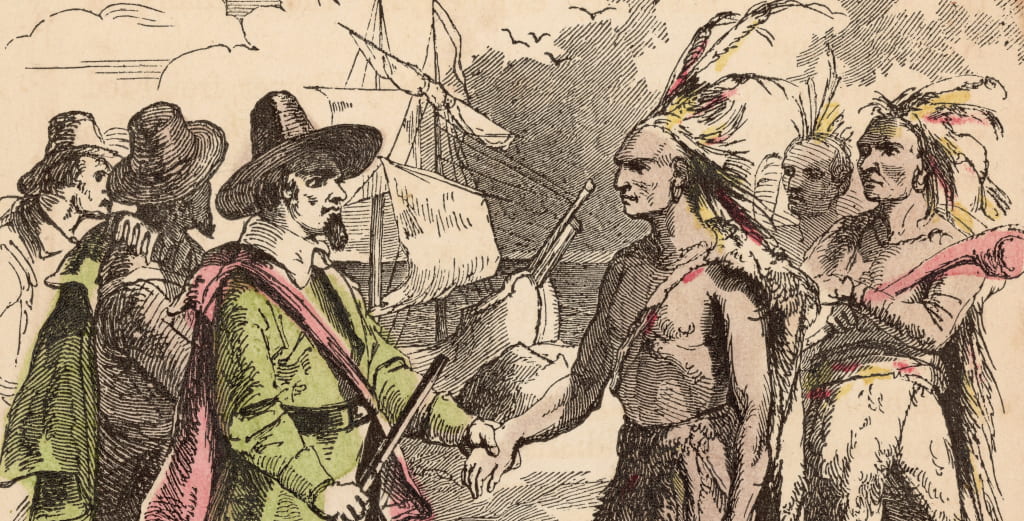
A drawing of three pilgrims meeting three Native Americans in front of the Mayflower.
Squanto (right of center) was a member of the Samoset tribe, known for being friendly to the European colonizers, teaching them language, agriculture, and traditions. Source: Yahoo! Images

Property and Greed

When the Europeans arrived, the Americans taught them how to live on their continent. They taught them how to grow crops in their soil, hunt for their own food, and use every part of the animal including the hide, bones, and meat. They were more than willing to allow these settlers to join them in their symbiotic relationship with nature. To them, more people meant a more diverse and stronger community to help each other out. 

One can imagine their surprise when the Europeans introduced them to greed. They introduced them to the ideas of personal property, wealth hoarding, and social status based on material goods. They saw all of this land as unclaimed and up for grabs since the Americans had no formal ownership system. They started violently enforcing this ‘property view’ of land onto the Americans. They would claim plots of land as their own and hoard all of the resources that could be obtained from it. They also were not fond of the Americans’ religion. They started threatening them with eternal damnation if they didn’t convert to Catholicism. They called them “primitive” for their symbiotic relationship with nature, and “savages” for their denial of Christianity. 

Centuries later, after colonizing the East Coast, the English-speaking Europeans separated from the British monarchy and believed it was their god-given manifest destiny to own the land all the way to the West Coast. So they loaded up their swords and crossed the Appalachian mountains, slaughtering and relocating the Native people along the way. Although many Native tribes had helped Great Britain during the Revolutionary War, Great Britain was nowhere to be found when the colonizers perpetuated their genocide.

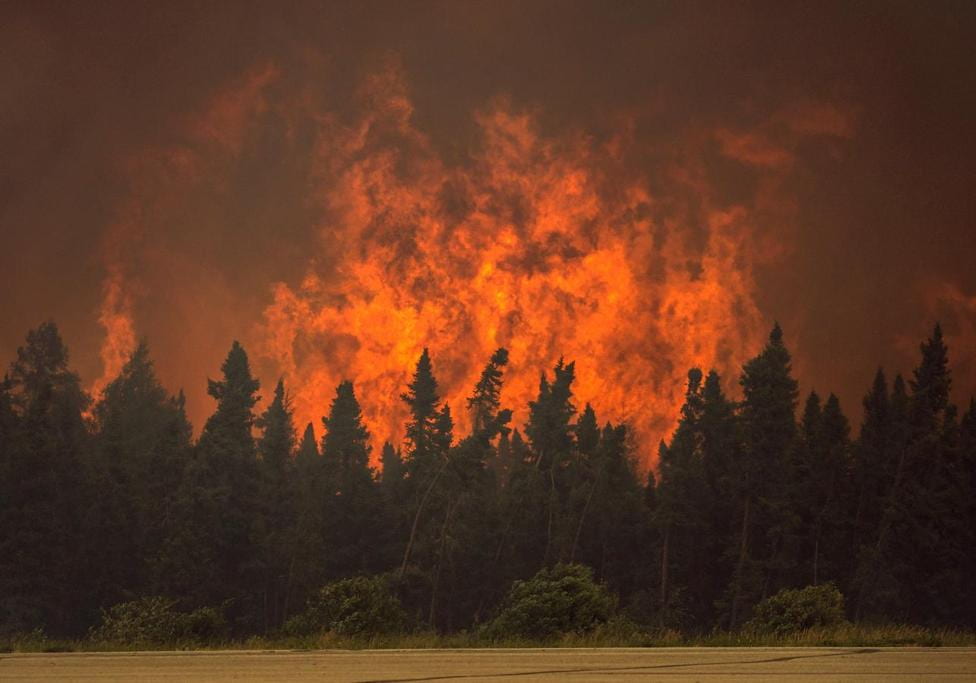
A huge wildfire burns in front of a dark sky and behind a row of trees in Quebec.
This wildfire season has been the worst Quebec has ever seen. Indigenous people, while only 5% of Canada’s population, make up 42% of wildfire evacuees. Source: Global News. Click here to read more about the personal effects that these wildfires have caused Indigenous families and communities.

A Culture of Climate Apathy

Today, we live in a world where we mow our lawns once a month and call it environmental care. We plant uniform gardens outside our homes solely for aesthetics without caring that the ‘weeds’ we pull up are the only sources of food for certain butterfly and bumblebee species. We stomp spiders into our carpets for daring to wander onto our property. We spray poison on our foods so that humans are the only ones that can eat them, and we pack hundreds of cows into small barns with no ventilation to steal their children’s food for ourselves before slaughtering them when they stop producing. We can’t survive without constant air conditioning (partly because global temperatures have been consistently warming for over 50 years) and the air we share has record-high levels of carbon in it. 

We have taken ownership of the Earth and drained it of its resources. The Earth was never meant to be claimed for oneself; it was never meant to be commodified. It was never meant to be drained of oil to fill the pockets of wealthy CEOs. The Earth was meant to be shared by all its living beings. Similarly, humans were never meant to be in solitude. We were meant to live symbiotically with each other and with nature. Greed has divided us as one humanity; it murdered the Native American tribes and robbed the Earth of its biggest supporters. And I am afraid that Mother Nature might never accept our apology. 


Commemorating the International Day of Peace on September 21, 2023


International Peace Day vector poster background with pigeons and planet. (Source: Alamy Stock Vector)


Human Suffering  at the World Trade Center Bombing -September 11, 2021

https://www.gettysburgflag.com/blog/iconic-911-flag/
World Trade Bombing September 11, 200. A fireman stands amid rubble with a 911 flag on his helmet. (Source: Gettysburg Flag Works Blog )

On September 11th, the world acknowledged the 22nd Commemoration to honor the loss of life of thousands of humans after the terrorist attack on the World Trade Center in New York and also at the Pentagon in Washington, D.C. on September 11, 2001. At all of these sites of tragedy, memorials, and monuments have been erected to honor the lives of the deceased, as a site of memory for the families left to mourn, and for the world to remember the human cost of the tragic violence and the urgent need for peace.

Human Suffering in September – Birmingham, Alabama-  September 15, 1963

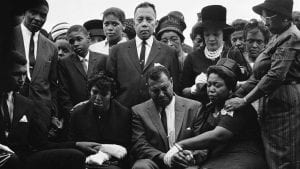
On September 15th, the city of Birmingham, the 16th Street Baptist Church acknowledged the 60th year since a racially motivated terrorist attack by the Klu Klux Klan who bombed their church and left “four little girls” to die in the rubble.

Provided by CNN The family of Carole Robertson, a 14-year-old African American girl killed in a church bombing, attend graveside services for her, Sept. 17, 1963, Birmingham, Ala. Seated left to right: Carol Robertsons sister Dianne and parents, Mr. Alvin Robertson Sr. and Mrs. Alpha Robertson. The others are unidentified. (AP Photo/Horace Cort) - Horace Cort/AP
The family of Carole Robertson, a 14-year-old African American girl killed in a church bombing, attend graveside services for her, on Sept. 17, 1963, in Birmingham, Ala. Seated left to right: Carol Robertsons’ sister Dianne and parents, Mr. Alvin Robertson Sr. and Mrs. Alpha Robertson. The others are unidentified. (Source: CNN; AP Photo/Horace Cort)


https://www.al.com/news/birmingham/2014/09/scholarship_fund_in_honor_of_4.html
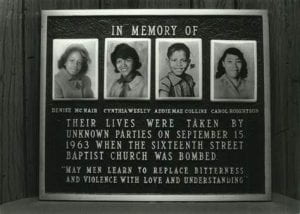
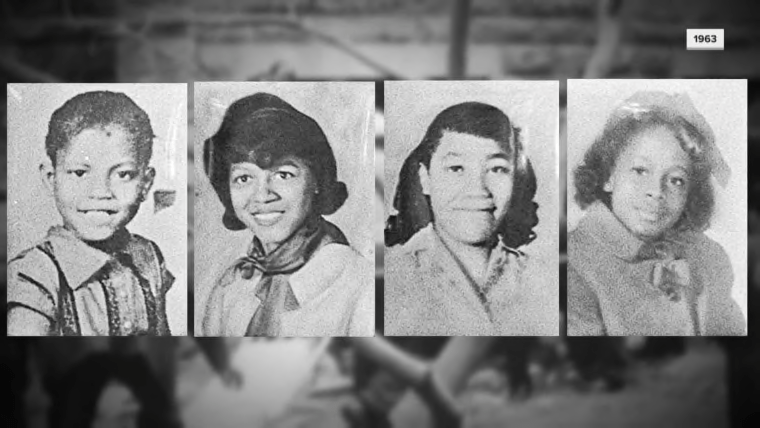
These four innocent girl children, pictured below, Denise McNair, Cynthia Wesley, Addie Mae Collins, and Carole Robertson, were killed in the bombing. (Source: Al.com)

Why do We Need an International Day of Peace?

“United Nations Secretary-General António Guterres said, “Peace is needed today more than ever. War and conflict are unleashing devastation, poverty, and hunger, and driving tens of millions of people from their homes. Climate chaos is all around. And even peaceful countries are gripped by gaping inequalities and political polarization.”

Looking at our current political climate, there is unrest around the world from the war in Ukraine, the anti-gay laws of Uganda, to the racially motivated murder of three African Americans in Jacksonville, Florida.  As humanity, our individual, collective and national peace humans are under threat.

Many humans are suffering under the umbrella of structural violence and actively fighting against oppressive, racist, homophobic, sexist, misogynist, classist, and religiously intolerant systems and regimes. Human rights are being violated and for many, peace feels like as author Langston Hughes would call it a “dream deferred.” Many would agree with Secretary Guterres that “…Peace is needed today…” and many more would argue that looking back through the historical record, peace has been needed for quite some time now.


Violence in Numbers

Beyond the devastation of the loss of life, according to National Today, since 2015 there has been $13.6 trillion dollars spent related to violence in 2015, 9,800 terrorism websites containing violent material, 11% of ceasefire agreements between 2015 and 2019, which included gender provisions, 15.9 million – the estimated number of people in Yemen’s population hit by the world’s worst food crisis, 135 million – the number of people in 2019 living with acute hunger, 60% of people struck with acute hunger living in conflict countries, 88 countries that had national action plans on women, peace, and security by October 2020, 417 policy measures enacted by national governments in response to the COVID-19 crisis and 408 million youth living in areas of armed conflict in 2016.

If we are to address the myriad of ways violence affects humanity, we must look at peace as a process, according to Peter Verbeek, Ph.D., associate professor and Graduate Program Director of the Master’s Program in the Anthropology of Peace and Human Rights in the UAB College of Arts and Sciences.  Verbeek and co-editor Benjamin A. Peters state, “Peace is not a passive state but an active behavioral process that can and must be studied in science like any other behavior.”

September 21st is International Day of Peace or World Peace Day

So today, on September 21st, we acknowledge the need for peace through the commemoration of the International Day of Peace, also referred to as World Peace Day. Sanctioned by the United Nations in 1981 and observed annually on September 21st, this day is dedicated to world peace and the absence of war and violence and “might be occasioned by a temporary ceasefire in a combat zone for humanitarian aid access. It is commemorated by many nations, political groups, military groups, and people around the world.” Established through a resolution passed by the United Nations General Assembly, this resolution was sponsored by Costa Rica and the United Kingdom.

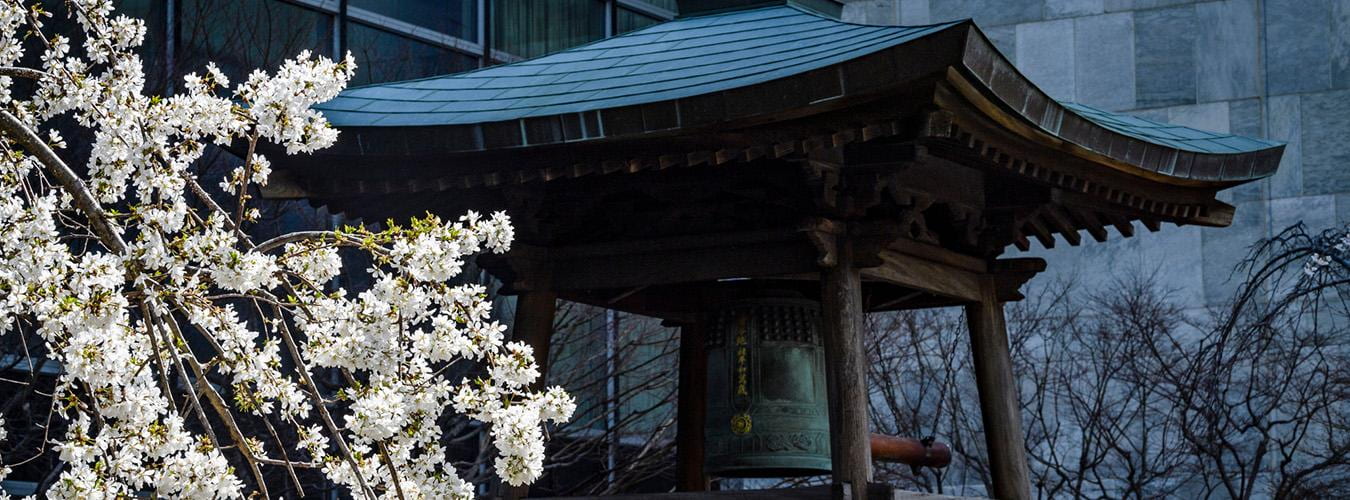
The Peace Bell

The Peace Bell was donated by the United Nations Association of Japan in 1954. It has become tradition to ring the bell twice a year: on the first day of spring, at the Vernal Equinox, and on 21 September to celebrate the International Day for Peace.PHOTO:UN Photo/Manuel Elías
The Peace Bell was donated by the United Nations Association of Japan in 1954. It has become a tradition to ring the bell twice a year: on the first day of spring at the Vernal Equinox and on 21 September to celebrate the International Day for Peace. (Source: UN Photo/Manuel Elías)

To inaugurate the day, the United Nations Peace Bell is rung at UN Headquarters in New York City. The bell was “…was a gift from the United Nations Association of Japan, as “a reminder of the human cost of war”; the inscription on its side reads, “Long live absolute world peace”.

2023 Theme-“Actions for Peace: Our Ambition for the #GlobalGoals”

This year’s theme highlights our individual and collective responsibility to ensure that peace is maintained. This call to action works to achieve Sustainable Development Goals (SDGs) and through attaining these goals, it is believed that peace will be acquired by all. To learn more about the SDG’s, watch this video: Do you know all 17 SDGs? – YouTube

IHR in Actions for Peace – May 2023

Mrs. Waltina Josephat, IHR
Mrs. Waltina Josephat, IHR Admin Assistant (Source: Photo by Chadra Pittman)

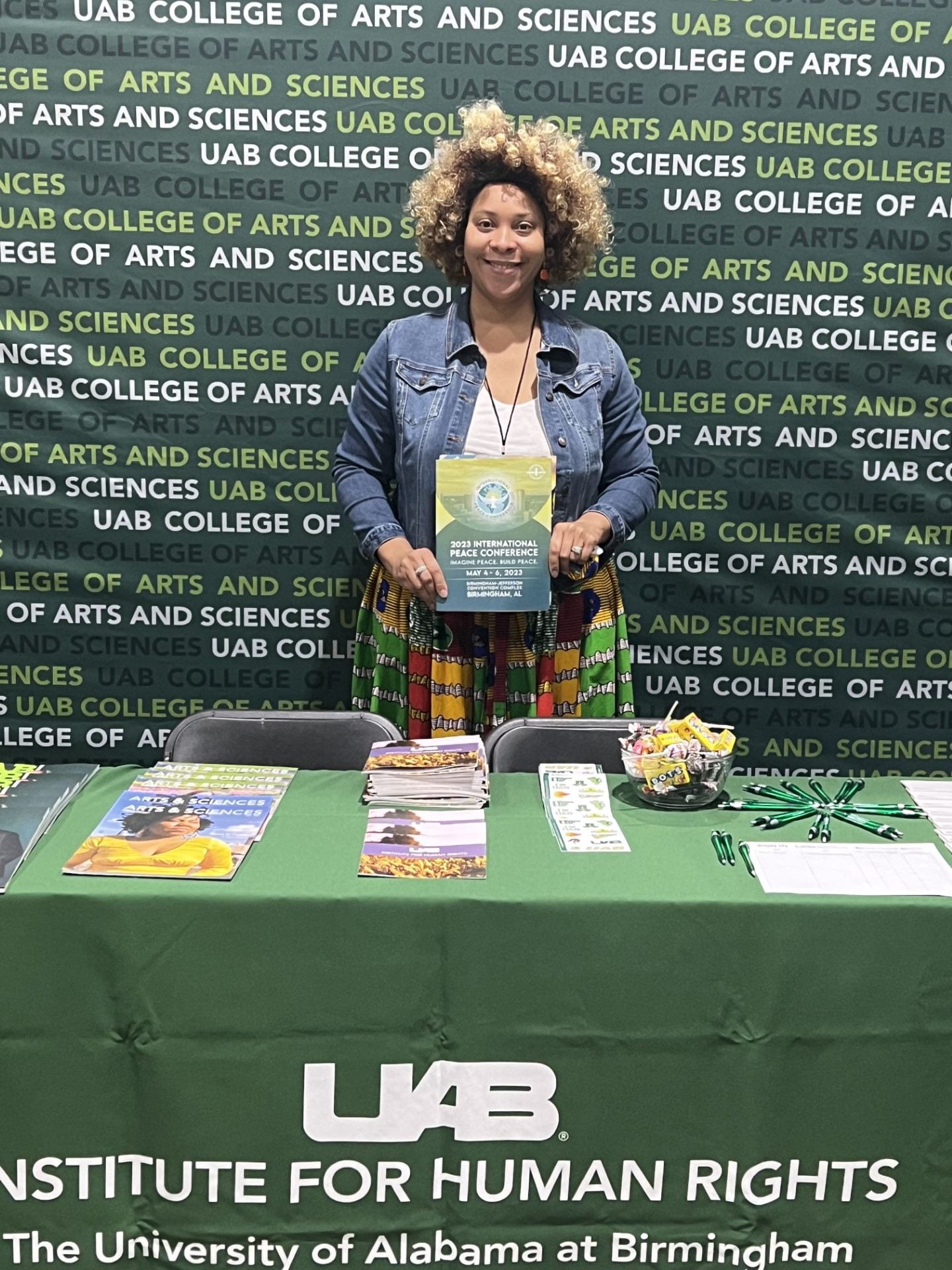
This past summer, May 4-6th 2023, UAB’s Institute for Human Rights partnered with the Rotary International and the Birmingham Civil Rights Institute for the International Peace Conference. Leaders from around the world came to Birmingham to present, share ideas, and learn effective ways to achieve peace. Tina Kempin-Reuter, Ph.D. Director of the IHR and Social Science and Justice Research (SJSR) spearheaded the way for UAB in this collaboration which brought together diverse communities working for human rights and peace efforts.

IHR Pictured with IPC Founders, Will and Carolyn Ratcliff, Rotary Club Members, Past and current UAB Anthropology of Peace and Human Rights with Graduate Director, Dr. Peter Verbeek, IHR staff and interns, and Dr. Rev. Bernice King. To learn more about IPC 2023, click here.


International Peace Conference 2023
International Peace Conference 2023 Birmingham, Alabama. (Source: Photo by Chadra Pittman)

75th Year of The Universal Declaration of Human Rights & the Convention on the Prevention and Punishment of Genocide

As we work towards peace and reconciling with our past, the year 2023 marks the 75th anniversaries of the Universal Declaration of Human Rights and the Convention on the Prevention and Punishment of Genocide. We must work together to build paths to peace, eradicating systems of oppression and centering our shared humanity. With all the disturbances to our peace throughout human history, we must remember those who were slain, those who sacrificed, and honor those who fought a noble battle in the pursuit of freedom and justice.

In the words of Congressman John Lewis, “Not one of us can rest, be happy, be at home, be at peace with ourselves until we end hatred and division.” Let us work to end the division and hatred, work towards peace and pave a new way forward together.

For more information about the International Day of Peace, you can visit here.

UN Secretary General, Antonio Guterres, delivers his 100-day countdown to the International Day of Peace message. https://www.un.org/en/events/peaceday/100days.shtml

Diwrnod Gyda’r Urdd (A Day with the Urdd)

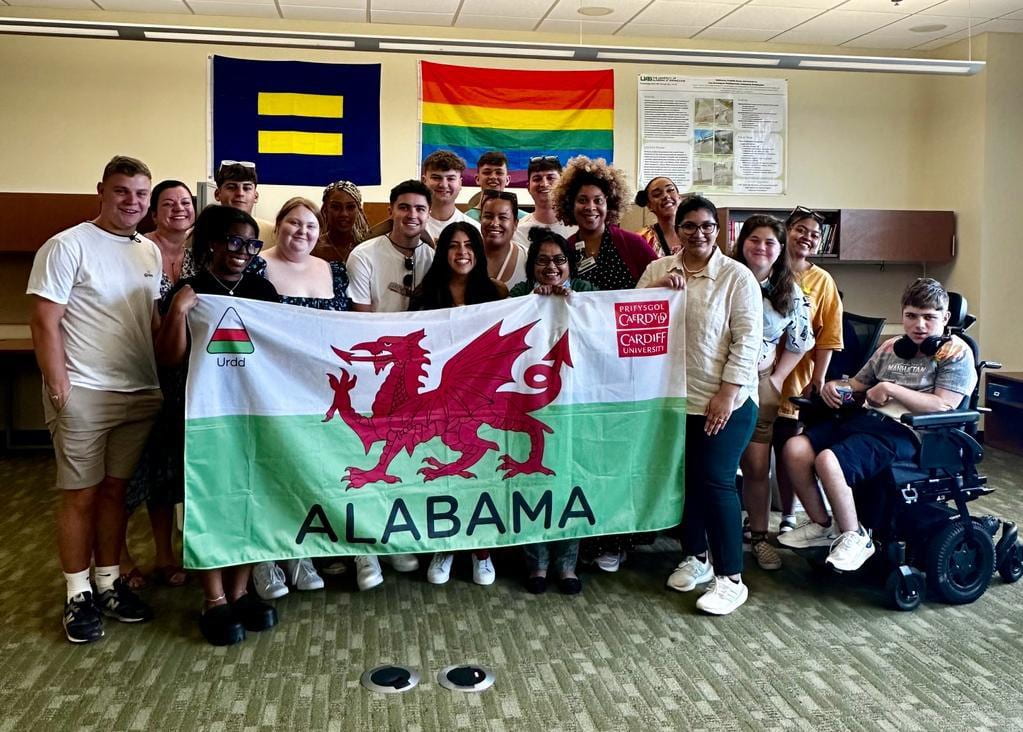
Image shows the Urdd delegation and the IHR team posing with a flag of Wales.
The Urdd and the IHR. Source: Institute for Human Rights.

by Sumaira Quraishi

On September 15th, 2023, the Institute for Human Rights (IHR) at the University of Alabama at Birmingham (UAB) and the Urdd, a Welsh youth organization, spent an afternoon together exploring human rights initiatives in Birmingham and the history of the Civil Rights Movement.

Dr. Tina Kempin Reuter, Director of the IHR, made opening remarks welcoming the Urdd delegation to UAB and facilitated introductions between the Urdd and members of the IHR team. Dr. Reuter then spoke on how the IHR is raising awareness of and advocating for human rights by making safe spaces to have open dialogues and hosting human rights advocacy conferences. Ms. Siân Lewis, Chief Executive of the Urdd, explained that the Urdd is the largest youth organization in the world and has been active for over 100 years. The Urdd’s primary objective is spreading a peace and goodwill message, with the focus this year being on anti-racism. The Urdd also aims to share the Welsh language and culture with others while learning about other languages and cultures around the world. The Urdd distinguishes itself in its anti-racism efforts through its “Galw Nhw Allan” (“Call Them Out”) motto, which encapsulates the Urdd’s desire to take substantive action against racism. In a video shown at the event, student leaders from the Urdd are shown describing the need to dismantle systemic racism through education to show the beauty and unity people’s differences bring to our communities. 

Two members of IHR led the group in a privilege walk, an activity that involves asking participants to line up side-by-side with their eyes closed and take a step forward if they agree with certain statements, or take a step back if they agree with others. Examples of the statements read included “Take a step back if someone in your immediate family is addicted to alcohol or drugs,” “Take a step forward if you see people with your skin color in your local government,” and “Take a step back if you have ever had to skip a meal or multiple meals due to your financial situation.” At the end of the exercise, every person of color from the group was at the back of the room, and every non-person of color from the group was in the middle or front of the room. This exercise was done to highlight the various advantages and obstacles faced by people around the world and fostered a great discussion about diversity and inclusion amongst the IHR and the Urdd. 

At the beginning of the meeting, members of the IHR handed out pieces of numbered paper to everyone in the meeting room. People with even numbers received a leaf to pin to their chest and people with odd numbers received a ribbon. After the privilege walk, everyone was asked to find a seat at tables decorated with pumpkins if they drew an odd number or tables decorated with scarecrows if they drew an even number. A short video on Jane Elliott’s “Blue Eyes/Brown Eyes” experiment was shown where Ms. Elliott divided her class by eye color and favored blue-eyed children one day, and brown-eyed children the next, giving each favored group more praise and privileges over the other group. The class soon adopted hateful and derogatory views of the out-group, bullying members of the unfavored group which was distinguished by brown collars tied around their necks. To simulate this experiment, two members of the IHR went around telling people with leaves pinned to their chests to get second helpings of lunch and engaging members of that group in conversation. Contrastly, the two IHR members ignored people with ribbons pinned to their chests and neglected to mention that those with ribbons could go and get second helpings of the food being served. The experiment was revealed after lunch was finished, to the surprise of the room which had no idea the simulation was being carried out. A short discussion followed on how discrimination affects people in real life and the unique challenges faced by people daily due to discrimination. 

A tour of the IHR office space followed lunch and the Urdd delegation kindly presented IHR with a flag of Wales, a Cardiff University dragon plush, and Cardiff University silk scarves. Thank you to the Urdd for the thoughtful gifts!

The final event of the day was a screening of Four Little Girls directed by Spike Lee and a Q&A session with Michele Forman, Director of the Media Studies Program at UAB, who helped with the production of Four Little Girls. The film follows the events of the Civil Rights Movement in Birmingham, Alabama, and includes interviews with the families of the children killed in the 16th Street Baptist Church bombing in 1963. In the Q&A session after the showing, Ms. Forman described how every aspect of the film needed to answer the question “How does it help us understand what happened to the girls that day?”. A particularly impactful statement from Ms. Forman when asked what the rationale for using post-mortem photographs of the four children killed in the bombing in the film was that the destruction and exploitation of the Black body are used too much in media, but it was needed in the film to show that we will not move on from this tragedy and will not forget “what racism comes to bear on the Black body.” Thank you to Michele Forman for facilitating an insightful discussion of the film and the Civil Rights Movement!

Image shows black and white photographs of Denise McNair, Addie Mae Collins, Carole Robertson, and Cynthia Wesley.
Victims of the 16th Street Baptist Church bombing. Source: Yahoo Images.

The IHR is grateful to have had the opportunity to connect with the Urdd and looks forward to future collaborations! 

Watch the full Peace and Goodwill message video here

Lifesaving Aid Delayed In the Wake of Morocco’s Catastrophic Earthquake


Image 1 – Source: Yahoo Images; An image of collapsed building as a result of earthquake

A devasting, 6.8 on the Richter scale, earthquake hit the North African nation late Friday, killing at least 2,886 people and injuring 2,562. The earthquake struck the High Atlas Mountain range ripping through the small villages and the center of Marrakech. Rescue operations are still taking place, as there are many people crushed under the remains of Al Haouz, where the quake was most devastating. Every minute counts in the search for survivors, yet the Moroccan government is selective with which countries they accept. France was left out of Morocco’s decision to accept aid from the UK, Spain, Qatar, and the United Arab Emirates. When the death toll continues to rise and the city turns to rubble, why is Morocco declining French assistance in disaster relief? Analyzing recent tensions between Morocco and France, it is apparent that the strained relationship between the two countries is the contributing factor to the refusal of aid during this dire time of need. Major humanitarian crises like this are supposed to be a chance to bridge the divide between nations, but they can also be an opportunity that is overlooked.

Image 2 – Source: Yahoo Images; An image of survivors going through the rubble.

Context

The controversy between Morocco and France has its roots in historical, political, and diplomatic factors. Originally, Morocco was a French protectorate from 1912 to 1956, and then in 1956 the country gained its independence. Therefore, there is a significant Moroccan diaspora in France which is why the government pledged 5 million euros to help with aid. Additionally, four French residents died in the earthquake. However, one topic of contention between the two is the sovereign claim over the Western Sahara. Morocco recognizes the West Sahara as part of their country, but France refuses to acknowledge that. Back in 2021, France went on the offensive against migrants from Morocco, Algeria, and Tunisia, threatening to cut off their visas unless they agreed to accept back migrants. The aforementioned nations took that as a sign of shame. These controversies, compounded with the government’s decision to reject French assistance, are indicative of the icy diplomatic relations between President Emmanuel Macron and King Mohammed VI. Despite the King being in France when the quake hit, no attempts were made to resolve the tension.

Image 3 – Source: Yahoo Images; An image of rescue operations after earthquake.

Significance

Morocco’s reluctance to accept aid is baffling global aid groups. Time is the most precious resource when it comes to disaster relief. By refusing the French, the Moroccan government is taking precious time away from the survivors of this devasting earthquake.  Especially since France is known for being an expert in disaster relief, they have the resources to mobilize coordinated rescue operations on the ground. In the wake of this horrible humanitarian crisis, the focus should be on helping the suffering, not balancing adverse international relations. This decision made by the Moroccan government is actually hurting its people. That aid could be used to reach parts of the village that are not accessible due to the vast destruction. The increased delays have resulted in families digging themselves out of the debris. In addition, the government has been dubiously quiet about the severity of the crisis. Instead of making a broad appeal for help, Morocco is limiting foreign aid. For this to be the strongest earthquake to hit the country in over a century, the government is keen to downplay the seriousness of the situation and provide inadequate resources. Therefore, the catastrophe response promotes the notion that the administration is indifferent to the plight of the people in the impoverished mountain towns shaken by the quake, rather preferring wealthy metropolitan inhabitants and foreign tourists. With lives lost and homes destroyed, now is not the time for petty politics, but rather a chance to come together in a time of need.


Libya Flood Relief

The case of Libya’s flood is another case where relief efforts are hindered by political complications in North Africa. More than 5,300 people were killed and 10,000 are missing in Libya when a storm caused rivers and dams to breach. Storm Daniel wreaked havoc on Libya’s eastern port city of Derna, virtually flattening it. The Morocco quake and the Libya have resulted in 8,000 dead and significantly more injured or missing. Both devastated communities have waited for days for aid, frequently digging out and burying their dead with little to no help from their governments. Some of the delays can be attributed to damaged infrastructure; however, the main impediment, though, is politics. It seems that the immediate aftermath of a natural disaster qualifies as a moment for political differences to be put aside. The delays in receiving aid in Morocco and Libya, one nation perceived as the bedrock of stability in the region and the other torn apart by conflict and governed by rival governments, show how difficult it is to separate political concerns from humanitarian help. Despite the stark differences between the two, both are in the same predicament. Both governments need to accept responsibility and make a coordinated effort to provide aid to the citizens of their respective countries.