The Right to Menstrual Hygiene

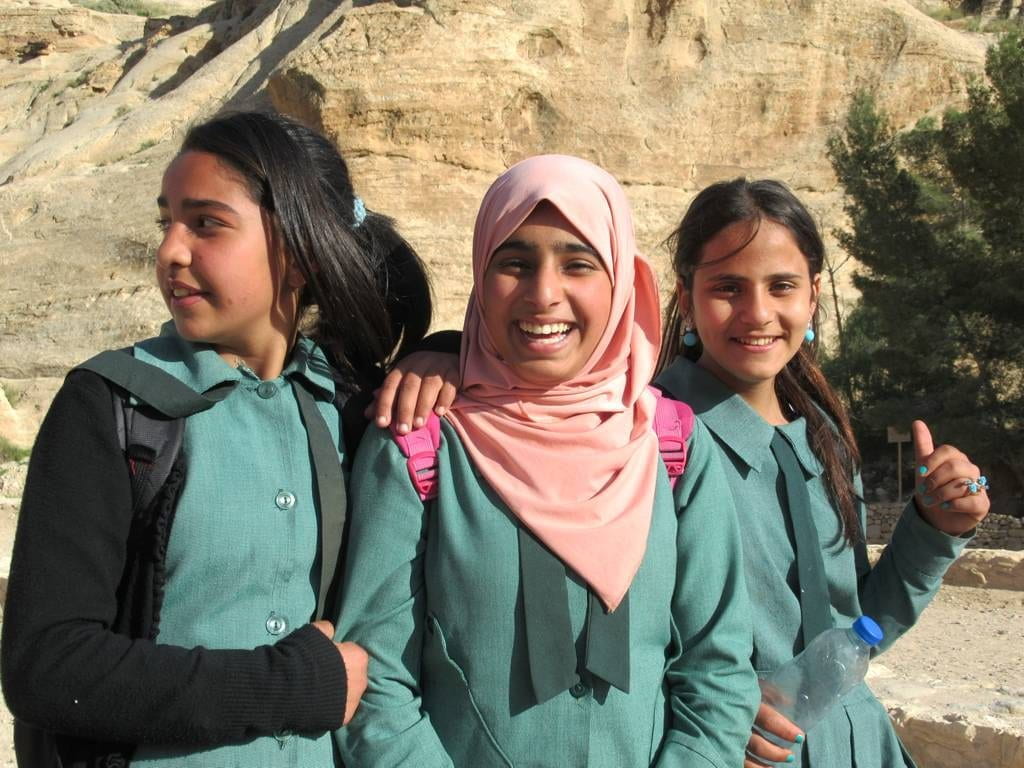
a picture of three girls smiling
Jordanian School Girls. Source: David Stanley, Creative Commons

It probably goes without saying that periods are difficult to manage. They are painful, expensive, and often quite problematic for people who experience them.  We use resources such as pads, tampons, pain relievers, and bathrooms in an effort to manage menstruation. According to the WHO-UNICEF Joint Monitoring System, menstrual hygiene management (MHM) is when people with periods are able to use sanitary materials to absorb menstrual blood, change and dispose of these materials in privacy as needed, and have access to soap and water to keep clean.  For those of us who do have access to what we need to manage menstruation, it seems that we often take these things for granted. But what if someone doesn’t have these resources within reach? The bottom line is that a lack in opportunity to practice proper menstrual hygiene is a violation of human rights due to its negative impact on mental and physical health, access to education, and gender equality.

What Is the Problem?

The aspect of this issue that might be the easiest to recognize is the inaccessibility of products like sanitary pads and tampons. One study in Kaduna State, Nigeria reported that only 37% of women in their sample had all the products needed for proper menstruation management. In Uganda, 35% of women reported the same thing. This can partly be attributed to financial issues and the frequency at which the products must be purchased. Some products, such as menstrual cups or washable pads, can be washed and reused over an extended period of time, making them cheaper in the long run. However, they are initially far more expensive than the disposable options. They are simply outside of the budget for many people. Even when someone can afford to pay for the reusable materials, finding somewhere to purchase them may be a problem.

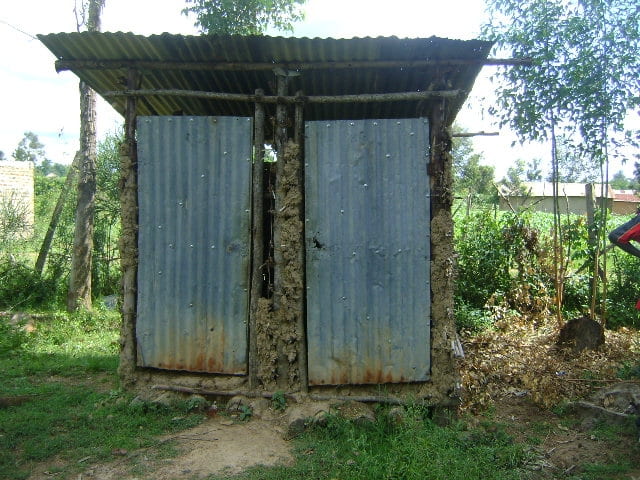
Issues of accessibility do not end with menstrual hygiene products. In many countries, schools lack proper sanitation facilities, like bathrooms, which are vital to being able to safely and comfortably replace and dispose of used menstrual products. This is seen in Cochabamba, Bolivia, where there is an average of 1.2 “toilets” per primary school. These “toilets” are actually pit latrines. They are not usually kept in good condition and rarely have sufficient waste disposal options. In situations like this, there is little to no access to a truly safe and private place to change menstrual materials.
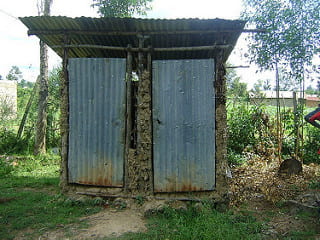
a picture of a traditional pit latrine, which looks like a very small building with a tin roof and two tin doors
Traditional Pit Latrine. Source: SuSanA Secretariat, Creative Commons

Exacerbating this issue are the stigma and shame associated with menstruation. Around the world, girls are taught from a young age that having a period is something to hide and to be embarrassed of. In many countries, girls are even considered to be “dirty” when on their period. This can be seen in western Nepal, where there is a tradition called “chaupadi” which requires that girls and women stay outside throughout menstruation. If they enter a home, it is believed that all of the people and animals of the household will fall ill. This perspective puts both their mental and physical health at risk. Menstruation is frequently viewed as a taboo subject, so many girls are not taught anything about it before their first period. Even after they begin to experience menstruation, they do not have access to much knowledge of why it happens or what good menstrual hygiene management is.

It is also important to recognize the relationship between menstrual hygiene management and the transgender community. Menstruation is typically referred to as a strictly feminine issue, but that is simply not the case. Many transgender men and non-binary individuals experience periods, and they should be included in the conversation about menstruation. By failing to recognize their connection to menstruation, we fail to recognize the validity of their experiences and identities. This failure is a problem within itself, but it can also have repercussions on the mental health of transgender and non-binary individuals and their ability to access sanitary materials and bathrooms for menstrual hygiene management. We need to actively work towards being more inclusive with the language we use when discussion periods and related topics. This involves choosing gender neutral terms over gendered terms, such as choosing to say “menstrual hygiene products” rather than “feminine hygiene products”.

Why Does It Matter?

According to Article 25 of the Universal Declaration of Human Rights, every individual has “a right to a standard of living adequate for the health and well-being” of themselves. When you are told that one of the basic biological processes that you experience and cannot control is shameful, it has the potential to lower the value that you see in yourself. Combined with the common lack in understanding of menstruation, this can lead to significant amounts of fear and confusion and have a considerable negative impact on mental health. Article 26 dictates that everyone has a right to education. Without access to clean menstrual management products or places to change and dispose of used ones, many girls around the world miss school during menstruation to try to keep it hidden. Some girls do not even have the option to go to school during that time. This creates a disparity between the educational and career opportunities of men and women, violating Article 2 of the declaration, which says that everyone is entitled to their rights without discrimination based on distinctions like one’s sex. It is unacceptable to allow limitations to be placed on individuals’ access to their human rights based on something that is uncontrollable. In order for things to change, individuals must take action.

What Can We Do?

Part of the reason why access to menstrual management products is such a difficult issue to deal with is that the majority of people are not comfortable talking about it. Even in the United States, where we generally have access to education about the most basic aspects of menstruation and know that it is normal and healthy, there seems to be some sort of collective, irrational fear surrounding the topic. Periods have a direct impact on half of the world’s population and an indirect impact on all of the population. We cannot continue trying to pretend that the obstructions of human rights that are caused by poor menstrual hygiene management do not exist. Conversations about menstruation might be uncomfortable at first, but they are absolutely necessary. uncomfortable at first, but they are absolutely necessary.

Many organizations have begun working towards improving MHM worldwide. AFRIpads, for example, works to provide menstrual kits with reusable sanitary pads and storage bags to women and girls throughout Africa, while creating job opportunities within the organization for women in Uganda. They also collaborate with Lunapads in a program called One4Her. For each eligible product that is purchased from Lunapads, an AFRIpad is donated to a student in need. On UAB’s campus, we have access to a chapter of Period: The Menstrual Movement, an organization that is dedicated to improving access to menstrual hygiene products for homeless women in the United States. If you are interested in taking action, the group is currently hosting a donation drive for pads and tampons through October 31. You can find donation boxes by the elevators in any of the residence halls. They are also hosting a Period Packaging event at the Spencer’s Honors House from 6:30pm to 8:30pm on November 1, where people will come together and pack menstrual hygiene products in kits to be given to those in need. Additionally, the Blazer Kitchen is hosting a toiletry drive through October 30, to which you can donate menstrual hygiene products, as well as many other non-perishable items.

If you lack the resources to financially support the improvement of MHM, do not be afraid to speak up and get involved in the conversation. Be a part of spreading awareness and breaking the stigma surrounding periods.
 

Protecting the Dishonored: The Jailing of Honor Crime Victims in Jordan

The silhouettes of a man and a hijabi woman face each other with a sunset behind them
We will stay forever. Source: Kamal Zharif Kamaludin, Creative Commons

“And the Oscar goes to, Mad Max! No.” The audience laughs as they await the announcement from host Louis C.K. for the winner of the 2016 Best Documentary Short. He pauses, then reads “A Girl in the River: The Price of Forgiveness, Sharmeen Obaid-Chinoy!” Applause erupts as Obaid-Chinoy makes her way to the stage, and during her brief acceptance speech she reveals that “Last week, the Pakistani Prime Minister has said that he will change the law on honor killing after watching this film. That is the power of film.” Another round of applause sweeps across the theater as the crowd cheers the progress made to end this extreme case of violence against women.

Obaid-Chinoy’s film focuses on eighteen-year-old Saba, a Pakistani girl who was the victim of an attempted honor killing, defined by the BBC as “the murder of a person accused of ‘bringing shame’ upon their family. Victims have been killed for refusing to enter a marriage, committing adultery or being in a relationship that displeased their relatives. In many instances, the crimes are committed by family members against a female relative.” Saba survived the encounter, and the resulting documentary chronicling her experience caught the attention of human rights activists around the world. Pressure from these groups was put on the Pakistani government to change the law allowing the perpetrators of honor crimes to avoid charges should the victim or relatives of the victim forgive them, and as of October 2016 the law was changed so that there are now mandatory prison sentences for those who commit an honor killing. However, this is not the case for every country, as other loopholes exist to protect the perpetrator while simultaneously punishing the victim.

Sharmeen Obaid-Chinoy smiles and poses with her newly won oscar.
Sharmeen Obaid-Chinoy. Source: Disney, Creative Commons

During my stay in Jordan, a second film on honor crimes caught my attention. Shown to the local community at the Abdul Hameed Shoman Foundation in downtown Amman, I sat with 50 other people as we watched If You Meant to Kill Me, a 2014 feature length documentary by Jordanian filmmaker Widad Shafakoj. Her film spotlights Jordanian women who are survivors of honor crimes but were detained in prison by the state “for their own protection” due to the lack of shelters serving victims in the community. These women would spend years inside their cell, released only after a family member signs a paper stating they would not harm her or until the guards arbitrarily decide to let her go. Once released, the women often have no money, no community connections, and no support to help them start again.

Jordanians who commit honor crimes face the threat of arrest in theory, but traditions and stigmas going back generations have created informal barriers to prevent the perpetrators from conviction. An honor crime is not committed by a single individual but instead multiple individuals, ranging from immediate family members to a group within the community. This poses a difficulty for police to convict participants because they must identify an entire social network. To counter this difficulty, they have adopted a second approach that only involves a single person: the female target/survivor. By putting the target/survivor in jail, it relieves the justice system of the stress of convicting an entire family or worrying about another crime being committed. The system also faces little backlash for this decision as the families of the women imprisoned accomplishes two tasks. Without advocates to help their case, the female target/survivor resorts to her families for a signature for release; thus, exposing herself to a future risk of violence.

Jordan is publicizing its work on improving other women’s issues inside of its borders, with some measured success. The Convention on the Elimination of All Forms of Discrimination against Women (CEDAW), adopted by the UN General Assembly in 1979, and ratified by Jordan in 1992 with the intention of allowing women to have equal rights under the law. However, Jordan still maintains two reservations to the document:

The first reservation is against Article 9, which states that women and men should be granted equal rights in transferring their nationality to their children. Currently, a child of a Jordanian man and a foreign woman can take Jordanian citizenship, but a child of a Jordanian woman and a foreign man cannot take Jordanian citizenship without a special identification card. The second reservation is against Article 16, which states “Parties shall take all appropriate measures to eliminate discrimination against women in all matters relating to marriage and family relations.” Here is where the difficulty lies, for within a marriage the woman has far less legal power and is therefore tied to the relationship formally and informally, even when violence is introduced.

Freedom House, in 2010, reported that while “domestic abuse is a valid reason for initiating such a divorce, it is often very difficult for a woman to prove her case, because Shari‘a courts require the testimony of two male witnesses.” This poses a significant deterrent for victims to come forward as their own testimony will not be adequate in a court of law. They also risk forced imprisonment for their safety should they come forward, making the risk even less of an option. Besides acting to protect their own safety, the women also shoulder the burden of staying to protect their children. Freedom House reports that the father is the de facto guardian of his children, and while the mother may be able to leave with the children initially, should she remarry she would lose custody. This forces the mother into a position of staying in an abusive situation, where there is a threat of death, or leaving without the security of a second income source to support herself and her children.

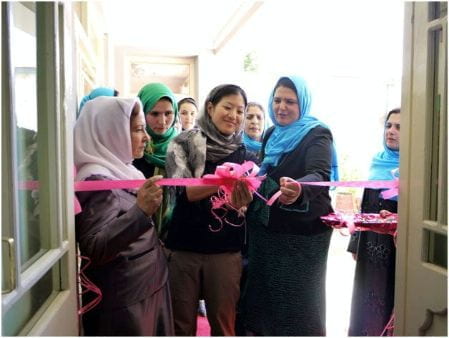
A group of hijabi women cut a ribbon to open the new shelter.
Women for Afghan Women open a shelter in Badakhshan province. Source: State Dept, Creative Commons

With the outcry growing louder to find a better solution for these women instead of placing them in protective imprisonment, a small number of departments and shelters developments give an attempt at a solution. The Jordanian government created the Family Protection Department within the Public Security Directorate in 1997 to work specifically on cases of domestic violence and sexual assault; however, their focus is children in the family, instead of the women. In 1999, the Jordanian Women’s Union opened a shelter capable of housing 20 women. The Family Reconciliation Centre opened its first house for 50 women in 2007 and a second in 2009 for 80 women. A

Between the three current shelters, a maximum of 150 women can be protected in a non-prison environment, but with a population of 9.5 million as of 2016, the number of shelters are incredibly too small to adequately serve the women of Jordan. Even if women are gaining more rights to interact equally in the public sphere, the lack of safety for some women in the private sphere blocks them from participating in this progress.

The dedication of more resources is necessary to ensure the women in danger are properly cared for in a safe environment. Additionally, attention to convicting perpetrators is imperative; allowing the women to reenter society knowing they are not at risk for future harm. Freedom House does note that Jordan is taking steps to enact more punishments that are forceful: “stricter sentences are now issued for honour killings and a new specialized tribunal was set up by the Ministry of Justice in 2009 to hear such cases.” The arrests of those committing the acts must occur immediately to hasten the release of the victimized women presently held indefinitely within the Jordanian prison system.


The Silenced Women of the Rwandan Genocide and their Fight to be Heard

Trigger warning: this blog references graphic physical and sexual violence. Please do not read if easily affected by these topics.  

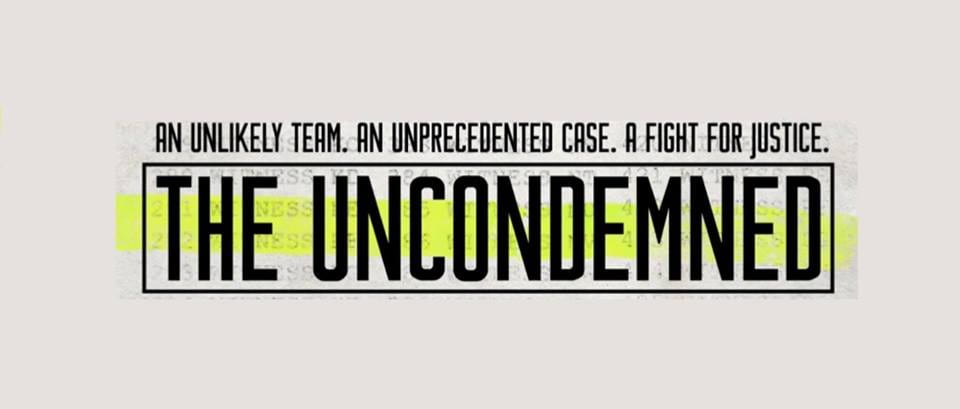
The Uncondemned Movie Poster

On Thursday, September 21, the University of Alabama at Birmingham’s Institute for Human Rights and UAB’s Women’s & Gender Studies Program hosted the screening of the documentary: The Uncondemned. The film explores the challenges and triumphs of a group of fledgling lawyers, investigators, and Rwandan women during a trial after the Rwandan Genocide. From their juridical victory, the legal definition of genocide was expanded to include acts of rape.

Background

Over the course of four months in the summer of 1994, roughly 800,000 Rwandan citizens were massacred in the east-central area of the country. The ethnic majority of Rwanda, the Hutu, murdered most of the Tutsi minority in an attempt of “ethnic cleansing” as a result of ethnic and religious tensions between the two groups. This decimation of the ethnic Tutsis became known as the Rwandan Genocide.

Skulls of the victims of the Rwandan Genocide lined up
Death – Rwandan Genocide

On April 6, 1994, a plane carrying General Juvenal Habyarimana, a moderate Hutu leader, was shot down by an unknown assailant. All the passengers on the plane crashed to their deaths, including the Burundian president, Cyprien Ntaryamira. Rumors place blame on the extremist Hutus for the murder as part of a revolt against the power-share agreement Habyarimana agreed to sign in accordance with the Tutsis. Another argument blames the Tutsis in the crash, using the act of terrorism as an attempt to regain power in Rwanda. Almost immediately after the plane crash, the murder of the Tutsi people began. Extremist Hutus began slaughtering Tutsis and moderate Hutus by setting up roadblocks and raiding homes. Radio stations ran by the extremists were encouraging civilians to attack and kill their neighbors.

The church played a significant role in the division among the Hutu and Tutsi. Hutu pastors preached on how “the war should be brought to the Tutsi, because they will come to wipe us away.” The church taught to kill their Tutsi neighbors as they claimed the Bible designated the Tutsi as their mortal enemies. During the genocide, not even the churches were safe. Hutu militiamen raided them and murdered anyone seeking refuge there. Pastors often trapped those hiding in the churches and alerted the Hutus.

The genocide was as horrifying as it was dehumanizing. Not all Hutu fighters had access to guns or even machetes, and much of the genocide was conducted using simple weapons such as sharpened sticks, large rocks, and common household items such as forks and knives – making death slow and painful. According to the film, bodies could be found in every village and on every hill. Its simplicity and scope earned it the title as the “most efficient genocide in modern history.” The first reconnaissance mission conducted by the United Nations (UN) reported one thousand Tutsi were killed in twenty minutes when the investigators first arrived.

Tragically, women endured gender based violence during the genocide. The total number of rape survivors will never be known, however countless women testified to being raped during the genocide. Stories of rape, whether gang-raped or with objects, are consistently mentioned. If they were not killed after being raped, the women were sold into sex slavery or forced into marriage. Additionally, they were traded among groups of men for them to sexually abuse them. Once the men were “done” with them, their reproductive organs were gruesomely mutilated with machetes, knives, bare sticks, or even acid. After pleading with her rapists to kill her, one woman testified they responded: she was to be kept alive so she would “die of sadness.”

The film shows the use of rape as a psychological weapon to strip the humanity from more than just the individual Rwandan woman. The rapists wanted to both degrade larger groups of women the rape survivors were a part of and as a means to assert their superiority and population control. Throughout the history of armed conflict, women often become the targets of sexual violence– this is a common weapon used in larger crimes against humanity, such as genocide. Whether it comes in the form of physical abuse, rape, mutilation, or sex slavery, being a woman becomes a risk factor – no matter the age, religion, ethnicity, political affiliation, or any other characteristic outside of biology. Niarchos concludes rape is used to inflict terror and force cooperation, both on the female survivor and others in her close community. In Rwanda’s case, rape was used to humiliate Tutsi women and terrify the community as a whole; making the suffering of Tutsi women a violent means to the Hutus’ political end.

The UN declared rape as a war crime in 1919, however in cases prior to the Rwandan Genocide, rape was never prosecuted in this manner. In Resolution 1820 that was adopted by the Security Council at its 5916th meeting, of the UN Security Council noted “women and girls are particularly targeted by the use of sexual violence, including as a tactic of war to humiliate, dominate, instil fear in, disperse and/or forcibly relocate civilian members of a community or ethnic group.” The International Criminal Tribunal of Rwanda (ICTR) was the first time rape was pursued as a war crime and was the first tribunal enacted since World War II. The film, The Uncondemned, tells of the efforts taken by the UN to connect rape to genocide. The documentary focuses on the case the mayor of Taba, Jean Paul Akayesu, who was the first to face charges of inditement over genocide – including rape.

The team of lawyers sent by the UN was ambitious but inexperienced. Most were in their 30s, recently graduated from law school, and were taken to task by gathering intelligence to prosecute this case that was like none before it. More importantly, they deduced they must prosecute it in a way that laid the groundwork for future cases – setting legal precedence.

Woman praying in front of others.
Woman Praying – Rwanda by Brice Crozier

Doctor Odette Nyiramilimo of Le Bon Samaritain Clinic in Kigali was one of many doctors who said almost every woman and adolescent girl who survived the Rwandan Genocide was raped. As she examined victims immediately after the genocide, she asserted that at least two cases of rape were coming in each day to her clinic. As mentioned before, the exact number cannot be known, which is due to a number of factors such as the stigmatism that surrounds rape. Across the globe, rape survivors are shamed and seen as guilty for the violent crimes committed against them. Eisler asserts this is especially prominent in societies that value men over women. Fear of reprisal compromises the reporting of rape, and this is particularly true in the case of Rwandan survivors. Bernadette Muhimakazi, a Rwandan women’s rights activist in an interview with Human Rights Watch, states many of the women were afraid to say anything because they know who their perpetrators are. These women know exactly who killed their families and who violated them. In many cases, these women live in the same community as their perpetrators.

“Women here are scared to talk because it was their neighbors who raped them.”

– Bernadette Muhimakzai

Prior to the visibility the tribunal brought, rape was viewed as a negligible outcome of war. The testimonies of the Rwandan women changed this perception, and rape was legally billed as a true war crime. The team the UN pulled together to prosecute this case proved to be successful in their endeavors, and justice prevailed; Akayesu was convicted of crimes against humanity and acts of genocide. The film concludes with rape survivors coming forth to name their rapists. While their sense of inner peace may never be fully restored, the tribunal gave the women a sense of justice and vindication.

A 29th Floor Perspective


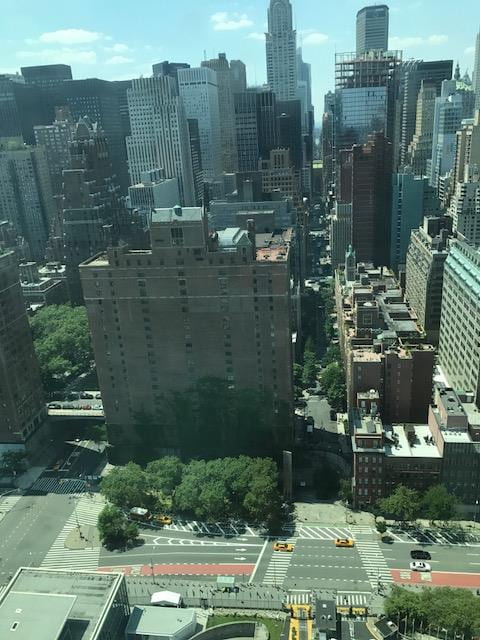
1st Ave from the 29th Floor of the UN
1st Ave from the 29th Floor of the UN. Photo by Ajanet Rountree.

The United Nations (UN) Conference on State Parties (CoSP10) experience began on the 29th floor for me. I say this because I lived in New York City and toured the UN on a couple of occasions. Additionally, living a life that is inclusive of persons with disabilities is in my wheelhouse. A friend and mentor utilizes crutches to help him walk because an accident, when he was younger, took the full use of his legs. Cancer took the use of B’s legs when she was a baby, and a motorcycle accident left my uncle paralyzed from the waist, making them both wheelchair users. I lead with all of this to say that making room in my world for persons with disabilities is something I have done for decades. My familiarity, in a sense, is akin to the knowledge gained by a couple of tours of the UN lobby and gift shop. Therefore, walking into CoSP10, I was prepared or so I thought.

I had never been on the 29th floor. The perspective is much different up there.

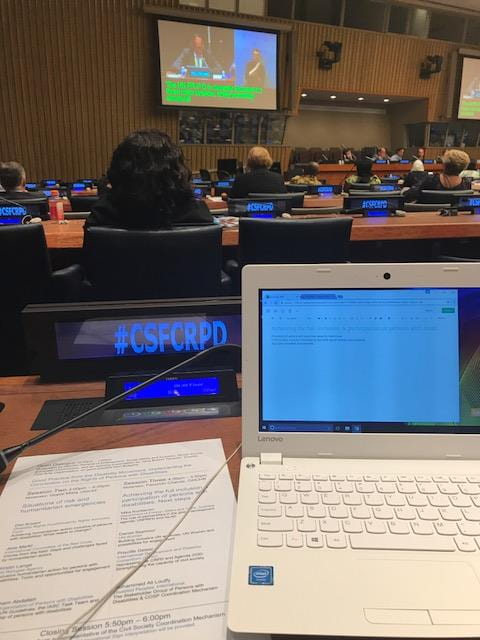
The Division of Economic and Social Affairs (DESA) is located on the 29th floor of the UN. The DESA team is responsible for both the economic and social affairs of persons with disabilities for all the UN member states as directly related to the Convention on the Rights of Persons with Disabilities (CRPD). They write and disseminate policies and ideas to the member states as suggested modes of implementation. Each policy and suggestion lies within the UN mandated Sustainable Development Goals (SDG) which is an extension of the 1945 UN Charter. SDGs are the 17 goals all member states, through collaboration, seek to achieve by 2020 as a means of ensuring “no one is left behind” while honoring the Universal Declaration of Human Rights (UDHR) and CRPD. Sitting in the conference room, I am inspired by the opportunity but not fully awake to what is about to take place.

Enter Daniela Bas.

Bas is the DESA director. During her chat with us, she disclosed a couple of points that stand out to me. First, the UN, as an employing entity, is beginning to put into action many of the policies and measures, tasked to member states for implementation. Most specifically, employing persons with disabilities in key leadership positions of which she is one. Second, the UN is an organization led by human beings seeking to do the right thing. With full acknowledgment, she reminds that the UN is not perfect but that the process of coalescing 196 backgrounds, traditions, religious affiliations, and attitudes to make significant strides at securing human rights and making the world more peaceful, is an accomplishment. Lastly, when compared to men and boys, and those who are able-bodied, discrimination against women and girls with disabilities doubles, and even triples if they belong to a minority race or class in their country. This last point, triple discrimination for women and girls with disabilities will become a recurring theme in the conference for me. The harsh reality of this fact remains an echo in my soul to this moment.

Confrontation with another person’s truth requires an adjustment to what is known through experience and education, and assumed through familiarity.

On the floor. Photo by Ajanet Rountree

I study and view life and the world with a gendered perspective in mind. I look for the role of women, our impact on families and societies, and our visibility and invisibility when it comes to equality. I am aware of the trials of living life at intersections. Intersectionality complicates because discrimination is complicated. I believe there is a temptation to separate the intersections so to obtain a solid understanding; however, it is in the attempt to separate that understanding is lost. Gaining a complete understanding of the dynamics of discrimination requires a holistic not segmented perspective.

Girls, irrespective of ability, are not as valuable or visible in many societies as boys are. Nora Fyles, head of the UN Girls Education Initiative (UNGEI) Secretariat, asserts invisibility is the fundamental barrier to education for girls with disabilities. She confirms this assertion when explaining the search for partnership on the gendered perspective education project by stating that 1/350 companies had a focus on girls with disabilities. For Bas, the failure to identify girls and women with disabilities is a failure to acknowledge their existence. Subsequently, if they do not exist, how can we expect them to hear their need? She suggests addressing crosscutting barriers. Leonard Cheshire Disability (LCD), in partnership with the World Bank, UNICEF, and UNGEI, hosted a side-event where they released their findings regarding a lack of inclusive education opportunities for girls with disabilities. Still Left Behind: Pathways to Inclusive Education for Girls with Disabilities sheds light on the present barriers girls, specifically those with disabilities, experience when seeking an education.

Article 26 of the UDHR lists education as a human right. Bas believes if knowledge is power, and power comes from education, the fact that 50% of women with a disability complete primary school and 20% obtain employment, reflects social and economic inequality. Ola Abu Al-Ghaib of LCD emphasizes policies, cultural norms, and attitudes about persons with disabilities perpetuate crosscutting barriers for girls with disabilities to receive an education. She concludes that schools are a mirror of society. In the absence of gendered sensitivity, boys advance and girls do not. Every failed attempt to address and correct the issue is a disservice to girls generally, and girls with disabilities, specifically.

It is imperative to remember that the spectrum of disability is multifaceted. Most people recognize developmental and physical disabilities like Downs Syndrome, Autism, visual and hearing impairment, and wheelchair users, but fail to consider albinism and cognitive disabilities as part of the mainstream disability narrative. Bulgaria is focusing on implementing Article 12 of CRPD regarding legal capacity. Legal consultant and lawyer, Marieta Dimitrova explains that under Bulgarian law, only reasonable persons have the right to independence; therefore, persons with cognitive disabilities receive the “unable” descriptor under assumption they are unable to reason and understand, thereby placing them under a guardian. Guardianship removes the right to participate in decisions regarding quality of life, which is a deprivation of liberty. She resolves that although full implementation into law awaits, stakeholders are seeking renewal in the new government because pilot projects have proven that an enjoyment of legal capacity in practice yields lower risk of abuse, changed attitude within communities, personal autonomy and flexibility.

Not all disabilities result from birth or accidents. War and armed conflict factor into 20% of individuals maimed while living in and fleeing from violence. A lack of medical access leave 90% of maimed individuals permanently disabled. Stephane from the International Committee of the Red Cross (ICRC) submits that for refugees with disabilities, access to essential services can be difficult on the journey and in camps, but also for those who are unable to flee. He infers a “double disability” inflicted upon refugees with disabilities: first as a refugee, and second as a person with a disability. Human Rights Watch advocates that refugee camps produce a humiliating and degrading existence for persons with physical disabilities because the “tricks” employed prior to arrival in the camps, are no longer applicable as wheelchairs sink in the mud and crutches break on rocky grounds. The Lebanese Association for Self-Advocacy (LASA) reports the underrepresentation of women and girls is significant when receiving information and access to assistance.

In a refugee simulation seminar, LASA informed that on the ground, confusion is high given that humanitarian organizations do not consult with each other, making communication difficult and non-supportive. For families with a person with a disability, nonexistence communication means a prevalence to fall victim to violence and harassment. Jakob Lund of UN Women divulges that humanitarian aid can be ineffective for women with disabilities, while Sharon with OHCHR suggests a clear dichotomy between the rights of the able-bodied and the rights of persons with disabilities holds central to the ineffectiveness. At the core of a lack of communication and accessibility is invisibility. Stephane concludes that there is an obvious need for a necessary and systematic retraining specific to educating others on how to see the invisible.

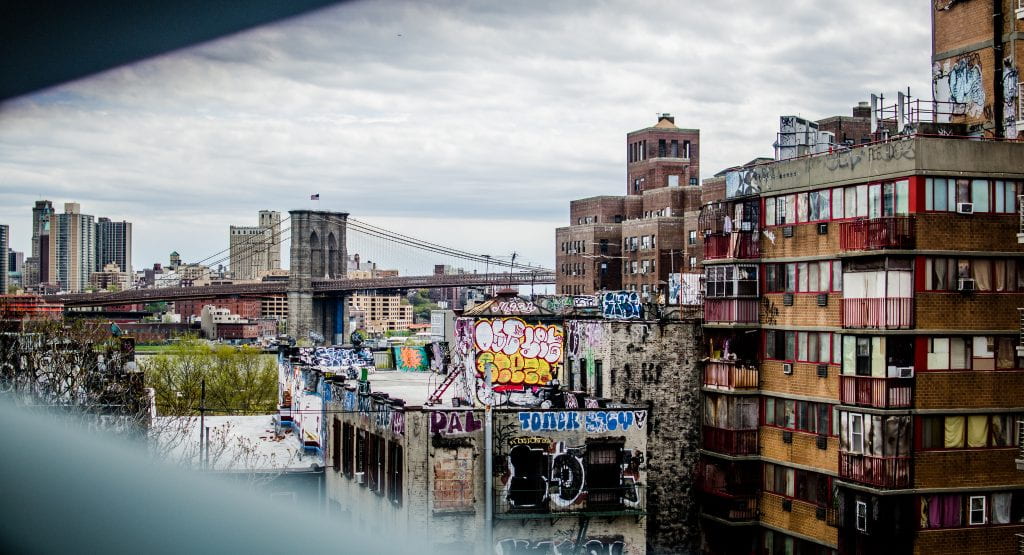
a picture of Chinatown, NYC and Brooklyn Bridge
Chinatown, NYC, and Brooklyn Bridge. Source: Madhu Nair, Creative Commons

The process of inclusion and equality relates directly to the decision to acknowledge a person’s existence. Retraining the mind to see any human being with a physical disability takes decisive action so I put myself to the test. First, I thought of all the famous women with a physical disability I could think of, and arrived at about six, including Heather Whitestone and Bethany Hamilton. I then googled celebrity women with disabilities which yielded a Huffington Post piece that identified Marlee Matlin, Frida Kahlo, Helen Keller, and Sudha Chandran as 4/10 “majorly successful people with disabilities”. I had Marlee Matlin and Helen Keller. What is more interesting is that I arrived at seven when naming men with physical disabilities. Here is the point: society is not inclusive of persons with disabilities if we have to strain our brains to remember the last time we sat next to, opened the door for, ate a meal with, or saw on the television/movie screen/church platform a person who did not look like us physically.

Perspective changes everything because perspective is everything.

Bangladesh: The Forgotten Genocide

April is Genocide Awareness and Prevention Month. The word genocide brings to mind the well-known horrors of the Holocaust, Rwanda, and the former Yugoslavia; yet, numerous atrocities that have gone unnoticed and unmentioned.  I will focus on dehumanization, extermination, and denial for this blog to bring awareness by shedding light on and bearing witness to the history of the Bengali people. For clarity, dehumanization is defined as when one group denies the humanity of another group, extermination is the action of mass killing itself, and denial refers to the perpetrator’s effort to disprove that the genocide ever occurred.

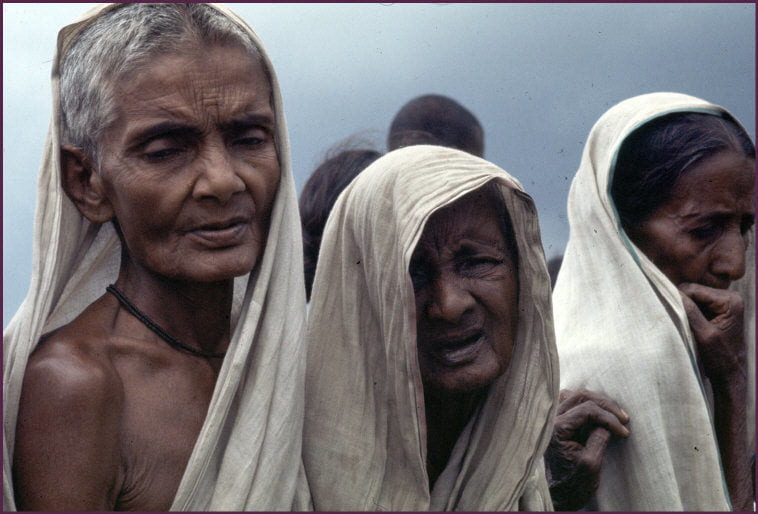
Three refugee Bengali women look sad.
“Bengali Refugees in India, 1971” by Bruno Barbey. “মুক্তিযুদ্ধ ই-আর্কাইভ ট্রাস্ট.” Creative Commons.

During the 1970s, a genocide took place in present-day Bangladesh. Rough estimates approximate a death toll numbers of nearly 3 million. The systematic annihilation of the Bengali people by the Pakistani army during the Bangladesh Liberation War, targeted Hindu men, academics, and professionals, spared the women from murder, but subjected nearly 400,000 to rape and sexual enslavement.

Bangladesh, as a nation, did not exist prior to 1971 because it was part of an area called “East Pakistan”. The pursuit of independence for Pakistan came following India’s independence from Britain. At the time, religion and culture separated the East and West sections: West Pakistan was populated by mostly Muslim Punjabis, while East Pakistan was more diverse with a considerable population of Hindu Bengalis (Pai 2008). West Pakistan looked down upon their eastern neighbors, calling the area “a low-lying land of low-lying people” who “polluted” the area with non-Muslim values (Jones 2010). This is a clear demonstration of dehumanization which Stanton says “overcomes the normal human revulsion against murder” by equating the victimized groups to vermin and filth. Lacking empathy for their disregarded neighbors, the people of West Pakistan abused their eastward neighbors economically and through lack of aid. West Pakistani elites, living and working in the political center of the country, siphoned most of the country’s revenue, initially generated by East Pakistan (Jaques 1999). Additionally, West Pakistan neglected to send adequate aid following the Bhola Cyclone that ravaged East Pakistan, and left close to 500,000 dead in 1970 (Pai 2008). The amalgamation of denied human rights contributed to the commencement of the Bengali independence movement. In response to the Bengali’s call to secede, West Pakistan developed Operation Searchlight.

Operation Searchlight is seen by many as the first step in the Bengali genocide (Pai 2008). Per the Bangladesh Genocide Archives, the operation, initiated on March 25, 1971, resulted in the death of between 5,000 and 100,000 Bengalis in a single night. Forces of the Pakistani Army targeted academics and Hindus, specifically murdering many Hindu university students and professors. The goal of the operation was to crush the Bengali nationalist movement through fear; however, the opposite occurred. Enraged at the actions of the Pakistan Army, Bangladesh declared its independence the following day (Whyte and Lin Yong 2010). Over several months, the Pakistani Army conducted mass killings of young, able-bodied Hindu men. According to R.J. Rummel, “the Pakistan army [sought] out those especially likely to join the resistance — young boys. Sweeps were conducted of young men who were never seen again. Bodies of youths would be found in fields, floating down rivers, or near army camps” (Carpenter 2016).

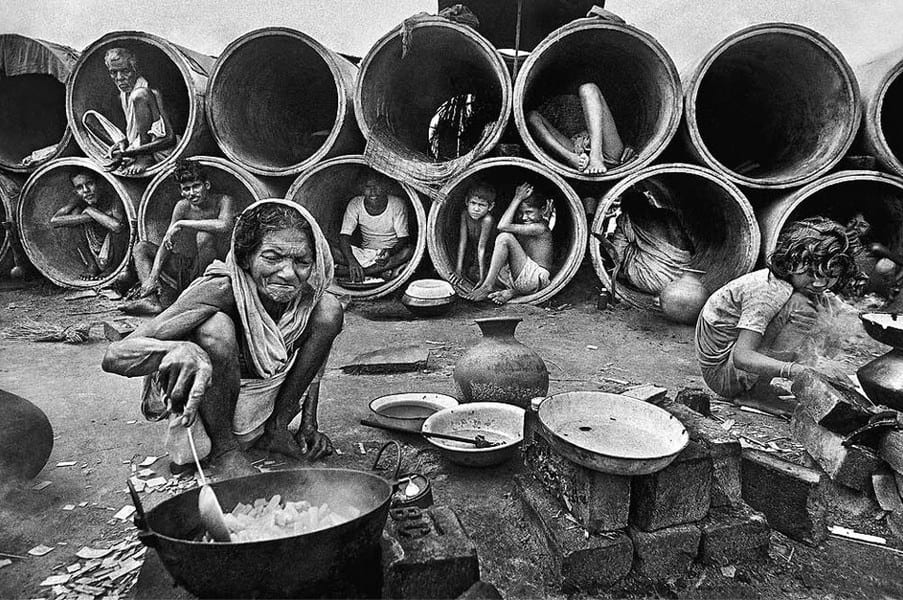
Refugees sit in cement pipes while other refugees cook.
“Bengali Refugees 1971” photographed by Raghu Rai. Uploaded by মুক্তিযুদ্ধ ই-আর্কাইভ ট্রাস্ট. Creative Commons.

Men became primary targets (almost 80 percent male, as reported by the Bangladesh Genocide Archives). The abduction and subsequent rape of women by soldiers took place in camps for months. Many more were subject to “hit and run” rapes. Hit and run rape explains the brutality of forcing male family member–before their own death–view the rape of their female family member by soldiers (Pai 2008). The use of rape, as a weapon of war by Pakistani forces, violated 200,000-400,000 Bengali women during March and December 1971. The high number represents the complicity of religious leaders who openly supported the rape of Bengali women, referring to victims as “war booty” (D’Costa 2011).

Archer Blood, American ambassador to India, communicated the horrors to US officials. Unfortunately, the United States refused to respond because of Pakistan’s status as a Cold War ally. President Nixon, taking on a flippant and discriminatory attitude, regarded the genocide as a trivial matter, assuming a disinterested American public due to the race and religion of the victims. His belief that no one would care because the atrocities were happening to people of the Muslim faith (Mishra 2013), created an uninformed and disconnected America concerning the Bengali genocide of 1971.

 “Our government has failed to denounce the suppression of democracy. Our government has failed to denounce atrocities… Our government has evidenced what many will consider moral bankruptcy.” – Archer Blood, American ambassador to India

Pai (2008) suggests the Pakistani Army strategized the genocide into three phases over the course of 1971:

  1. Operation Searchlight was the first phase as discussed earlier, which took place from late March to early May. It began as a massive murder campaign during the night of March 25, 1971. The indiscriminate use of heavy artillery in urban areas, particularly in Dhaka, killed many, including Hindu students at Dhaka University.
  2. Search and Destroy was the second where Pakistani forces methodically slaughtered villages from May to October. This is the longest phase because this is when Bengali forces mobilized and began to fight back; rebel Bengali forces “used superior knowledge of the local terrain to deny the army a chance to dominate the countryside”. This was also the phase in which the Pakistan army targeted women to rape, abduct, and enslave.
  3. “Scorched Earth” was the third phase beginning in early December, and targeted and killed 1,000 intellectuals and professionals such as doctors, lawyers, and engineers in Dhaka. The Pakistani Army surrendered to Indian forces days later, ending the genocide on December 16, 1971. Though Bangladesh established its initial independence directly following Operation Searchlight, the people of Bangladesh established themselves and their nation as a peaceful country, and began the reconciliation process.


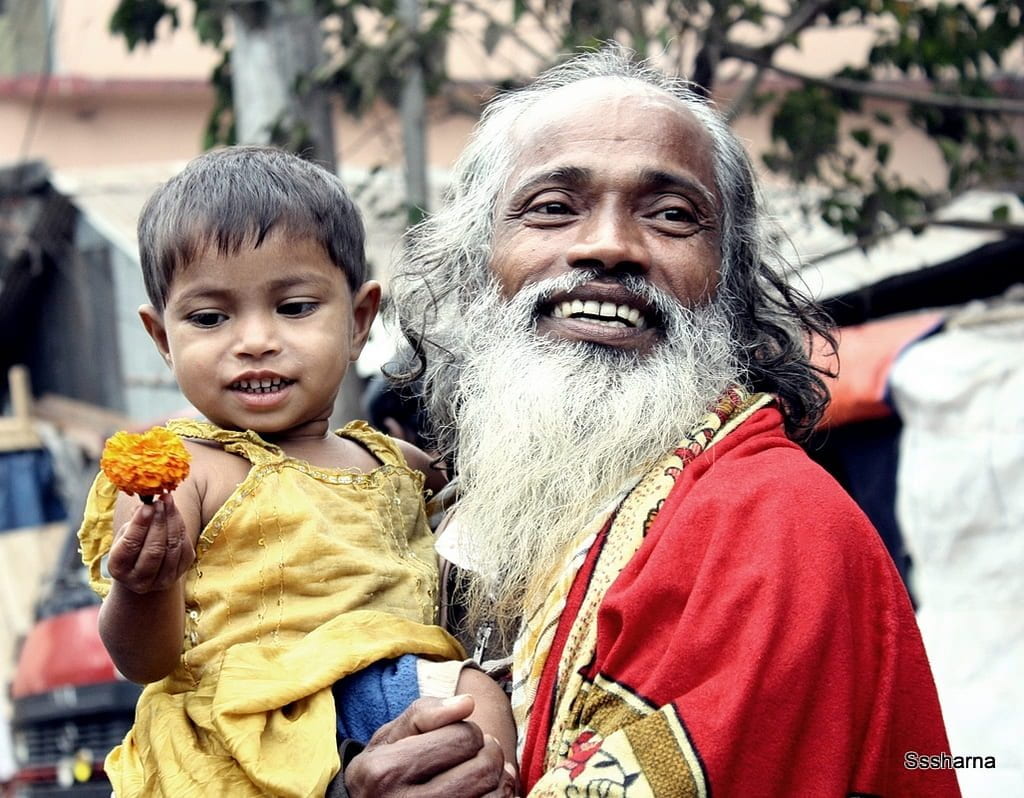
An old man with a beard and child sitting on his shoulder in a yellow dress celebrate 40 years of Bangladesh Independence.
“Sadhinota 16/40” by Shumona Sharma on Flickr. A man and child celebrate 40 years of Bangladesh Independence.

The American government has never acknowledged the actions of the Pakistan Army as a genocide. Henry Kissinger characterized it as unwise and immoral, but never termed it to be genocidal. The horrible acts that occurred to the Bengali people was clearly a genocide under the terms of the UN Convention on the Convention and Punishment of the Crime of Genocide of 1948 (CPPCG). The CPPCG defines genocide as “any of the following acts committed with intent to destroy, in whole or in part, a national, ethnical, racial or religious group, as such:

  • Killing members of the group;
  • Causing serious bodily or mental harm to members of the group;
  • Deliberately inflicting on the group conditions of life calculated to bring about its physical destruction in whole or in part;
  • Imposing measures intended to prevent births within the group;
  • Forcibly transferring children of the group to another group.”
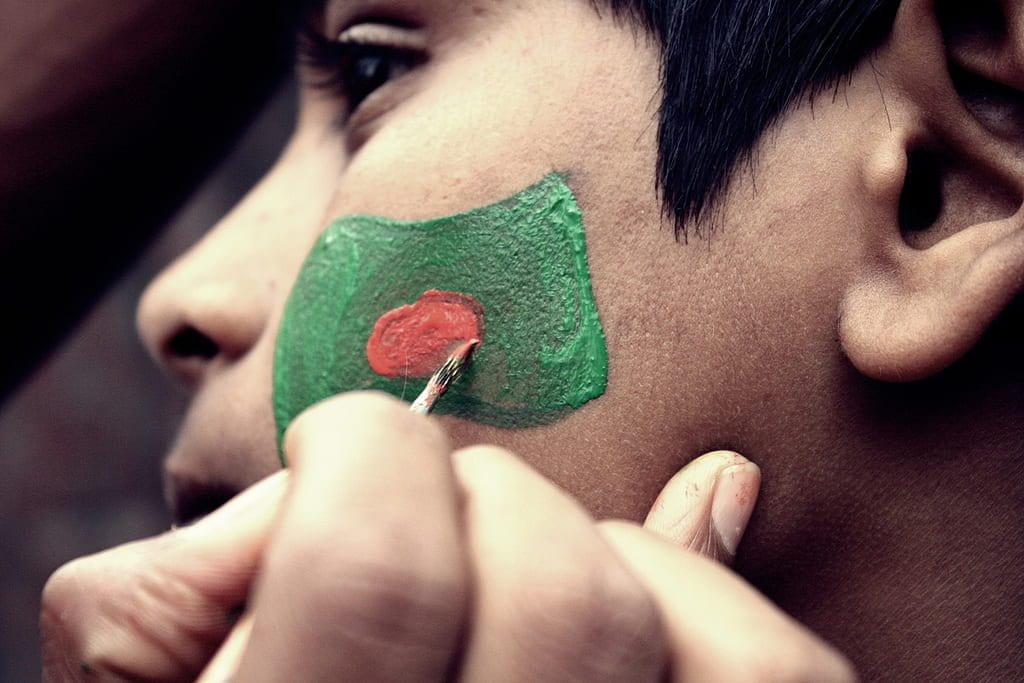
A boy has the flag of Bangladesh painted on his face.
“Sadhinota 8/40” by Shumona Sharna. Creative Commons.

Pai (2008) asserts, “That the genocide took place in a context of civil war, communal riots (which include instances where Bengalis did the killing) and counter-genocide, should neither mitigate nor detract us from the fundamental conclusion that casts the Pakistan army as guilty of perpetrating genocide.” To this day, Pakistan has continued to explicitly deny the occurrence of a genocide.  Despite this, the atrocities that mark the journey to Bangladesh’s independence have not swayed the Bengali people; their rich culture and flourishing country provide clear evidence. Today, Bangladesh is a prosperous country, ranking 46th of 211 countries in terms of GDP. They are one of the largest contributors to UN Peacekeeping forces, and the Global Peace Index ranks them as the third most peaceful country in South Asia (behind Bhutan and Nepal).

Works Cited

Boissoneault, Lorraine. “The Genocide the U.S. Can’t Remember, But Bangladesh Can’t Forget.”Smithsonian.com. Smithsonian Institution, 16 Dec. 2016. Web. 11 Apr. 2017.

Carpenter, R. Charli. ‘Innocent Women and Children’: Gender, Norms and the Protection of Civilians. Routledge, 2016. Print.

D’Costa, Bina. Nationbuilding, Gender and War Crimes in South Asia. London: Routledge, 2011. Print.

Jones, Adam (2010). Genocide: A Comprehensive Introduction. Taylor & Francis. ISBN 978-0-415-48618-7.

Pai, Nitan. The 1971 East Pakistan Genocide – A Realist Perspective. International Crimes Strategy Forum, 2008. Print.

Weber, Jacques. “THE WAR OF BANGLADESH: View of France.” World Wars and Contemporary Conflicts, No 195.1999, pp. 69-96.

Whyte, Mariam, and Jui Lin Yong. Bangladesh. New York: Marshall Cavendish Benchmark, 2010. Print.

Progress of Women’s Rights in Saudi Arabia

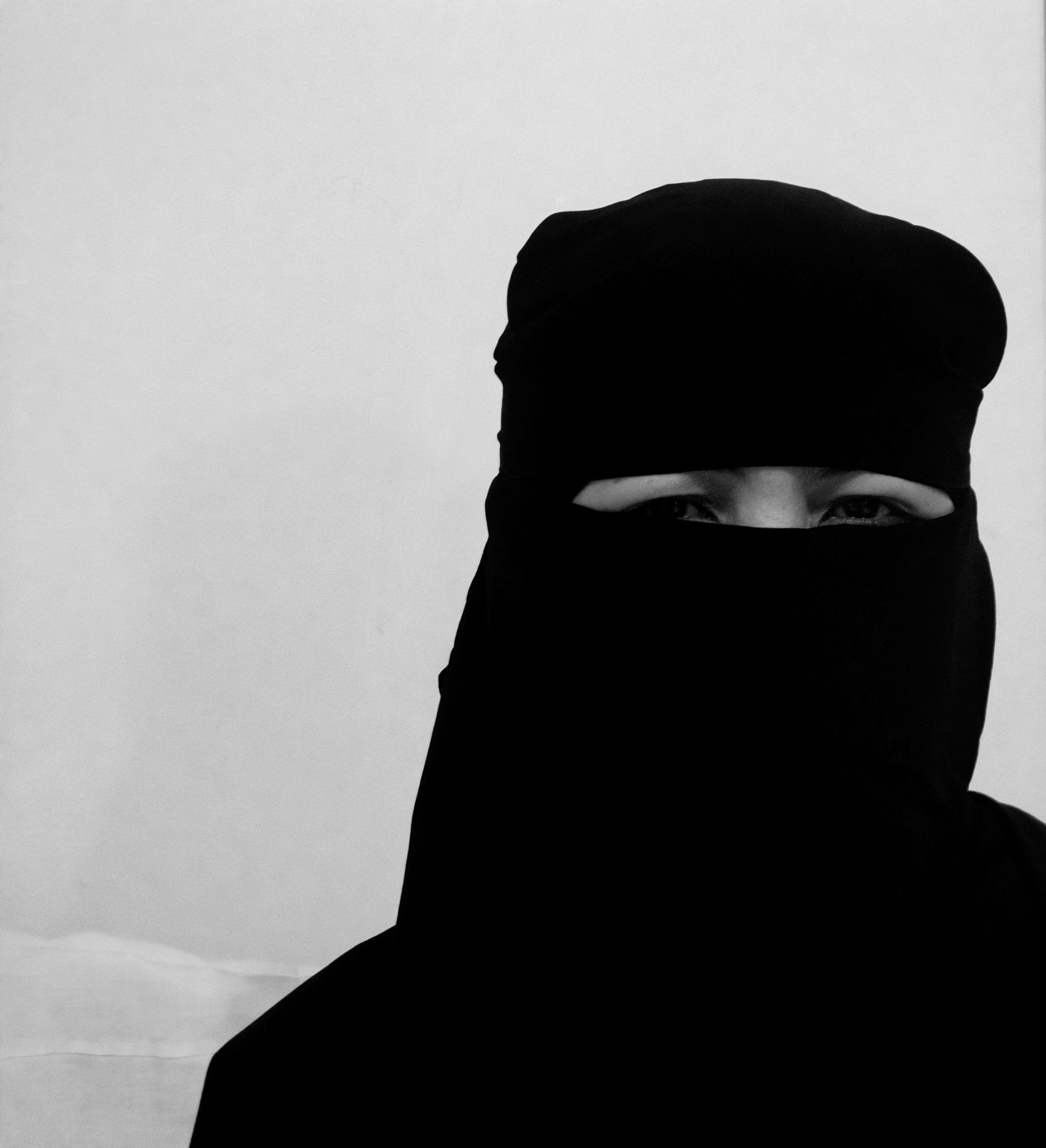
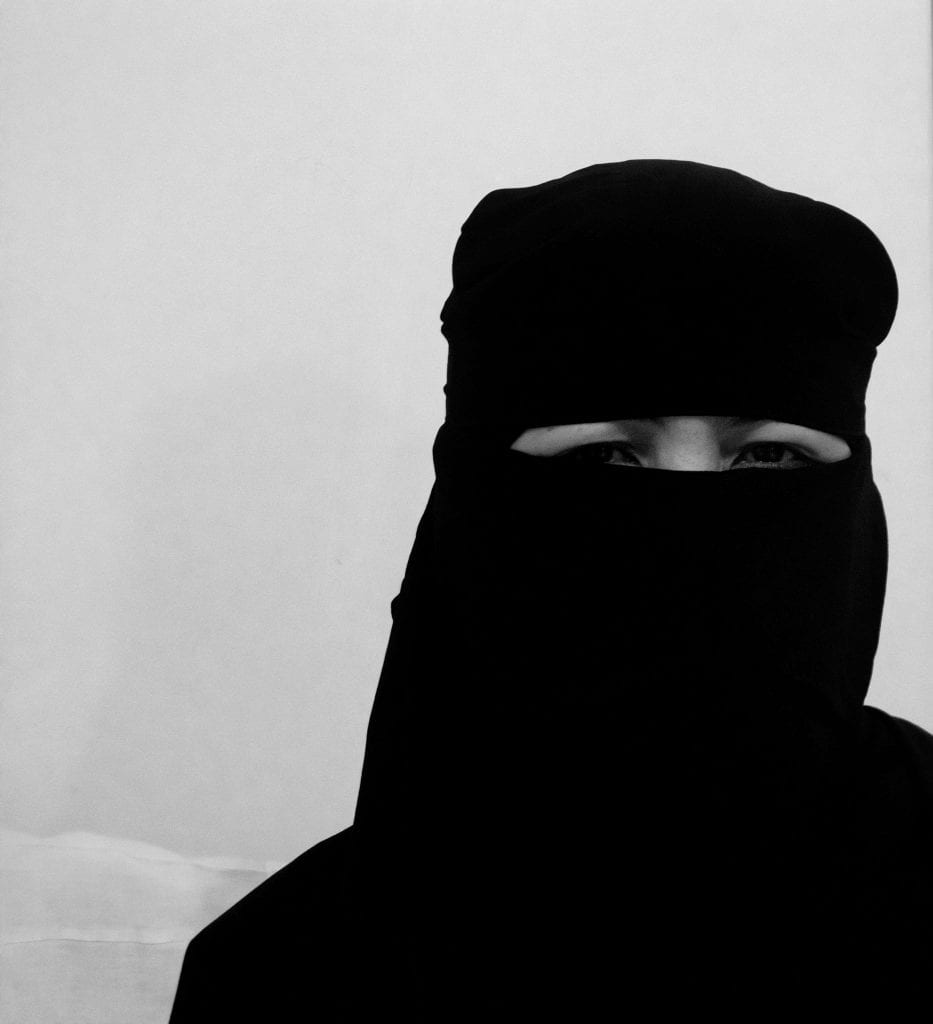
a picture of a Saudi woman
Saudi portrait. Source: edward musiak, Creative Commons.

The Kingdom of Saudi Arabia, home to the origin of Islam, is an absolute monarchy with no formal written constitution. The Holy Book of Islam–the Quran–is what the country has announced as their constitution. Saudi basic laws of governance, social structures, and overall culture are all based strictly on and reinforced by Islamic law. Saudi government has a reputation for using Islamic laws to marginalize the rights of Saudi women. Saudi laws inhibit women freedoms such as the right to drive, the right to free choice of employment, the right to travel, etc. However, in the past ten years, Saudi has made progress in easing the restrictions on women. In 2005, King Abdullah bin Abdul Aziz Al Saud ascended into the throne and restructured the importance and dynamic of women rights in the kingdom. King Abdullah is seen by many as a reformer, advocate for women rights, and modern. Under his rule from 2005 to 2015, late King Abdullah advocated for various women’s rights, specifically their civil political rights.

Women rights are embodied in both the Universal Declaration of Human Rights (UDHR) and the legally binding Convention on the Elimination Against of all Forms of Discrimination Against Women (CEDAW).  Saudi Arabia worked towards promoting gender equality and ratified the CEWAD in 2000. Unfortunately, the Kingdom placed a reservation upon the ratification process of the Convention stating, “In case of contradiction between any term of the Convention and the norms of Islamic law, the kingdom is not under obligation to observe the contradictory terms of the Convention.” In other words, Saudi does not see itself obligated to comply with paragraph 2 of Article 9 of the Convention which states nations “shall grant women equal rights with men with respect to the nationality of their children.” Even though the adoption of this Convention is in some sense incomplete and impartial, the acknowledgment of the Convention by the Saudi government, gives women legal protection to fall back on.

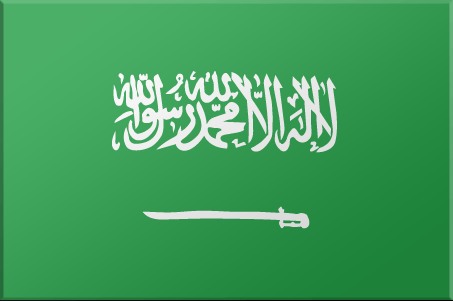
a picture of the Saudi Arabia flag
Saudi Arabia. Source: Steve Conover, Creative Commons.

Progress: Civil Political Rights

Before 2003, the Ministry of Education in Saudi Arabia was only responsible for overseeing male education. There was an independent ministerial level department named the “General Presidency of Girls Education (GPGE),” which was in charge of overseeing female education from primary schools to university colleges in Saudi. In 2003, the GPGE department was terminated and merged into the Ministry of Education for pre-university programs and the Ministry of Higher Education for university level programs. This was a major step for the government in recognizing the importance of female education. King Abdullah took it a step further in 2009 by appointing Saudi’s first ever female minister. Nora Al Fayez was appointed as Saudi’s first female deputy education minister, in charge of a new section in the Ministry of Education in control of female education. Unfortunately in 2015, after the death of King Abdullah, Nora was removed from her position by the new appointed King Salman.

King Abdullah, in 2011, announced that he will allow women to run for municipal council positions, and give them the right to vote. On December 13, 2015, participation in government procedures became a reality for women during Saudi’s historic municipal elections for the very first time, as they were allowed to vote and run for municipal governmental positions. During the election more than 1,000 female candidates ran for a municipal council positions, and 100,000 women registered to vote compared to more than 1 million male voters. At least 18 female candidates won municipal council positions. The number of female voters were low due to multiple reasons: they are unfamiliar with the voting process thus did not participate, did not have rides to the voting booth, or were unaware of where to vote due to lack of information. Even though voting numbers were low, the fact that more than 100,000 women did vote proves that with the right campaigning and access to general information about voting rights for women, the turnout will increase in the future.

“I exercised my electoral right. We are optimistic about a bright future for women in our homeland.” – Najla Harir, Female Voter 

The most noteworthy reform by King Abdullah was his royal decree to appoint 30 women to the 150 member advisory Shura Council. The Shura Council, also known as Saudi Consultative Council, is a group of 150 people which advise the king on certain social, economic, political issues by proposing laws and modifications, but cannot enforce any suggested laws. Women have never been appointed to this council prior to King Abdullah, so this action was a major statement towards the need for modernization. It also made it very clear that women and men have different needs, and women need to be the ones voicing their own concerns. King Abdullah verified that a women’s opinions and needs are just as important as men, and have a right to be heard.

Social impact

The continuum of women breaking the glass ceiling in Saudi Arabia is causing a major social impact and a change in attitudes amongst Saudi women. Saudi women are starting to show solidarity for their rights by starting and promoting campaigns that protests against social inequality and discrimination towards women. The two most popular campaigns Saudi women supported and participated in are “Women2Drive” and “#IAmMyOwnGuardian.” #IAmMyOwnGuardian demands that the Saudi government abolish the male guardianship, and has rallied more than 14,000 signatures for their online petition which was delivered directly to the Saudi government. Women2Drive is another women rights movement started by Saudi women activists. This was a Facebook based campaign, started by Saudi activist Manal Al Sharif when she posted a video of herself driving a car in Saudi, trying to prove she is capable of doing so. She was detained and arrested eventually; however, she inspired other women to follow her resistance. On October 26, 2013, at least (if not more) 30 women took to the streets throughout Riyadh and Jeddah, driving themselves around the cities. Even though technically no change come out of those two protests, women have joined each other in solidarity for their rights. Most importantly, they have started a very important discussion amongst themselves regarding their human rights.

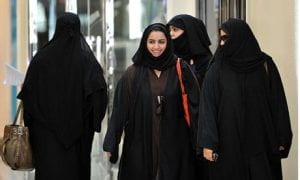
Saudi women walk inside the Faysalia shopping centre in Riyadh.
Saudi women walk inside the Faysalia shopping centre in Riyadh. Source: Tribes of the World, Creative Commons

Future Goals

Despite the progress, there is still a long ways to go regarding women rights in Saudi Arabia. The CEDAW commends Saudi on the progress it has made towards gender equality, while strongly encouraging Saudi to continue implementing women’s rights. In 2008, the CEDAW released their concluding comments regarding the elimination of discrimination against women and how to more actively implement all the provisions of the Convention. The ultimate goal for women’s rights in Saudi addressed by the CEDAW and non-government organizations, like Humans Right Watch, is the abolishment of the current male-guardianship system in Saudi. Saudi requires every women in the country to have a male guardian–usually her father, husband, or son–who holds the legal power to make decisions for women. A Saudi women’s male guardian must grant her permission to participate in a range of daily activities, like getting a job, going to college, leaving the country, and even receiving healthcare. Women in Saudi, if unable to fully embody individual rights and make key decisions for themselves, will remain at a disadvantage if their national constitution and laws do not match the progress of the past ten years.

Saudi Arabia continues to make progress towards women rights in the Kingdom. More and more Saudi women are becoming activist and using their voices to fight for change. It is refreshing to know that women all over the world are also taking on the challenge and uniting together for a brighter future. Start encouraging and supporting each other. Show solidarity for the effort women are making to ensure their human rights are acknowledged and respected. Foster thoughtful discussions about women rights so we can confront our biases, instead of disregarding men and women who are different than us. As J.K. Rowling said “we are only as strong as we are united, as weak as we are divided.”


NEVERTHELESS, SHE PERSISTED

Preventing the practice of FGM/C in primary schools. Source: DFID – UK Department for International Development Follow, Creative Commons.

These three words “NEVERTHELESS, SHE PERSISTED” by Mitch McConnell, meant as a means of expressing his authority over Elizabeth Warren on the Senate floor last month, have been co-opted by women around the world as a rallying cry and a reminder that women’s rights are human rights. The phrase uttered to news outlets, regarding Warren’s defiance as she read a letter from Coretta Scott King about the US Attorney General appointment of Jeff Sessions. As Warren read, she was interrupted, forced to stand down and remain silent for the duration of the session. Unshaken, Warren utilized another room and modern technology to continue the statement. The male Democrat Senators proceeded to read the entire letter on the Senate floor, without interruption. This scene symbolizes, in various ways around the world, the blatant and subtle, dismissive and disrespectful interaction of some men towards women.

Yesterday was International Women’s Day (IWD). IWD originated as a nod to the women in the 1909 New York City factory workers strike. A 1910 international meeting in Copenhagen established the annual recognition of female advancement in human rights, including voting rights, though there was no date for the observance; in 1975, the United Nations settled on March 8. UN Secretary General Antonio Guterres explains that the protection of women and girls comes to fruition through empowerment, reducing the gender inequality that leads to discrimination, and bolstering socially and economically weak communities and societies. “Women’s legal rights, which have never been equal to men’s on any continent, are being eroded further.” Gender equality, one of the 17 Sustainable Development Goals, is an essential component in the plan “agreed by leaders of all countries” as they work in partnership to ensure the inclusion of all.

Women have been fighting against an imbalanced relationship between the sexes for centuries. Sherry Ortner believes “the universality of female subordination, the fact that it exists within every type of social and economic arrangement and in societies of every degree of complexity…something we cannot rout out simply by rearranging a few tasks and roles in the social system…The underlying logic of cultural thinking assumes the inferiority of women.”  According to historian Gail Collins, the single women of the colonies were either “tobacco brides”, indentured servants who were raped and often forced into marriage, or labeled witches and spinsters. Married colonial women achieved the highest status and authority when contributing to the progress of the nation by working in the fields, growing crops, and harvesting food; black couples were indentured servants who once they gained their freedom, owned businesses and shops. At the time, black women did not have the same constraints as white women. She contends, “Virtually all the colonial women wanted to marry, but when they did, they were automatically stripped of their legal rights. A wife’s possessions became her husband’s, and she was unable to do any business on her own, sue, borrow money, or sign contracts. A married women was virtually powerless…His character determined how far she could rise in life.” Collins is describing colonial America; however, presently, in 2017, women—whether single or married– many countries around the world remain powerless, consigned to relying on the males in their family to determine who and what she becomes.

By the 1800s, white women and homemakers were creating reform movements and petitioning for equality; black women were now domestic and sexual property of slave owners. In 1848, abolitionist Elizabeth Cady Stanton gave her Declaration of Sentiments and Resolutions at the Seneca Falls Women’s Convention she organized. Suffragette Susan B. Anthony pronounced, “Woman has been the great unpaid laborer of the world, and although within the last two decades a vast number of new employments have been opened to her, statistics prove that in the great majority of these, she is not paid according to the value of the work done, but according to sex.” The late 19th century brings the right to vote to the women of New Zealand; however, for the public sphere to hear the voice of women, it will first arrive in the form of protest from around the world.

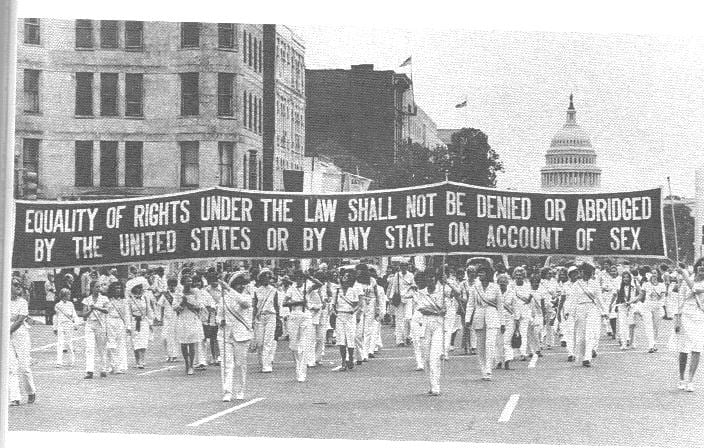
a picture of a women's protest from 1930s
Feminism. Source: kcochran06, Creative Commons.

The 20th century generates the fight for suffrage via women like Emmeline and Christabel Pankhurst in Britain. Margaret Sanger battles Comstock Laws, making birth control available for women desperate to end the circular nature of “barefoot and pregnant”. The rise of labor needs introduces women to factory work. Yet with wars end, women lost their jobs by being “expressly fired”, replaced by men, and reduced to the ranks to domesticity. In 1963, the Civil Right Act passed, the Commission on the Status of Women is established and the Equal Pay Act, which bars unequal pay for the same or similar work completed by men or women, within the same organization, becomes federal law. Betty Friedan in her book, The Feminine Mystique, exposes the American ideal as a myth, stating

“Over and over women heard voice of tradition and of Freudian sophistication that they could desire no greater destiny than to glory in their own femininity. Experts told them how to catch a man and keep him, how to breastfeed children and handle their toilet training… They were taught to pity the neurotic, unfeminine, unhappy women who wanted to be poets or physicists or presidents. They learned that truly feminine women do not want careers, higher education, political rights—the independence and the opportunities that the old-fashioned feminists fought for. All they had to do was devote their lives from earliest girlhood to finding a husband and bearing children.”

Enter the second wave of feminism. Ortner argues that ‘female is to nature as male is to culture’ is a code of practice derived to perpetuate inequality. Most distressing is that global humanity bought into this lie and label anyone willing to stand against it, deviant. Herein lies the disdain for the term “feminist”.

The characterization of feminists as an ambitious, aggressive, bossy, b*%$#y, bra-burning woman who hates all men reveals the failed understanding of a women who stand up for themselves and the rights of other women as a means of gender equality. The fight for feminists is political because the political is personal, and the personal, political as Leymah Gbowee believes. Though progress has been made, there are significant strides yet to be made on behalf of women, politically, socially, and economically; until the fullness of women’s rights are human rights is fully accepted, implemented, and recognized.

First, women need positions of governmental leadership. The public sphere has made room for female representation by respecting the human right to participate in country elections–Saudi Arabia was last in 2015—but the issues facing women are not accurately addressed. Of the 192 nations on earth, women represented 59 in the past 50 years. The feminine voice has representation on some local levels of government within the US; however, on the national level, women possess less than 20% of the seats. Conversely, Rwandan women account for 64% of parliamentary seats as of 2013. Rwanda, known for the 1994 genocide, “has the most women’s participation globally.” Additionally, www.heforshe.org ranks Rwanda as the highest commitment leader, based upon population, for gender equality.

Second, “boys will be boys” is not an acceptable stance to take regarding misogyny and sexism. The cliché permits the turn of a blind eye where gender-based violence (GBV)–sexual harassment, bullying, stalking, assault, etc.–are concerned. Whether UN peacekeepers or college students, the combination of these actions, and a lackadaisical response from citizens and law enforcement, creates a culture where violence against women is not considered taboo. Brock Turner caught in the act and convicted of sexual assault, and released within three months of his six-month sentence. Survivors of sexual assault, regardless of gender, endure treatment as guilty of contributing to their assault: ‘what were you wearing’ or ‘why did you walk alone’, more often than the perpetrator is innocent of committing assault; therefore, most go unreported. Jill Flipovic presents rape and sexual assault as “both a crime and tool for social control.” She believes sexual assault is the result of a systemic problem of misogynistic behavior, rooted in the debasement of women by men and accepted by the by-standing status quo.

Rape and sexual assault will continue as a weapon and means of control until perceptions about sexism and misogyny change, and the creation and implementation of laws protect the survivors rather than the attacker. In Malawi, the government plans to increase the number of reported GBV by “setting up a mechanism… [that] will strengthen the 300-community based victim support units and build their capacity to handle cases in coordination with law enforcers and judiciary.”  Male heads of state, university presidents, and business leadership possess a unique opportunity of deconstructing structural violence and reconstructing institutional, gender equal framework by employing IMPACT 10x10x10 top-down engagement strategy.

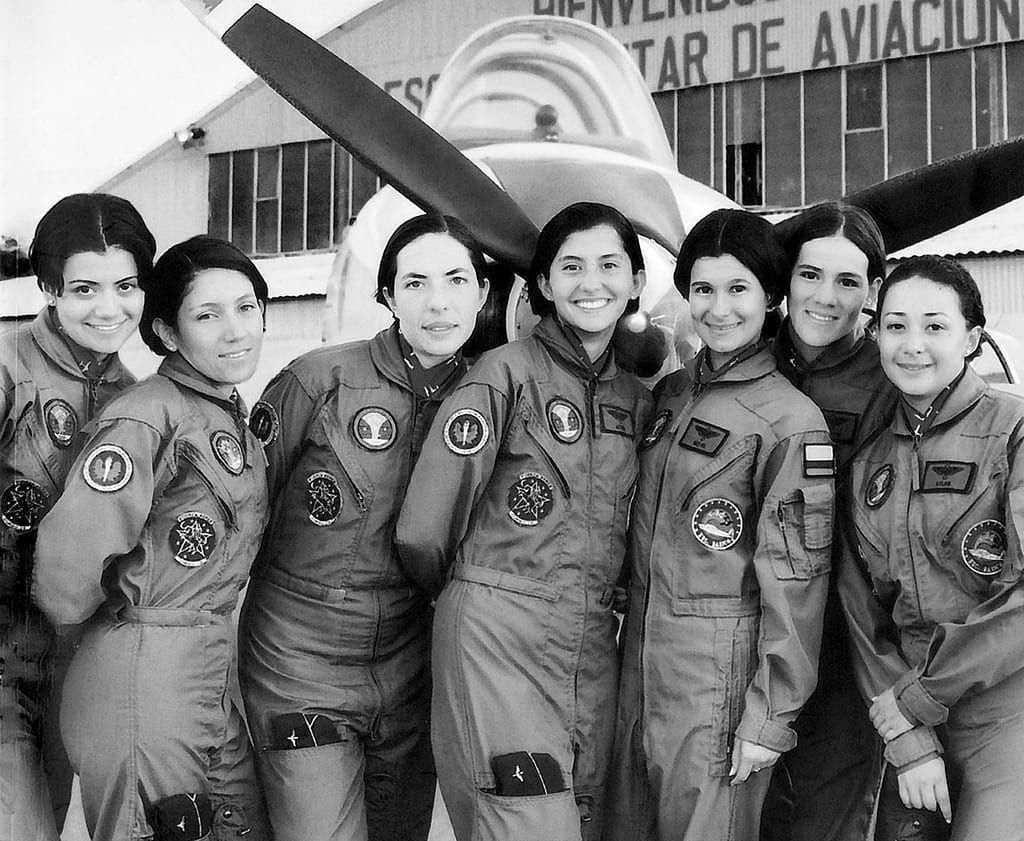
The first seven female pilot officers of the Colombian Air Force against a T-34
The first seven female pilot officers of the Colombian Air Force against a T-34. Source: Aviatrix Aviatrix, Creative Commons.

Third, look for the glass ceiling to be broken through the removal of economic and labor barriers. Tennis leads the way in pay equality due to the persistent advocacy of Billie Jean King and Venus Williams. American Bessie Coleman was the first black female pilot; two weeks ago, First Officer Dawn Cook and Captain Stephanie Johnson made history as the first black pilots to command the cockpit at the same time. In addition, Soudaphone and Phinanong of Laos, made aviation history as the first female pilots.

Nathaniel Parish Flannery writes, “one in 4,000” of the world’s largest companies have a seat for women on their boards. Prime Minister of Iceland Bjani Benediktsson stated, “When it is no longer news to have women in leading position, then—and only then—will we have gender parity.” According to the glass-ceiling index, Iceland is the best nation in the world to work, leading the way in gender equality. Over the course of five years, Scandinavian countries have positioned in the top five, whereas the United States ranked 20th, seven below the average. On Tuesday, the fearless girl representing gender inequality and pay disparity became an addition to the bull on Wall Street.

For more nearly 400 years, the persistence of women has pushed back the bounds of patriarchy, which interrupted our growth, forced us to take a backseat on policy and agenda issues regarding our personhood, seeking our demure silence and acceptance. Today, in 2017, given the persistent history, current global political climate, and subsequent rise of global solidarity, the collective SHE has heard the warnings, ignored the explanations, and raised a resistance.

The Controversy of Healthcare Rights

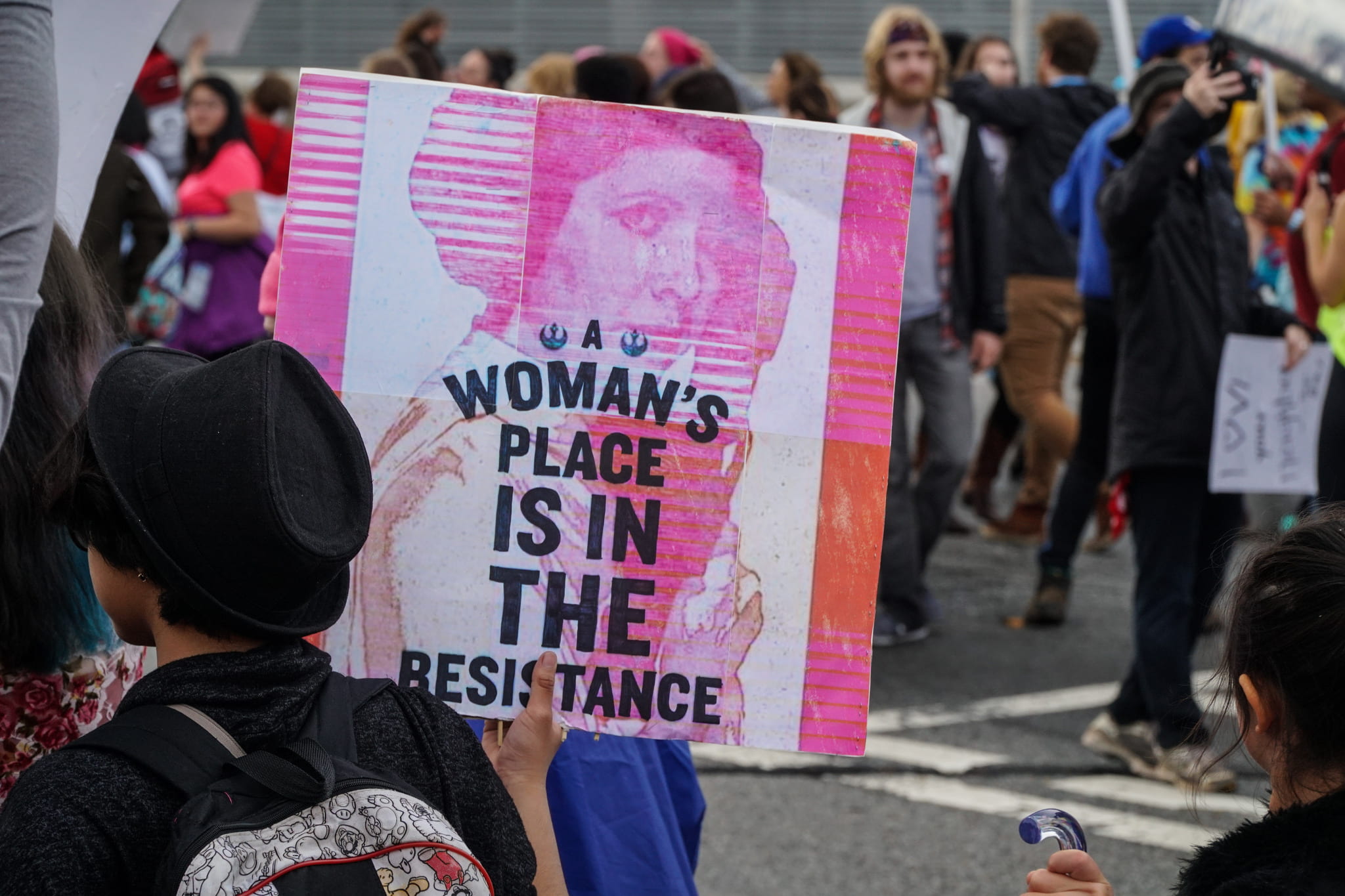
a picture of a sign that reads A Women's Place is in the Resistance
Women’s March. Source: Alan Sandercock, Creative Commons.

The promotion and focus on public health is in some sense evolutionary. As our world continues to globalize, a byproduct is the development and discovery of new technology and information that aid in the improvement of a nation’s health care system. Public health development relies on the accessibility of an efficient and feasible health care system that provides a range from prevention services, like vaccinations and screenings, and treatment services. Therefore, a lack of access to healthcare services and facilities could result in increased illness, disability, and death. Many people do not have access to reliable healthcare, for a variety of reasons, including poverty and high cost of insurance, raising the question of whether or not healthcare can remain simply public health concern, or if it is both a public health and human rights issue. The answer ultimately depends upon the implementation and exercise of a nation’s law.

The international community, through various declarations, recognizes the right to healthcare as a fundamental and universal right for every human being. Article 25 of the United Declaration of Human Rights (UDHR) states that “everyone has the right to medical care and necessary social services, and the right to security in the event of unemployment, sickness, disability, widowhood, and old age.” The social, cultural, and economic rights enshrined in the 1952 UDHR coalesced into legally binding responsibilities with the adoption of International Covenant on Economic, Social and Cultural Rights (ICESCR) in 1966. Article 12 of the ICESCR directly addresses health care stating, “the States Parties to the present Covenant recognize the right of everyone to the enjoyment of the highest attainable standard of physical and mental health. The full realization of this right shall include: The prevention, treatment and control of epidemic, endemic, occupational and other diseases; and the creation of conditions which would assure to all medical service and medical attention in the event of sickness.”  Both of documents thoroughly defend our rights to healthcare. In this blog, I will argue that all individuals have a right to healthcare without discrimination based on desired services.

According to the UDHR and ICESCR, every individual has a right to health care. Unfortunately, the access to healthcare, for women, is often discriminatory and limited. Males and females are biologically different and require dissimilar healthcare services, particularly different preventative screenings and reproductive health necessities, throughout different stages of life. That being said, one statement that really caught my eye during 2017’s presidency election is the possible defunding of Planned Parenthood.

Planned Parenthood (PP) is a non-government organization that provides crucial reproductive health care, sex education, and information to millions of women, men, and young individuals globally. 2.5 million women and men in the United States annually visit Planned Parenthood, and an estimated one in five women in the U.S. has visited a Planned Parenthood health center at least once in her life. Annually, this organization provides 270,000 Pap tests, more than 360,000 breast exams, more than 4.2 million tests and treatments for sexually transmitted infections, and lastly provides educational programs to 1.5 million young adults annually. Consequently, the reason why PP gets funded by the government is because PP provides free services such as pap tests, breast cancer screenings without any co-pay, thus the government is basically reimbursing the organization. From a public health perspective, PP is essential in maintaining and promoting population health due to preventative screening measures, controlling sexually transmitted infections (STI), and educating the community on positive and healthy behavior change.

a pic of a sticker that reads I Stand With Planned Parenthood
I Stand With Planned Parenthood. Source: Women’s News, Creative Commons.

The most controversial service offered by PP is pregnancy contraceptives and abortions. Overall, 80% of PP patients receive services to prevent unintended pregnancy, yet only 3% of PP healthcare services are abortion services. Abortions are controversial, yet regardless of what your personal views on abortion, PP helps millions of people and the general public stay healthy. In fact, in 2015 PP detected breast cancer in 71, 717 women and treated 171, 882 for STI’s, and without these prevention services, rates of cancer, and the spread of STI’s will increase.

Given that women make up more than half of the US population, is it truly just of the government to defund Planned Parenthood just because it provides abortions? The answer is technically no. The laws governing Medicaid prevent states from excluding certain providers solely because of other medical services they provide, like abortions. Specifically, the Freedom of Choice Act which states it is the policy of the United States that every woman has the fundamental right to choose to bear a child, to terminate a pregnancy prior to fetal viability, or to terminate a pregnancy after fetal viability when necessary to protect the life or health of the woman. The act also prohibits the interference of “discriminate against the exercise of the rights set forth in paragraph (1) in the regulation or provision of benefits, facilities, services, or information.” Defunding Planned Parenthood because the organization provide abortion services is technically illegal and defies the act. Another document that supports women rights to family planning health care services in the Convention on the Elimination of all Forms of Discrimination against Women (CEDAW). According to Article 12 in the Convention on the Elimination of all Forms of Discrimination against Women, State Parties will ensure women have equal access to health care services, including those related to family planning. In modern times, family planning includes services such as contraceptives like birth control and abortions, and according to CEDAW, access to these services are women rights.

As of right now, there is no alternative health care system or health care facilities in place to provide care for people covered by Planned Parenthood. According to the Congressional Budget Office, if Planned Parenthood were to be defunded, there would be increased direct spending for Medicaid by $20 million in 2016, by $130 million in 2017, and by $650 million over the 2016-2025 period. Also, as little as 5% or as much as 25% of the projected 2.5 million patients aided by Planned Parenthood would face reduced access to care. Ultimately, the Constitution of the United States establishes the government’s responsibility to promote general welfare. The potential lack of access to health care due to defunding Planned Parenthood means a failure to provide basic human rights for women, but also a failure to promote general welfare.

Americans need a health care system that works for all patients and providers. This is a turning point for the women in our nation. Many women are worried we are going back in time. The Women’s March on Washington showed the passion, respect, and trust American women have for their rights, their need for government support, and the gravity of the issue around the world. The Women’s March started in Washington, but inspired women all over the world to march for women rights in their own country, and demand their governments recognize women rights are human rights. Just like the thousands of men and women who marched in Washington and all over the world, don’t forget that the US government works for the people, and we need to start learning how to engage in our democracy to ensure our voices our heard. The Unites States of America is the only developed country who doesn’t offer health care to all citizens, and it is time for a change.

Women’s March: An Evolution in Global Solidarity

picture of Washington, DC Women's March 2017
DC Women’s March. Source: Liz Lemon, Creative Commons.

On January 21, 2017, over five million people marched–on all seven continents–in solidarity for women’s issues. In Washington D.C, one million marchers made their voices heard, nearly three times the size of the crowd at the inauguration, according to crowd scientists. The Birmingham, Alabama march numbered nearly five thousand, to the surprise of organizers who expected closer to several hundred. The official Women’s March website states the platform and approach is committed to equality, diversity, and inclusion. While initially, the Trump administration may have been the fuel for this rise, the movement presently signifies an international protest against the growing threat of a dishonest narrative about women’s rights and unjust treatment of them.

The sheer numbers of attendees at the march inspired and infused hope into the hearts of many deeply opposed to the injustices within the context of women’s rights. Critics of the march seem to misinterpret the intentions of marchers by claiming that the cause was American-centric, thus ignoring the subjugation of women globally. There is some validity to this, in that, the focus of many marchers remained centered in American political issues, and often excluded some key actors from the discussion like transgender people. However, many critics used these potentially valid grounds to deny the existence of oppression in America. Blogger Stephanie Dolce, after listing a series of wrongs against women in other countries, writes, “So when women get together in America and whine they don’t have equal rights and march in their clean clothes, after eating a hearty breakfast, it’s like a vacation away that they have paid for to get there.” This critical narrative reveals the false impression that many Americans have about women’s rights, the nature of protests, and the human right to participate in protest.

picture of girl holding signs at Birmingham Alabama Women's march 2017
Women’s March in Birmingham, AL January 2017. Source: Ajanet Rountree.

Dolce mentioned the issues of rape, limited education access, gender violence, and denial of bodily autonomy through legislation, infanticide, and female genital mutilation (FGM). She then suggests that American women do not experience these acts of violence and oppression. To believe that these issues are absent in America is to remain blinded by privilege. Dolce’s argument, supported and shared many times across social media, is rooted in privilege—a privilege that often undermines the nature of exploitation and oppression of another because distance rather than proximity and a lack of knowledge discredit the acknowledgement of an experience.

Marchers in cities around the world reflected the microcosm of the global civic society. It is highly unlikely that Dolce, who is vocally critical of the march, attended a protest based on her blog writing. Conversely, I have been an advocate for human rights for years and decided to experience the Birmingham march firsthand. I found myself deeply moved by the variety of issues and identities represented; therefore, I can bear witness to a crowd of people marching for a diverse set of causes, each inherently political but not as a political reaction. Protest signs held high regarding immigration, environmental issues, racism, disability rights, and more, dotted the landscape of Kelly Ingram Park. The diversity of the city was visible in the composition of marchers and their causes. The harsh, judgmental “anti-Trump” rhetoric is an insult to social justice, as this march and subsequent protests, are not about him or any one person.

The highly divisive stage in American politics provides a vehicle of change through shock and outrage; fortunately, the movement is not limited to the American arena. This activism is not a backlash to the election or simply a march about women’s issues. This is not, as some may see it, a petty protest against the shift in ideology represented in our new president. This is the beginning of a global movement to protect rights presently impacted by global structural violence targeted towards women specifically, and humanity generally.

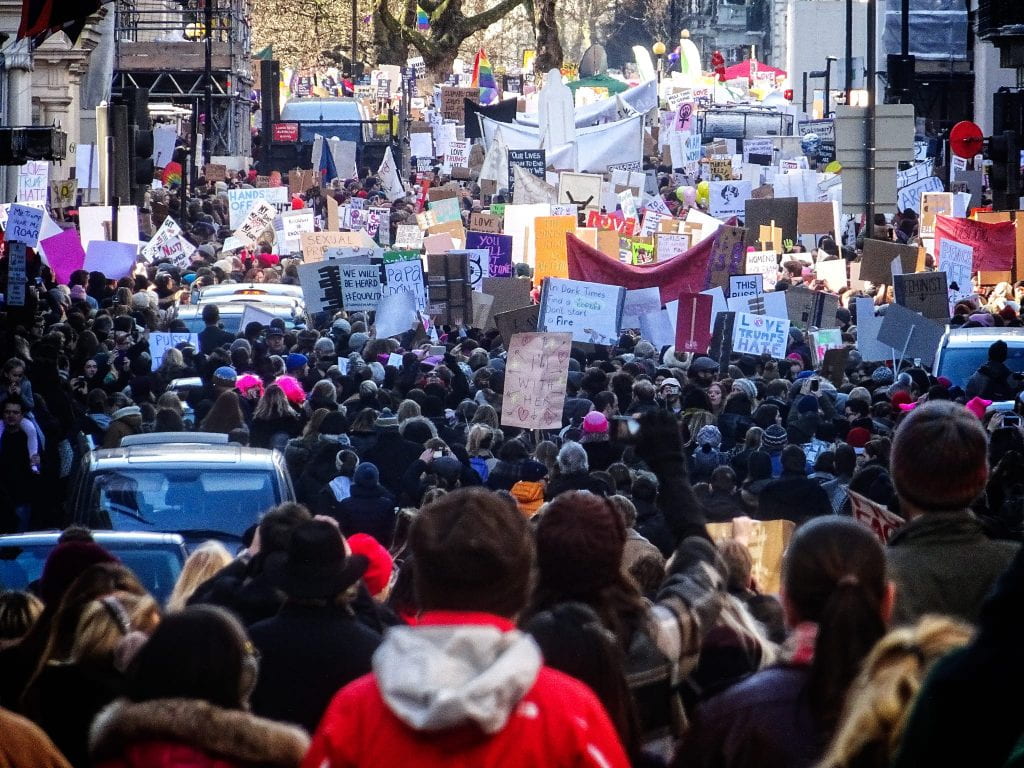
picture of Women's March in London 2017
Women’s March London. Source: Garry Knight, Creative Commons

The Women’s March website has listed steps to transform the vigorous energy seen on January 21 into a long-term international movement. Given the millions of marchers who came out, it is hard to imagine that the momentum and awareness for women’s rights will simply fade away. The evolution of the movement is already underway. They currently have two “global action steps” listed and a third still developing. First, communicate concerns for women’s rights by contacting representatives, using postcards or letters with a picture of the march. Second, organize local “next up huddles” which are intended to foster support and community. The goal is that each area brainstorm a “set of actions and strategies our group will pursue in the coming weeks and months”, mobilizing the community through grassroots activism and people power.  The grassroots approach, fueled by people power, is essential because it empowers leadership and change from the bottom-up rather than top-down. People power initiates the quicker and more effective change across nations.

With an enormous base of supporters and power of grassroots change, it is clear that the spirit behind the Women’s March is thriving and quickly evolving into a transnational platform.


Female Empowerment via the Internet

The Internet is a veritable minefield of content for women. For adolescent girls, as they begin to explore their freedom and independence, this boundless online environment contributes to their ability to educate themselves on women’s rights earlier than ever before. Online articles on topics from personal health to social change grant a generation of young girls access to an increased knowledge base for advocacy and protection. The Internet also empowers adult women through professional education, resources for help in dangerous situations, and access to communities that may be inaccessible in their areas. The United Nations’ Guidelines on Women’s Empowerment states, “‘Advancing gender equality and equity and the empowerment of women, and the elimination of all kinds of violence against women, and ensuring women’s ability to control their own fertility … are priority objectives of the international community’.”  Empowerment at any age is vital to women in a time where sexism is still very much alive. In communities that may be lack gender equality, girls can find ways to adapt and thrive.

picture of a girl at a laptop
Source: StartupStockPhotos, Creative Commons.

The internet equips adolescent girls with accurate information about puberty, sexual health, and reproduction in cultures where discussing reproductive health is forbidden. Menstruation, a taboo topic in many cultures, is often punishable by death. In Nepal, a practice called “chaupadi” has resulted in the deaths of many young women. Though outlawed, the practice involves banishing menstruating girls from their homes because they are viewed as “impure and treated as untouchable,” according to the New York Times. Forced to live in tiny, poorly constructed sheds for the duration of their menstrual cycle, girls often die from animal attacks, exposure, or suffocation from lighting a fire without proper ventilation.

In an example more familiar to Americans, Donald Trump recently commented on a female reporter by saying, “You could see there was blood coming out of her eyes, blood coming out of her wherever.” Though he later claimed that he was referring to her nose, the implication that periods contribute to irrationality garnered notice by much of the audience. Periods have long been used as evidence to block women from certain professions and fields. Some may recall a similar quote by Edgar Berman, claiming women were incapable of wielding political power because of “the raging hormonal imbalance of the periodic lunar cycle.” In direct response to Trump’s comment, social media created a campaign called #PeriodsAreNotAnInsult to empower menstruating females and erase the stigma of periods.

The online availability of domestic violence resources as proven crucial in the empowerment of women. The resources help save the lives of women in abusive relationships, including finding an escape from dangerous situations. Women are empowered to use  resources like the “safety exit” feature on many sites, which exits the site with a click of a button if their abuser is nearby, as exhibited on the National Coalition against Domestic Violence’s website. The ability for victims of abuse to find a support network is invaluable. In cases of those escaping situations where abusers left them isolated and degraded, many victims felt helpless and alone until they find an online outlet. At the same time, these websites also offer help to victims of human trafficking. Online tip centers and hotline databases can bring justice to numerous women.

a picture of a girl asking the audience to help prevent domestic violence
Source: Wikimedia, Creative Commons.

Online resources have been an avenue in providing an education outside of a traditional classroom. Women, previously hindered and halted in completing a college degree, now have the opportunity to enroll and graduate from online universities. Online education contributes to the empowerment of people with disabilities and social disorders. People with disabilities can find relief from an unaccommodating and inaccessible university through online classes. Women living with anxiety or sleep disorders can obtain educations without worrying about attendance or overwhelming social environments.

Finally, universal access to online communities is perhaps the most significant contribution to empowerment across genders, races, cultures, abilities, and sexualities. In societies that often silences minority voices, the ability to share your voice and connect with like-minded individuals is invaluable for both community and individual well-being. For example, the platform of Twitter has been a vital resource to the black community. According to the Pew Research Center, 40% of young African Americans online are on Twitter — more than 12% higher than the rate reported by young white Internet users. Jenna Worthan of Smithsonian Magazine writes an illuminating article on the relevance of Black twitter, saying in part that “black Twitter—and the Black Lives Matter activists who famously harnessed it—have created a truly grassroots campaign for social change unlike anything in history.” Beyond the activism aspect, a subject I wrote about in an earlier blog post, the beauty of Black Twitter is the visible, dynamic communal dialogue that allows white Americans a insight into the humanity and brilliance of a minority population.

The LGBTQ+ community also offers a vibrant insight into their culture through their online presence, while also extending support to people who are exploring their identities. Media platforms such as Tumblr gave rise to a vigorous culture of support for disabled people, giving hope and survival tips to afflicted individuals. Searching for the terms “disabled,” “chronic illness,” or “spoonie” (referring to spoon theory, which refers to a disability metaphor of how energy is dispensed through the day for chronically ill people) results in a plethora of supportive and potentially life-changing results. Increased visibility for these marginalized communities improves both how society perceives the group overall and each individual members’ well-being.

a picture of four Black women with t-shirts that read respect me, protect me, support me, and hear me.
Source: Flicker, Creative Commons

I am personally familiar with how valuable the Internet can be in advocating for and understanding human rights. Growing up in Alabama, where Southern culture can be particularly toxic to young girls, it was on social media sites that I was exposed to new viewpoints and gained access to social justice-related literature. I followed accounts and blogs run by marginalized members of society that I never had met in my predominantly white, able-bodied, middle-class hometown. I was able to discover my own identity and find how I fit in within these communities. Without access to the online communities where marginalized people freely and comfortably discussed their issues, I might be the same socially ignorant person that I was before I found online educational resources. I am certain that having access to the voices of people of color, LGBTQ individuals, persons with disabilities, and other groups has made me the person I am today: a passionate activist for all marginalized communities, whether I am a part of them or not.