“I Didn’t Know It Had a Name”: Understanding Labor Trafficking — and How to Spot It

AdobeStock_136448884 - Maid changing pillows during housekeepingBy Robert Kneschke
AdobeStock_136448884 – Maid changing pillows during housekeeping By Robert Kneschke

When Rosa* arrived to clean guest rooms at a popular beach hotel, the recruiter’s promises still echoed: “$12 an hour, free housing, and a chance to learn English.” Her temporary work visa had cost thousands in “fees,” which the recruiter said she could repay from her first months of wages. But the free housing was a crowded motel room with six other women. The “fees” kept growing. Her passport was locked in a supervisor’s desk “for safety.” Twelve-hour shifts stretched into sixteen. If she complained, the supervisor reminded her that she “owed” the company and could be sent home in debt, or reported to immigration. Rosa wasn’t chained. She could walk to and from work. Yet every part of her life, documents, debt, threats, and isolation, was controlled.

Rosa didn’t know it had a name. It does: labor trafficking.

What is labor trafficking?

Under U.S. law, labor trafficking (also called forced labor) occurs when someone obtains another person’s labor or services through force, fraud, or coercion. This includes threats of serious harm, schemes, abuse of legal process (for example, threatening deportation), or withholding documents and wages to compel work. 

Globally, the International Labour Organization (ILO) estimates 27.6 million people are in forced labor on any given day. A 2021 report estimated that 50 million people are in “modern slavery,” which also includes forced marriage.  In 2024, the ILO reported that illegal profits from forced labor in the private economy reached $236 billion annually, a 37% increase over a decade; this is evidence that coercion is lucrative for traffickers and intermediaries. 

AdobeStock_36854977. Black Businessman holding black bag full money. By RODWORKS
AdobeStock_36854977. Businessman holding a bag full of money. By RODWORKS

How does it happen? The “means” traffickers use

The ILO identifies 11 indicators that commonly appear in forced labor situations. You rarely need all 11 to determine risk; one or more strong indicators can be enough to signal danger. These are abuse of vulnerability, deception, restriction of movement, isolation, physical or sexual violence, intimidation and threats, retention of identity documents, withholding wages, debt bondage, abusive working and living conditions, and excessive overtime. 

Rosa’s story shows several in practice:

  • Debt bondage via unlawful recruitment fees and deductions.
  • Withholding documents (passport confiscation).
  • Threats and abuse of legal process (“We’ll call immigration”).
  • Excessive overtime and abusive conditions.

These tactics can entrap anyone, citizens and migrants, men and women, adults and youth.

AdobeStock_321877815-1. Man putting smartphone, passport and money into safe. By New Africa

Where labor trafficking shows up (it’s closer than you think)

Contrary to the myth that labor trafficking only happens “somewhere else,” it also occurs in wealthy countries, including the United States, across both hidden and highly visible industries. 

  1. Agriculture, forestry, and food processing: Seasonal, remote worksites and complex contracting chains create risk. Temporary visa programs (such as H-2A for agriculture and H-2B for non-agricultural seasonal work) can be both lifelines and levers for coercion when employers or labor brokers retaliate or threaten to withhold visa renewals. The Hotline data and policy research from Polaris Project detail cases involving wage theft, unsafe housing, and retaliation.
  2. Hospitality, cleaning, and landscaping: Hotels, resorts, commercial cleaning, and landscaping often rely on subcontractors and staffing agencies, which can obscure who is responsible for wages, safety, and housing. The National Human Trafficking Hotline has identified hundreds of potential victims linked to hospitality supply chains.
  3. Construction and manufacturing: Long hours, dangerous sites, and layers of subcontracting elevate the risk of coercion, document retention, and threats. The ILO’s indicators surface repeatedly in these sectors.
  4. Domestic work and caregiving: Workers in private homes can be isolated from the public and regulators, leaving them vulnerable to withheld wages, restricted movement, and threats. The ILO’s global estimates include millions of cases of domestic work under forced labor.
  5. Seafood and global supply chains: Beyond U.S. borders, supply chains can mask the use of forced labor in fishing, seafood processing, apparel, electronics, and more. The U.S. Department of Labor’s List of Goods Produced by Child Labor or Forced Labor is a sobering catalog, as it lists 204 goods from 82 countries (as of Sept. 5, 2024). Policymakers and purchasers use it to identify high-risk imports and improve due diligence.
AdobeStock_573441418. Exhausted little girl sitting on floor concrete wall background. child labor and exploitation
AdobeStock_573441418.  Exhausted little girl sitting on floor – labor exploitation. By AungMyo

State action and import bans

In recent years, the U.S. has restricted imports tied to forced labor under the Uyghur Forced Labor Prevention Act (UFLPA) and other authorities, adding companies to enforcement lists and blocking imports in sectors such as footwear, aluminum, and seafood. These steps matter because cutting off profits reduces incentives to exploit. 

Common threads: What to watch for

While every case is unique, patterns repeat:

  1. Recruitment fees and debt: Workers are charged unlawful or inflated fees by recruiters. Debts balloon through deductions for housing, equipment, or transport, paid back through labor; the worker can’t freely leave.
  2. Document confiscation: Passports, IDs, or visas are held “for safekeeping,” removing mobility and increasing fear.
  3. Threats and abuse of legal process: Supervisors threaten deportation, blacklisting, or calling the police if workers complain.
  4. Isolation: Workers are transported to remote sites, housed on-site, or told not to speak to neighbors, customers, or inspectors.
  5. Wage theft and excessive overtime: Unpaid overtime, below-minimum wages, or pay withheld until a season ends.
  6. Subcontracting opacity: When multiple entities sit between the worker and the brand, accountability gets murky, and traffickers exploit the gaps.

Who is at risk?

Anyone facing economic hardship, discrimination, or a lack of legal protections can be targeted. Migrant workers, especially those whose visas tie them to a single employer, can be especially vulnerable to coercion. Data from the National Human Trafficking Hotline’s analysis shows thousands of victims holding temporary visas at the time of their abuse. 

But vulnerability isn’t limited to migrants. Youth aging out of care, people in debt or homelessness, and disaster-displaced families are at an elevated risk of labor exploitation. Traffickers prey on need, not nationality.

AdobeStock_265465062. Teenage girl with other homeless people receiving food.By New Africa
AdobeStock_265465062. Teenage girl with other homeless people receiving food. By New Africa

How is labor trafficking different from “regular” workplace abuse?

Workplace violations (like unpaid overtime) are serious and enforceable through agencies like the U.S. Department of Labor, but they are not all trafficking. Trafficking involves a compelling mechanism (force, fraud, or coercion) that deprives a worker of a meaningful choice to leave. If you see indicators like debt bondage, document confiscation, or threats of serious harm or deportation, you may be looking at forced labor, which is a crime. 

What progress looks like

Governments, companies, and civil society have tools to reduce risk:

But the profit motive remains powerful, given the staggering $236B in illegal profits stemming from forced labor, so vigilance and reporting are critical. 

AdobeStock_475597494.jpeg. "Ban goods made with forced labor " By AndriiKoval
AdobeStock_475597494.jpeg. “Ban goods made with forced labor ” By AndriiKoval

How you can help (even if you’re not sure it’s trafficking)

You don’t have to decide whether a situation is “definitely” trafficking. If you notice multiple indicators, such as debts used to control, threats, confiscated documents, isolation, abusive conditions, withheld wages, or excessive overtime, say something. Trained specialists can sort out whether it’s a labor law violation, trafficking, or both, and connect people to help.

In the United States

  • National Human Trafficking Hotline – 1-888-373-7888 (24/7), text “BEFREE” (233733), or online report/chat: humantraffickinghotline.org. (The hotline is supported by Health and Human Services and is transitioning operators; the number and channels remain active.)
  • DHS Blue Campaign / ICE HSI Tip Line – To reach federal law enforcement directly about suspected trafficking or smuggling: 1-866-347-2423 or submit an online tip.
  • U.S. Department of Labor, Wage & Hour Division (WHD) – For wage theft, child labor, or overtime violations that may overlap with trafficking: 1-866-4-US-WAGE (1-866-487-9243) or file a complaint online.
  • OSHA – For unsafe or abusive working conditions posing imminent danger: 1-800-321-OSHA (6742).
  • 911 – If someone is in immediate danger.

If you’re an employer or community leader, post these numbers in break rooms, faith centers, and shelters—and ensure reporting won’t trigger retaliation.

Bringing it back to Rosa

One winter night, a guest slipped Rosa a folded flyer with a number and the words: “You have rights.” She called during her only free hour. The advocate didn’t ask her to be certain; they asked about indicators, debt, documents, threats, wages, and hours, and created a safety plan. Law enforcement and labor investigators coordinated with a local nonprofit. Rosa got her passport back, moved into safe housing, recovered wages, and started English classes. She still cleans rooms, but now she does it on her own terms, and she keeps extra copies of that number in her apron pocket.

AdobeStock_239599722.jpeg. Young chambermaid with clean towels in bedroomBy New Africa
AdobeStock_239599722.jpeg. Young chambermaid with clean towels in bedroom By New Africa

If you or someone you know might be experiencing labor trafficking:

You don’t need to be sure. Calling could be the beginning of someone’s freedom.

Unchained hands raised to the sky
AdobeStock_54553304. Formerly tied hands raised to the sky. By Marina

*The name and story used are a representation of labor trafficking victims.
THE BRIDGE PERSPECTIVE: HUMAN TRAFFICKING, HUMAN RIGHTS, AND RACE IN AMERICA

by Sunny Slaughter

It took me a minute to get my thoughts together on exactly what I wanted to say in this piece as a guest blogger. I rewrote this more than once, almost to the point of nausea thinking about whether I should not offend the host and its readers, but then I realized that truth can sometimes be a bitter pill to swallow, one drop can create a ripple effect, and this truth is my reality. Human Trafficking thrives off many things including silence. Human Rights is not always a matter of what is given, but rather what is demanded. Race and racism has never been about justice, but rather privilege and the privileged can never fully comprehend what they won’t ever fully experience.

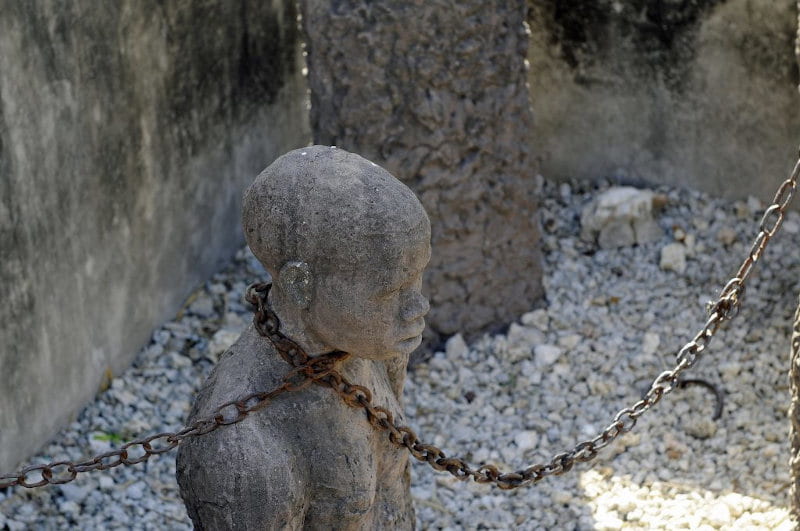
picture of Stone Town Slave Trade. Source: Son of Groucho, Creative Commons.
Stone Town Slave Trade. Source: Son of Groucho, Creative Commons.

History does matter. The truth is I don’t personally like the term “modern-day slavery”. In fact, I’ve often wonder whose idea it was to coin this phrase in the first place?  “Slavery” and particularly in the U.S., was the legal victimization and oppression of an entire population of people based solely on race, that continues to have generational repercussions. Black women and girls were raped, beaten, held captive, violated, taken from their families, sold, mutilated and even murdered. They were forced to bare the children of their perpetrators, teach others how to endure, passed between the family and visitors of their owners, and publicly shamed by their own people. Men were stripped of their human dignity as they stood by and watched helplessly as the women and girls in their lives were violated, impregnated, taken and sold.  Even more poignant is the unspoken evil with regard to their own rape and violation. Blacks were forced to endure extreme and hostile conditions of labor in fields and industries without regard to age, gender, physical condition or mental capacity. The laws protected perpetrators, not victims, there were no shelters, services, support, training or promises of restitution. It was called slavery, not modern, just slavery.

Now don’t get me wrong, I understand the premise behind the term “modern-day slavery” but it is disingenuous at best, to give weight to words in theory, without understanding or recognizing the ramifications of their historical context. I have long said that Human Trafficking is not new, it is slavery revisited, reinvested and renamed, but the only thing modern about it, would be the implication that now it is a problem, because the women and girls largely recognized as victims and survivors have European features. Laws are often changed when those who make them become uncomfortable with the societal ills that begin to impact them personally.

Nelson Mandela, said “The truth is that we are not yet free; we have merely achieved the freedom to be free, the right not to be oppressed.

The perception of modern-day slavery When most people hear the word human trafficking, it is almost always in connection to sex trafficking and tends to immediately invoke a strong emotional reaction of horror and disbelief. The visual perception of women and girls, with European features and as very young, being held captive and forced to engage in acts of sexual depravity and violence is unthinkable. People become even more horrified to learn that this is not just happening in some third world country, but right here in the U.S..

News articles, press conferences and information of coordinated law enforcement agency operations regarding human trafficking, dominate the media about white women and girls reported as runaways or missing, being lured through on-line exploitation and rescued at big sporting events, in hotels and from street-based prostitution. According to Natalie Wilson, co-Founder of The Black and Missing Foundation, 64,000 black women, girls and others are currently missing in the U.S., and yet it fails to make the headlines and sometimes even falls below the radar for law enforcement. Even more disturbing, is the reality that “anti-trafficking groups and policy makers continue to ignore the impact that race and racism play in domestic sex trafficking efforts which do not recognize minority youth as victims.”

Documentaries, movies, conferences, printed material and social media awareness campaigns, continue to keep the focus on shelters and organizations that gather substantial support and funding, while making headlines by incorporating survivors who have become the experts leading the charge for change, but rarely, if ever, do they have a hue to their skin. Not that they don’t exist, because history and truth tells us, WE most certainly do. But once again, another crisis thrives off misdirection, false perception and coded language “evidence based practice”, which is fundamentally derived from data of marginalized minority populations that have been hi-jacked by the mainstream, and successfully hood-winked the masked and disengaged. The scriptures says “my people are destroyed for lack of knowledge.”

However, this does not begin to accurately depict the totality of all that is happening. The bias of information reported does not include the stories of men and boys, transgender and gender non-conforming youth and adults who are homeless, missing from Child Welfare Services, have aged-out of foster care systems and who are being exploited or sometimes self-exploiting as a means of survival with no third party involved in the transactions. Prostitution, on-line sexual exploitation, child sexual exploitation, pornography and commercial exploitation are fueled by demand; however, they are also fueled and sustained by societal factors that have been managed in silos, with no regard to systems that are vulnerable for human trafficking schemes. There are vast populations of people, (veterans, formerly incarcerated, the elderly and disabled, single mothers, homeless and minorities) who are vulnerable for human trafficking schemes, that don’t typically capture the headlines, and go unrecognized because human trafficking has been pigeon-hold by what sells (sex) what can be sensationalized (sex and girls), and what is driven largely by emotion (white).

Unfortunately, people are less emotional and horrified when they hear the words labor trafficking often relying on the preconceived notion or misinformation, that these people (who are of foreign descent), and in the United States illegally, have willingly contributed to their own circumstances. The interweaving of issues like immigration, dreamers, confinement camps, and the belief that these people are stealing jobs from Americans and should be thrown out of the country, are heavily threaded in conversations of outrage without empathy or facts. The disregard for victims who are exploited in educational institutions through criminal justice systems, commercial business and major league sports, only scratches the surface of what is not always happening in silence, thereby making all the purported efforts to end human trafficking, splintered and unrealistic.

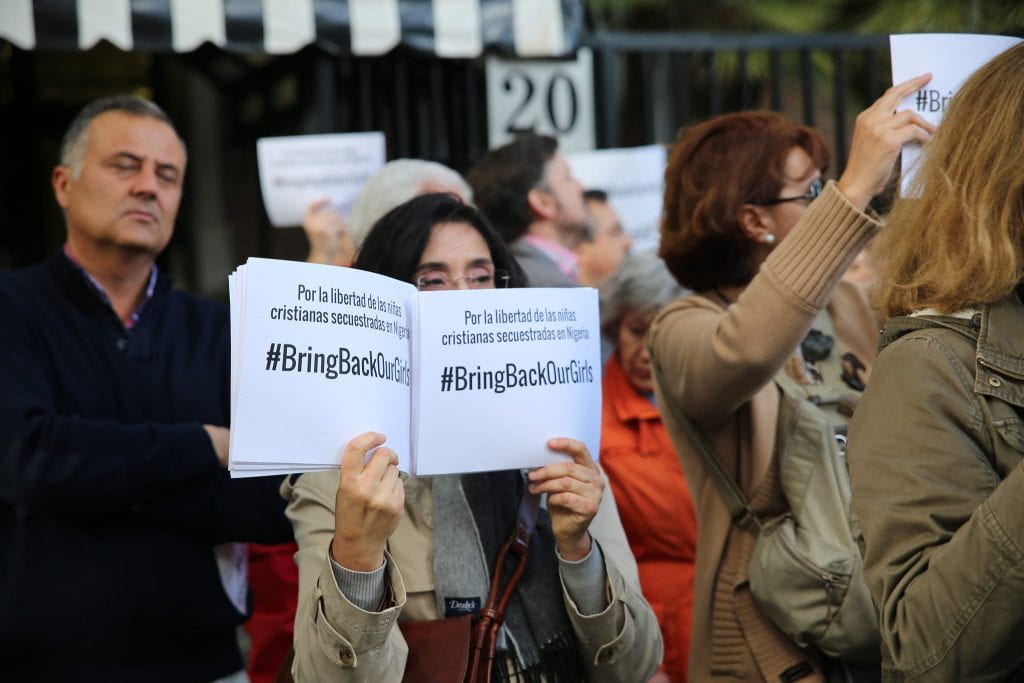
picture of Vigilia por la liberación de las niñas secuestradas en nigeria por Boko Haram
Vigilia por la liberación de las niñas secuestradas en nigeria por Boko Haram. Source: HazteOir.org, Creative Commons.

A global crisis Several years ago more than 200 black girls kidnapped in Nigeria sparked the global campaign “Bring Back Our Girls” individuals, groups and organizations across the racial, cultural and social spectrum galvanized and spoke publicly about what was happening. The viral campaign put black faces front and center in every form of media and print for the first time in the U.S., and bridged the nexus of human trafficking and global human rights. Unfortunately, according to photographer Ami Vitale, photos that she took on behalf of the Alexia Foundation were used and misrepresented as some the images of girls who were not actual victims of Boko Haram, nor from Nigeria. As someone who has been professionally engaged with international countries working on human trafficking and human rights issues for several years, I fully support the global response, but one must take everything into account when being responsive and responsible. Americans can quickly become horrified and outraged at what happens abroad and we can interject ourselves and posture about the money we give for the human rights atrocities. We can feel free to boast of our successes in politics and in a democracy which allows “our people” freedom of speech, choice and opportunity. But when the mirror turns inward, and we see our reflection from where we stand, as citizens of the greatest nation on earth, how dare we spin and spew with audacity, when we can neither reconcile our history of the slavery or even our attempts with modern-day slavery.

Paradigm shift  When you peel back the layers of structural inequality and violence, and identify the amount of injustices that contributes to marginalized populations becoming victims, you can recognize the nexus of human trafficking and human rights. Mandela said, “to deny people their human rights, is to challenge their very humanity”.  Systems embedded in structural violence only exacerbate opportunities of exploitation for marginalized populations. Organized and non-organized schemes swell out of the vulnerabilities known by the oppressor (trafficker, pimp, exploiter) and experienced by their victims (men, women, children); economic segregation, lack of access to quality education, health and mental health disparities and inequities, food gaps and disparities, cultural adaptation to concentrated poverty, generational trauma and violence, drugs gangs and groups, criminal behavior, discriminatory practices that alienate people and allow increased opportunities for victimization –bullying and much more.

Eleanor Roosevelt believed, “Where, after all, do universal human rights begin? In small places, close to home – so close and so small that they cannot be seen on any maps of the world…Unless these rights have meaning there, they have little meaning anywhere…”.

These are not new, nor are they beyond our control. But until we are committed to doing something that will make a substantive difference for all people and not just the select few and privileged, nothing will ever change. Martin Luther King, Jr. reminds us “injustice anywhere is a threat to justice everywhere”.

More than ever before, it is critically important for individuals representing the vast diversity of human beings in this country (African Americans, Latino/Hispanic, Native American/Alaskan Native and others) to lead, not just serve organizations. To establish shelters that provide and develop programs through a culturally competent lens for the delivery of trauma informed services and care, that address the specific needs of marginalized victims. It is imperative that we demand seats in greater numbers at the tables where decisions and policies are made with respect to human trafficking legislation, services, support, and funding.  The time for one or two just won’t do, especially when the data used to garner attention and make the case for funding, comes from the very population that is being ignored. It is vital that existing shelters not be given a pass because it’s the name everyone recognizes, or it’s the only facility that serves human trafficking victims. We must raise the bar, not lower it or we risk contributing to the re-victimization victims, damaging the reputation of worthy organizations and institutions, and opening the door for predators to prey on unsuspecting individuals and businesses within our communities. People often think someone else has done their due diligence by vetting and verifying organizations and shelters are operating ethically and with integrity, but that may not always be the case. Human Trafficking is all about money, it just depends whose on the receiving end. Robert G. Ingersoll asserts, “nothing discloses real character like the use of power…”

Consider This  People are looking for ways to become involved but before one does, I suggest pausing to turn down the background noise of hype and rhetoric that drives funding, volunteerism and emotions. Take the time to become fully knowledge about the issue of human trafficking, “modern-day slavery”, that has had a law for less than 20 years, that even seasoned professionals working in judiciary, law enforcement and victim service providers are still trying to understand how to respond to.

Recognize human trafficking is the new hot topic and cause, and do your own due diligence before you attach your time, talents and finances. Many people may also consider their faith, and although faith based shelters (mostly Christian), are popping up everywhere, you should be clear, that not every victim will be, nor should any person be coerced into religious practice. When a person is coerced to consider faith as a means of freedom and shelter, you have just infringed on their human rights and dignity.

Human trafficking is about the exploitation of the vulnerable and often uninformed. Predators both men and women, don’t have a certain look, and their demeanor is often not what one might expect. The same can be said of some survivors, who claims have been proven to be false or called into question.  You must decide. So, before you dive in and dig deep consider this!

Before you volunteer, ask questions What safety protocols do you have in place for staff, volunteers, victims/survivors? Are background checks conducted on ALL staff, volunteers, victims/survivors? What type of security do you have in place? Fencing, locked gates, guards etc.? Is the location of your facility known to the public? What safety measures do you have in place when and if a person leaves your facility to ensure that others do not find out the location? Have you ever had an incident where someone who was not authorized came to your facility? What is your rate of turn-over in staff, volunteers and victims/survivors?

Before you give, dig deep Board members are responsible for ensuring the organization is following all laws, run ethically and with integrity. So, asking for and reviewing a board’s 1099’s (GuideStar Nonprofit database) to see the names of members and have long they have served is information that you would want to know. Frequent and constant turn over should raise concern. In fact, frequent and constant turn over in staff, volunteers and even location should also raise a concern. It could be an indication of instability, financial integrity, compliance failure and even ethical reliability. How much have board members personally invested in the organization? How many victims/survivors are you currently serving, and how many have they served since the program began? How many licensed, qualified and paid, full-time staff do they have working with victims/survivors? This is an important question as to capacity and especially when it comes to transition shelters that house victims/survivors 24-hours, and drop-in shelters who may provide services and support during specified times and day. A facilities failure to have “paid” staff providing on-going professional services and support should send up a red-flag. And while it may seem like an extra step, provide your questions in writing and ask for an authorized representative to provide the information in writing, giving you time to review the answers and ask any potential additional questions later. Remember, no matter how small you give or how often you give, you have the right to know where and how your money is invested and the right to ask additional questions outside of the standard information they provide. Any organization that cannot provide you with what you require, doesn’t deserve what they are requesting. While these do not begin to exhaust the amount of questions and concerns that one should consider, this is a start.

Lealholm Bridge. Source: Red Rose Exile, Creative Commons.

The bridge I started out by talking about my perspective on the bridge between human trafficking, human rights and race in America. By now given the scale and what some might consider diatribe on the complexities and nuances surrounding these three topics, you may have stopped several times, considered clicking off all together, found yourself agreeing with some and disagreeing with other analysis. However, if you’ve made it this far, and I hope that you did, I also hope that you have come to realize that this is not easy, the bridge is broken and damaged in far too many places, it’s has a history of being unsteady and sometimes unreliable, it’s weak and in need of repair, but it’s what we have, until we come together to build a new one. You have now done what many of us who work on issues that impact social consciousness do every day, keep going. When it’s hard, heavy and sometimes unbearable, when the lie takes our breath away and the truth rips at our heart, when darkness gives more to our movements, than light gives to our moments. When we are crippled with fear, and yet continue to crawl, because we are survivors not merely by circumstance, but most assuredly by choice. We are destined to fight for victims, demand human dignity for survivors and seek a measure of justice where injustice reigns most supreme. We cross the spectrum of race, culture and ethnicity, we ask not for favors, but for the opportunity to bring every person’s reality into focus, so that they may become free. This is the bridge and I’m doing my part to help others cross it.

Invest wisely in the matters of change!” (literally and figuratively) – Sunny Slaughter


Sunnetta “Sunny” Slaughter is the CEO/Principal consultant for Sunny Slaughter Consulting, LLC . Slaughter is  subject matter expertise on human trafficking and intersecting crimes for a national and international clientele and serves as a policy strategist, facilitator, law enforcement instructor, expert, TEDx speaker and subject matter expert, across a broad spectrum of human rights, social justice and civil rights issues.


Additional resources:

UNODC

US State Department Annual Trafficking In Persons Report