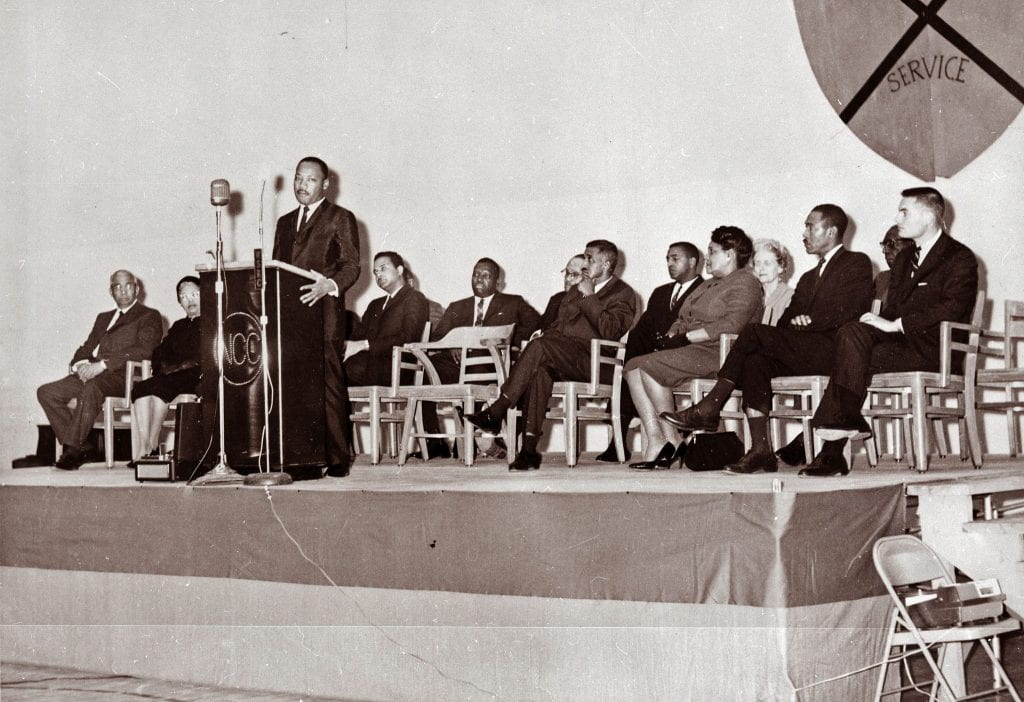
Martin Luther King, Jr. spent the final summer of his life articulating a way to move the United States from civil rights to human rights, a project that found him criticized from across the political spectrum. Fifty years later, King’s anguished attempt to navigate the complex racial politics of the Summer of Love illustrates many contemporary challenges facing progressives and radicals in the 21st century.
In popular memory, Martin Luther King largely operates on the level of myth, often appearing as a hallowed character in various tales of turmoil and triumph. Indeed, historian Jacquelyn Dowd Hall laments the dominant image of MLK—“frozen in 1963”—dreaming endlessly of an America where individuals are judged not “by the color of their skin, but by the content of their character.” Yet in my experience with college students in Chicago and Birmingham, race and ideology continue to influence how Americans interpret King. While racists continue to attack him and his legacy, it is now difficult to find critics of the man in polite circles. Indeed, like other folk heroes and founding fathers, there appears to be a King for everybody. Moderates celebrate his patriotism, piety, and non-violence. Progressives revel in their inside knowledge that the real King was much more militant than grade school portraits suggest. Radicals share and collect his lesser-known writings and speeches. Even conservatives appropriate the preacher’s dream to support color-blind policies anathema to his life’s work. As is their habit, academics live in the nuance and contradictions, depicting a multi-dimensional King that changed over time and remains difficult to capture.
The kaleidoscopic nature of King’s memory owes a great deal to the legacy of his life and times. In the decade-and-a-half of his public existence, MLK’s position often changed with the perspective of the observer. King’s worldview evolved as well. By 1967, King was in the early stages of a public shift to the radical Left, an incomplete journey whose end is impossible to know. At the time, however, King was beset from all sides with judgment, criticism, and ridicule. Conservatives hated him for challenging the racial status quo and for his alleged link to communism. Liberals cautioned him to moderate his demands and contain voices of extremism. Radicals doubted his sincerity and credentials. His own reflections depict a man grappling with uncertainty and doubt.
In the shifting political climate of the mid-1960s, King responded to new developments by reshuffling the movement’s priorities. Following passage of the Civil Rights Act of 1964 and the Voting Rights Act of 1965, the demands of battling Jim Crow moved to the background. In the face of continued racial inequality, King and others renewed their focus on an older set of priorities, principally in the field of economics. While African Americans had long demanded fair access to jobs, housing, education, and housing, Cold War anti-communism silenced an older generation of radicals whose voices sustained the movement prior to World War Two. In post-war America, the relatively safer fight for desegregation dominated the civil rights establishment. By 1967, however, King joined a growing chorus demanding fundamental changes to American society. Never silenced completely, traditions of anti-capitalism and anti-colonialism rose to the fore once again. In the final year of his life, King made explicit many radical values previously left implicit. In his effort to articulate the more radical elements of his dream, King drew much criticism.
In an attempt to challenge the static portrayal of King standing on the steps of the Lincoln Memorial in 1963, however, some commentators have exaggerated the degree of change between the younger and older MLK. While King’s public career reveals a noted radical turn after 1965, much of his later philosophy appeared earlier as well. As historian Clayborn Carson writes, “King’s basic beliefs remained remarkably consistent during his adulthood.” Indeed, King’s evolution was less philosophical than it was dispositional, even circumstantial. King always cultivated a radical perspective, but the passage of time—his internal maturation and a changing external opportunity structure—found him more comfortable articulating radical ideas. Analyzing King’s seminary training and roots in the Black church, for example, historian Douglas Sturm contends that King’s late radicalization was more of a “refinement” than a “transformation of his basic orientation.” While associates claim King only began describing himself privately as a democratic socialist in early 1968, King had long practiced a form of collective humanism, even while avoiding Marxist language in his speeches and publications.
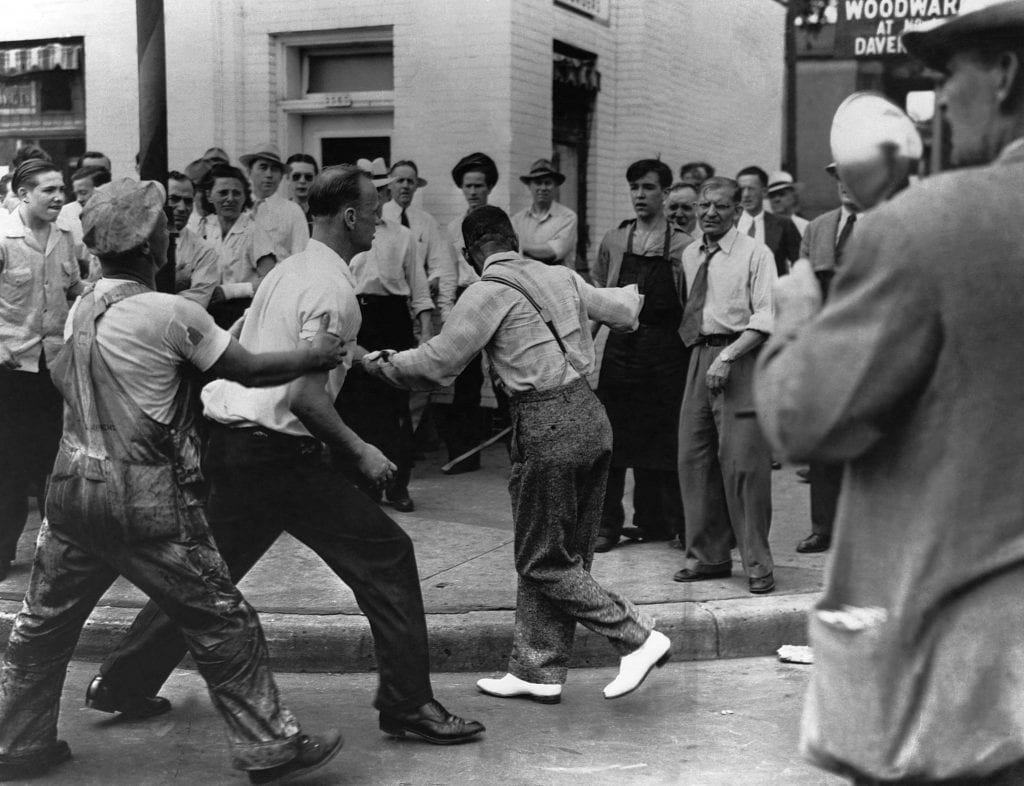
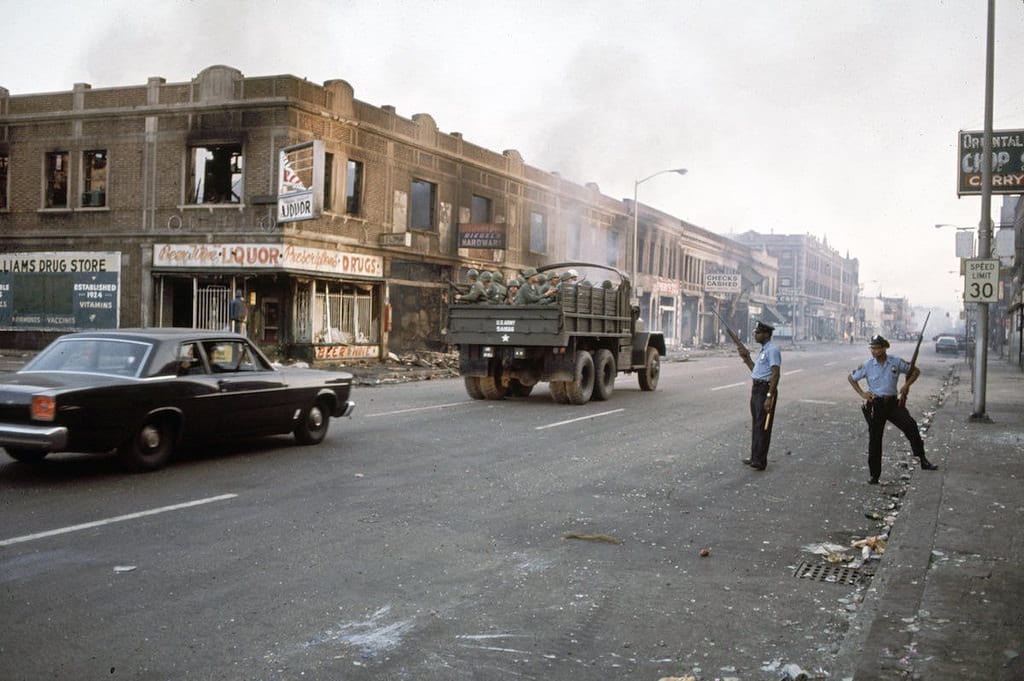
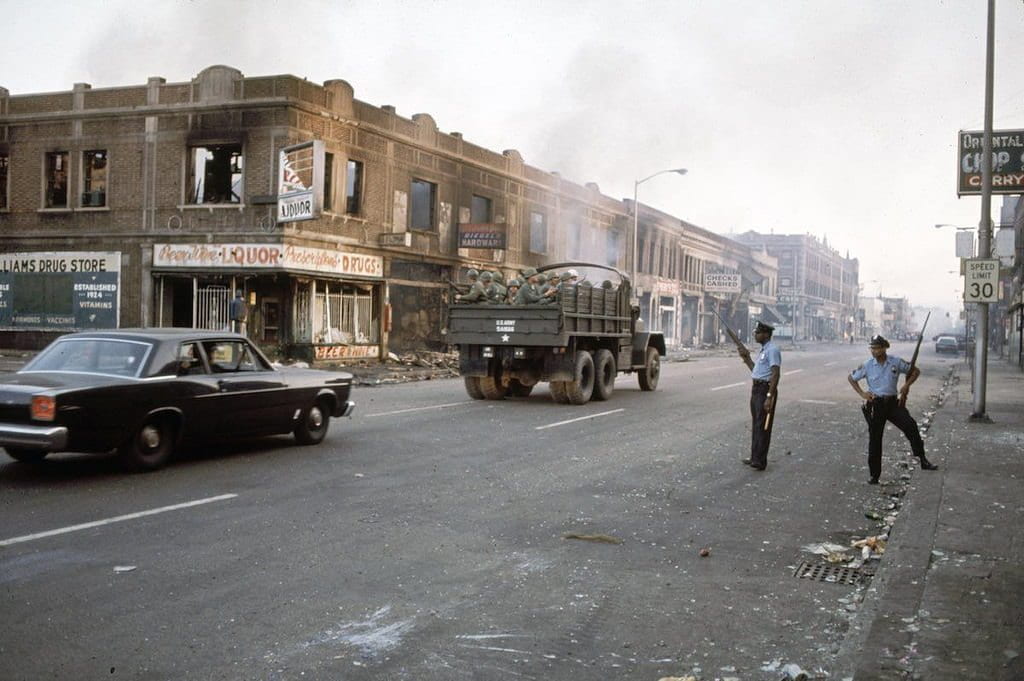
In the late summer of 1967, however, the momentum of outside events forced King to articulate a radical vision of civil rights—one grounded in a larger framework of human rights—that would anger liberal critics in Washington, alienate moderates within the movement, and arouse skeptical militants. Two examples from July and August serve to demonstrate King’s evolving public position and the volatile context within which he operated. July witnessed two of the worst civil disorders of American history, as first Newark and then Detroit exploded in several days of rebellion, riot, and uncoordinated violence. Dozens of people—mostly Black men shot by the police—died as authorities retook the streets. Distraught and physically fatigued, King placed his name on an official response endorsed by Roy Wilkins of the NAACP and Whitney Young of the National Urban League, two giants of civil rights known for their moderation and restraint.
Uncomfortable characterizing civil disorder as the act of lawless rioters, King issued his own public statement in the form of a telegram to President Lyndon Johnson. Blaming public officials—especially Congress—for failing to invest in the inner city, King insisted, “Only drastic changes in the life of the poor will provide the kind of order and stability [we] desire.” Determined to propose a solution, King implored Johnson, “Let us do one simple, direct thing—let us end unemployment totally and immediately. I propose specifically the creation of a national agency that shall provide a job to every person who needs work” (p. 570). Cautious in his sympathy for participants of urban rebellion, King avoided direct criticism of the president and tempered his support for economic redistribution.
Publicly optimistic, King privately worried that his words might encourage further disorder. In a phone conversation transcribed by the FBI, radical associates of King reassured him that “in taking this position, you are not isolating yourself with a few rioters; you are joining some very distinguished opinion-makers and a very large mass of people who have seen through to the real issue here.” While Wilkins, Young, and other moderates distanced themselves from “rioters” for tearing up their neighborhoods, King joined an influential group of observers—particularly those on the radical Left—who recognized the social and economic roots of unrest. According to the FBI transcript, “MLK described the Detroit riot as ‘an explosion of anger against an invisibility’ resulting from ‘a dull monotony of nothingness’ from which people escape occasionally to go to work but to which they must return.” (1) King would expand on this theme of anomie affecting inner city residents—and the nation as a whole—in a more militant speech a few weeks later.
On August 31, 1967, King delivered a keynote address titled, “The Three Evils of Society,” before the National Conference on New Politics (NCNP) in Chicago. Celebrated among King aficionados and radicals today, the speech found King at an emotional low as he faced a divided and occasionally hostile NCNP crowd. Alluding to the audience’s “disillusionment” and sense of “betrayal” with American liberalism, King claimed to share their “blasted” hopes and “shattered” dreams. In the face of an immoral war in Asia and widespread poverty at home, King sympathized with a group of “angry young men of our movement” who booed him the previous summer. King admitted, “I had preached to them about my dream,” only for them to watch it “turn into a frustrating nightmare.” At the heart of their frustration, King contended, was the great American “hypocrisy” whereby policymakers advocate “socialism for the rich and capitalism for the poor.”
King devoted the bulk of his speech to “a triple-prong sickness that has been lurking within our body politic from its very beginning”—the “sickness of racism, excessive materialism, and militarism.” King argued that a contemporary “white backlash” was not triggered by the recent “cry of Black Power “or the “unfortunate wave of riots.” Rather, racism constituted a core component of “Western Civilization,” a phenomenon “rooted in the same problem that has characterized America ever since the Black man landed in chains on the shores of this nation.” Far from aberrant, he insisted, racism was foundational to the American experiment.
Next, King turned to a second societal evil, the “extreme materialism” of the American economic system. “Capitalism,” King declared, “was built on the exploitation and suffering of Black slaves and continues to thrive on the exploitation of the poor—both Black and white, both here and abroad.” Proposing a federal guarantee of full employment, King called for investment in “education” and “health,” a “radical redistribution of political and economic power,” and a program to “aid in the transfer of power and wealth into the hands of residents of the ghetto.”
Finally, King turned to the “disease of militarism.” As American cities descended into “inexorable decay,” King denounced the “tragic adventure in Vietnam” as a drain on “our wealth and energy.” Not only was the war immoral, King argued, it also robbed vital resources from efforts to alleviate poverty at home. In sum, King diagnosed as “morally bankrupt” a society in which “profit motives and property values are considered more important than people.” Only a “radical revolution of values” could save the United States from impending “spiritual death.” Along with a handful of other notable documents, the July telegram to Johnson and the August NCNP speech reflect King’s efforts to steer the civil rights coalition toward a radical human rights agenda with the potential to bring economic justice and substantive freedom to millions of Americans.
Fifty years after 1967, many human rights advocates in the United States today echo King’s attacks on racism, materialism, and militarism. His efforts to move the freedom movement from civil rights to human rights involved demanding the United States government provide all residents adequate employment, housing, education, and healthcare. Including vocal criticism of war and the criminal justice system, King’s 1967 agenda speaks powerfully to 21st-century problems. Indeed, the 2016 platform of the Movement for Black Lives suggests the direct influence of King and his contemporaries. The radical voice of both MLK and #BLM, of course, inspired strong opposition. In King’s day, Cold War anti-communists labeled his prescription subversive and un-American. While the Cold War eventually ended, the rise of mass incarceration and the bi-partisan triumph of neo-liberalism after 1970 continues to stunt racial progress beyond the minimum of condemning Jim Crow statutes. In 2017, activists who challenge fundamental premises of American institutions or demand equitable employment, housing, education, and healthcare encounter the same oppressive forces attacking MLK half-a-century earlier.
Andy Baer is an Assistant Professor of History at UAB. He teaches U.S. History and African American History with a focus on social movements and criminal justice. He is currently working on a book manuscript titled Beyond the Usual Beating: The Jon Burge Police Torture Scandal and Social Movements for Police Accountability in Chicago, 1972-2015.
Footnote: 1) “FBI surveillance of Martin Luther King, Jr. and SCLC via surveillance of home telephone of King advisor Stanley Levinson, July 21, 1967-July 26, 1967,” accessed through the ProQuest History Vault.