Congratulations to Luke Sadergaski and the entire team for the recent acceptance of a new paper, “Remote Americium Detection Using an Optical Sensor: A D-Optimal Strategy for Efficient PLS-Based Modeling” in Sensors!

Congratulations to Luke Sadergaski and the entire team for the recent acceptance of a new paper, “Remote Americium Detection Using an Optical Sensor: A D-Optimal Strategy for Efficient PLS-Based Modeling” in Sensors!
Adrianna Orsi presented her research at the 22nd Symposium on Separation Science and Technology for Energy Applications. Thank you, Adrianna, for doing a fantastic job representing the Burns Research Group!
Adrianna is a senior pursuing a BS in Chemistry in the Department of Chemistry.

The DOE Office of Science recently published a highlight, “One Step Closer to a New Class of Radiopharmaceuticals: Astatine as a Cancer Treatment”, about some of our recent findings!

Congratulations to David Russell, who was announced as a FY 25 Innovations in Nuclear Energy Student Paper Competition Award: Undergraduate Award winner! The awards recognize published graduate and undergraduate students whose work is on the leading edge of nuclear energy research.
David is a postbaccalaureate who graduated in the Fall of 2024 from the Department of Chemistry with his BS in Chemistry. He is also double majoring in Public Health and has earned a Master’s degree in Environmental and Occupational Health.
Congratulations to Jenifer Pyles and the entire team for the recent acceptance of a new paper, “Recovering high-purity uranyl nitrate from simulated used nuclear fuel dissolver solutions by crystallization: rejecting technetium” in Separation and Purification Technology!

Congratulations to David Russel and the entire CoXTL Team on the recent acceptance of a new paper, “Remote Sensing of Nitric Acid and Temperature via Design of Experiments, Chemometrics, and Raman Spectroscopy” in ACS Omega!

Congratulations to David Russell, the second-place winner in the Federation of Analytical Chemistry and Spectroscopy Societies (FACSS) Student Poster competition as a part of the SciX 2024 Conference held in Raleigh, NC, from October 20–25, 2024. Great work, David!

Thank you CAS Communication for highlighting David’s great work in UAB News!
The Burns Research Group has two postdoc openings for highly motivated inorganic or radiochemists. The successful candidates will contribute to a variety of activities in inorganic radiochemistry including 1) the investigation into emerging radioisotopes At-211 for medical applications or 2) the development of new technologies for used nuclear fuel recycling.
Relevant Skills and Experience
Essential Duties:
Required Qualifications:
Preferred Skills/Desirable Qualifications:
If you are interested, please submit a Cover Letter, CV, and Research Statement to burnsjon@uab.edu
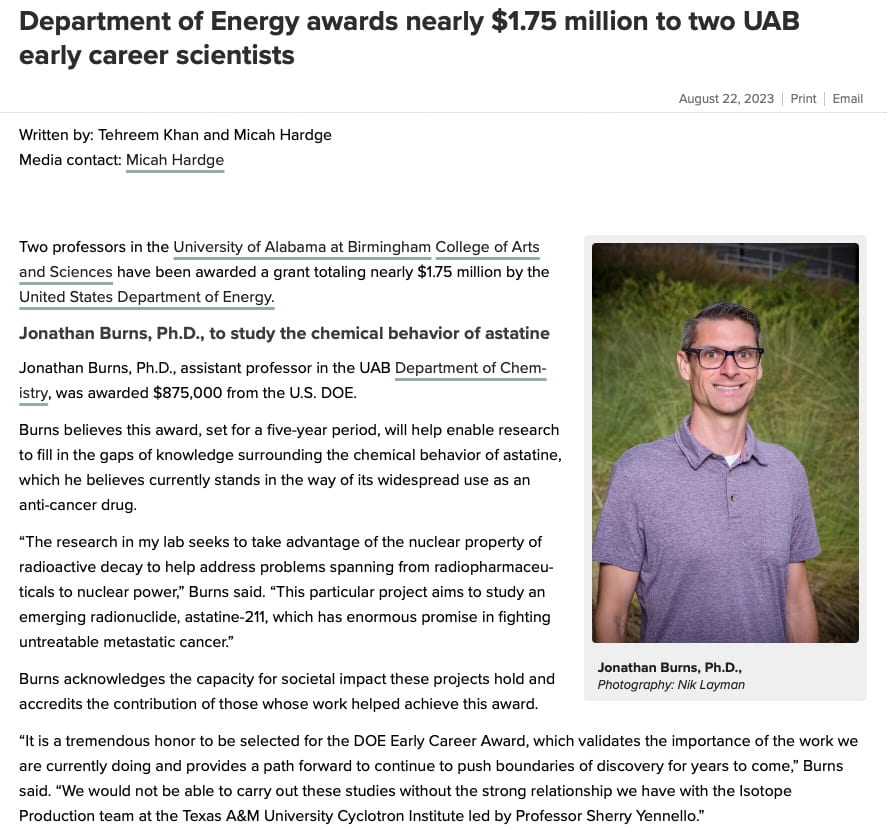
Thank you to UAB News for highlighting our recent DOE Office of Science’s Early Career Research Program (ECRP)proposal, Expanding the Fundamental Understanding of At-211 Chemistry: Towards Improving Binding and Complexation, which has been selected for funding through the DOE Office of Science’s Early Career Research Program (ECRP) by the Office of Isotope R&D and Production and the DOE Established Program to Stimulate Competitive Research (EPSCoR).