Preceptors must first be registered to access APEx.
Students should only access the APEx portal after they have secured an internship.
Aligning Internship Products with MPH Competencies
To fulfill the requirements of the MPH Internship students must create a minimum of two different, tangible products that can be uploaded into APEx and reviewed at the end of the semester. These products must be aligned with and demonstrate the student’s choice of five MPH Foundational competencies. The document below features some possible product and competency pairings that could work in the context of your public health practice focused internship. For any questions please contact OPHP@uab.edu. You can learn more about products on the APEx website’s Product Requirements page (linked).
Steps to Mapping Products to Competencies
When submitting the APEx Proposal and Final Product submission, students must describe how each product demonstrates each specific aligned competency, including a brief description. This mapping helps internship instructors assess the quality and appropriateness of both the product and the experience. These descriptions are 2 – 3 detailed sentences explaining how you plan to demonstrate the chosen competency with the aligned product. The document below can guide you through the process.
Product and Competency Alignment Examples
Open the menus below for example product and competency pairings.
MPH 1: Apply epidemiological methods to settings and situations in public health practice
To demonstrate this competency the student must include the application of various epidemiological study designs (e.g., cohort study) and principles (e.g., sample size, incidence, prevalence, morbidity, etc.). A single setting/situation is insufficient. Please select underlined headings for external links to examples. Example products include but are not limited to:
- Data Analysis Plan or Report – This product should demonstrate the application of epidemiological methods through the clear application of appropriate study design, data analysis techniques, and interpretation of findings. It should show the ability to analyze public health data, calculate key measures like prevalence or risk, and draw meaningful conclusions to inform public health action.
- Assessment/Survey Distribution Plan and Tool – This product can demonstrate epidemiologic principles by outlining how to collect reliable and valid data from a target population. It should include thoughtful survey design, sampling strategies, and planning for data collection, demonstrating how epidemiological methods are used to gather data for identifying and addressing public health concerns. Note: A Survey alone will not fulfill this competency, the survey must be included in a larger survey distribution plan/document that explains all aspects of the survey, provides the survey, background, distribution plan, etc.
MPH 2: Select quantitative and qualitative data collection methods appropriate for a given public health context.
To demonstrate this competency the student must be exposed to various methods so that they can distinguish between them. Must see that students can select among both quantitative and qualitative (e.g., focus groups, key informant interviews) data collection methods. Please select underlined headings for external links to examples. Example products include but are not limited to:
- Data Analysis Plan or Report – This product should demonstrate the selection and use of appropriate quantitative data collection methods by identifying relevant variables, data sources, and measurement strategies based on the public health issue being addressed. It should show how data type and collection approach align with the analysis goals and population context.
- Assessment/Survey Distribution Plan and Tool – This product can sufficiently demonstrate the selection of both quantitative and qualitative data collection methods tailored to the target population and public health setting. It should include decisions on survey questions, format, sampling, and distribution strategies to ensure the data gathered is meaningful, accurate, and relevant to the health issue.
MPH 3: Analyze quantitative and qualitative data using biostatistics, informatics, computer-based programming, and software, as appropriate
To demonstrate this competency the student must address both parts of the competency statement: 1) qualitative (i.e., non-numerical) and 2) quantitative. Must see that students can analyze both types of data using the appropriate software. Appropriate software may be general (e.g., Excel or Word) or specific (e.g., NVivo or SPSS). Please select underlined headings for external links to examples. Example products include but are not limited to:
- Data Analysis Plan or Report – This product should demonstrate the ability to analyze quantitative data using biostatistical methods and software tools such as R, SAS, SPSS, or Excel. It will show how statistical techniques are applied to interpret data accurately, identify trends, and support evidence-based public health recommendations.
- Series of Infographics or One Pagers – These visual products should reflect the translation of analyzed data into clear, accessible formats using informatics tools. They can demonstrate how both quantitative and qualitative findings can be synthesized and communicated effectively through data visualization software or design platforms to support public health awareness and decision-making.
MPH 4: Interpret results of data analysis for public health research, policy, or practice
To demonstrate this competency the student must understand and apply findings from data analysis for public health research, policy or practice. Students should demonstrate an understanding of the data findings and be able to draw linkages to how the results may influence decisions. Please select underlined headings for external links to examples. Example products include but are not limited to:
- Data Analysis Plan or Report – This product should demonstrate the ability to interpret data analysis results by drawing meaningful conclusions and identifying key public health implications. It should connect statistical findings to real-world health issues and informs research questions, policy development, or program planning.
- Data Analysis Presentation – This presentation should translate data findings into a clear narrative tailored to a specific audience. It should highlight the interpretation of results in a way that supports informed decision-making in public health practice or policy.
- Community Health Needs Assessment Report – This report should apply data interpretation to identify health priorities within a community. It will integrate both quantitative and qualitative findings to support planning, resource allocation, and policy recommendations grounded in community health needs.
- Annual Reports/Presentations or Stakeholder Reports/Presentations – These products should interpret and present data to stakeholders, emphasizing trends, outcomes, and areas for improvement. They should turn analysis into actionable insights that guide future public health strategies, funding decisions, or policy initiatives.
MPH 5: Compare the organization, structure, and function of health care, public health, and regulatory systems across national and international settings
To demonstrate this competency the student must clearly include systems across national and international settings. Please select underlined headings for external links to examples. Example products include but are not limited to:
- Policy Brief– This product should demonstrate the ability to compare public health or health care systems by analyzing how different organizational structures and policies impact health outcomes. It should highlight similarities and differences across national or international systems to support informed policy recommendations.
- Comparative Analysis Report – This report should directly compares the structure, function, and outcomes of public health, health care, or regulatory systems in different countries or regions. It should demonstrate critical thinking about how system design influences access, quality, and public health effectiveness globally.
MPH 6: Discuss the means by which structural bias, social inequities, and racism undermine health and create challenges to achieving health equity at organizational, community and systemic levels
To demonstrate this competency the student must be able to discuss factors (including racism, specifically) that impact health equity at multiple levels for a particular health problem. Students should be able to discuss health disparities and differences among groups, as well as the ways in which organizations, systems, and structures operate that may have inequitable influences on certain groups. Please select underlined headings for external links to examples. Example products include but are not limited to:
- Policy Brief – This product should discuss in detail with examples in the specific population for the context of the project how structural bias, racism, and social inequities shape health outcomes and limit access to care. It should identify policy-level barriers and propose evidence-based solutions to promote health equity, highlighting how systems and structures contribute to or can reduce disparities.
- Presentation or Training manual/Curriculum must explicitly discuss the effects of structural bias social inequities, and racism on health and achieving health equity – This product should explicitly examine the ways in which structural bias, racism, and social inequities affect individual and community health in the context of the student’s specific project. It should raise awareness, educate audiences, and promote strategies to recognize and address these issues within organizations or public health systems to support equity-driven change.
MPH 7: Assess population needs, assets, and capacities that affect communities’ health
To demonstrate this competency the student must assess a specific community’s strengths, challenges, and the desired outcomes that are necessary for community well-being. These products can help in understanding and addressing the health needs of a community effectively. Please select underlined headings for external links to examples. Example products include but are not limited to:
- Health Needs Assessment – A health needs assessment is the “process of determining the health and health care needs of any given population or sub-group in an area” (Bani, 2008). Assessments can be conducted at the agency level or at a community/population level. Regardless, the needs assessment is a process requiring a systematic approach to assessing needs. This typically includes 1) determining the goals and objectives of the needs assessment 2) developing pre-scripted question to inform or learn more about the health needs of a community or population 3) review of the needs assessment questions by leadership at the agency 4) distribution of the needs assessment to the target population through electronic survey and questionnaires, focus groups, and/or key informant (stakeholder) interviews 4) analysis or the results and 5) creating a written summary or report of the results. To fulfil this competency, students can develop part or all the components of the needs assessment (ex. draft survey questions/scripts to be used to gather data for the needs assessment or analyze the results of a needs assessment).
- Community Health Assessments
- Data analysis from data dashboards which highlight key indicators and trends within a community
- Asset maps & Resource Toolkits which are visual maps that identify community resources and assets that can be leveraged to improve health outcomes.
MPH 8: Apply awareness of cultural values and practices to the design, implementation, or critique of public health policies or programs
To demonstrate this competency the student must show preparation and assessment of connecting concepts of culture to the product (e.g., cultural adaptation/ tailoring, community involvement in planning, cultural humility). Please select underlined headings for external links to examples. Please select underlined headings for external links to examples. Example products include but are not limited to:
- Community Engagement or Awareness Campaign Plan – This product should apply cultural awareness by tailoring public health messages and strategies to align with the values, beliefs, and practices of specific communities. It should demonstrate respect for cultural differences in the design and implementation of outreach efforts, improving relevance and impact.
- Cultural Awareness Training – This product should promote understanding of diverse cultural perspectives in health, equipping public health professionals to recognize and address cultural influences on behavior, communication, and access to care. It should support more inclusive and responsive programs or services. This does not mean participating in a cultural awareness training as an intern.
- Educational Materials or Presentations – These materials should demonstrate cultural sensitivity by using language, visuals, and content that reflect and respect the norms and values of the intended audience. They should help ensure health information is accessible, appropriate, and effective across diverse populations.
MPH 9: Design a population-based policy, program, project, or intervention
To demonstrate this competency must be demonstrated clearly in a distinct product. The product could be an assessment project, plan for a program or intervention, policy statement, etc. Please select underlined headings for external links to examples. Example products include but are not limited to:
- Policy Statement – This product should demonstrate the ability to clearly define a public health issue and propose a targeted population-level policy. It should outline goals, rationale, and intended impact, reflecting a strategic approach to addressing health concerns through policy change.
- Informational Program/Training Session – This product should show the design of a structured program or training aimed at educating a specific population or workforce. It should include objectives, content, and delivery methods focused on improving health outcomes through knowledge and skill-building.
- Educational Materials or Presentations – These products should reflect thoughtful design of content to inform and engage target populations or stakeholders. They should communicate key health messages effectively to support behavior change or program goals.
- Program or Intervention Plan or Standard Operation Procedure – This product should demonstrate comprehensive planning for implementing a population-based intervention. It should include detailed steps, roles, timelines, and evaluation metrics to ensure successful execution and measurable public health impact.
MPH 10: Explain basic principles and tools of budget and resource management
These products can help effectively managing budgets and resources within an organization or community. Please select underlined headings for external links to examples. Example products include but are not limited to:
- Budget Templates – Pre-designed spreadsheets that help in creating and managing grant or agency budgets.
- Financial Reports – Regularly updated reports that show income, expenses, and financial performance.
- Cost-Benefit Analysis – Reports or spreadsheets that help in comparing the costs and benefits of different programs or policies.
- Training Manuals – Guides that explain the principles of budgeting and resource management.
MPH 11: Select methods to evaluate public health programs
Products need to demonstrate your ability to select and apply evaluation methods. Evaluation of public health programs typically involves skills in data collection, analysis, and communication. Please select underlined headings for external links to examples. Example products include but are not limited to:
- Development of Evaluation Metrics – Develop metrics for key performance indicators and outcomes of public health programs. Present material in dashboards or summaries to facilitate data-driven decision-making
- Evaluation Plans – Develop comprehensive plans outlining the methods and tools you will use to evaluate a specific public health program. This includes defining objectives, selecting appropriate qualitative and quantitative methods, and detailing data collection and analysis procedures.
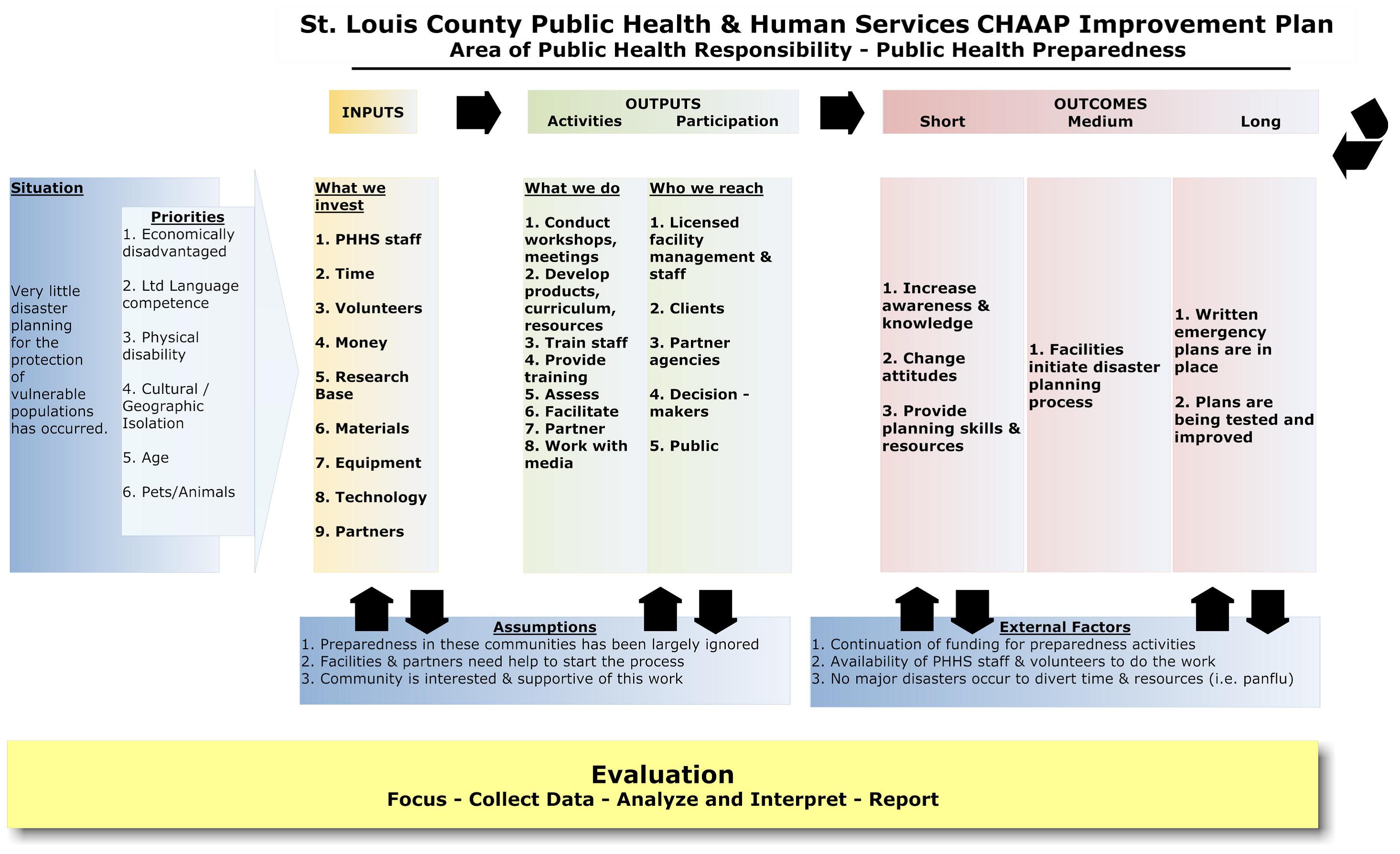
- Logic Models – Create visual representations that map out the resources, activities, outputs, and outcomes of a public health program. Logic models help in understanding the program’s structure and in planning the evaluation process. A graphic alone would not be accepted as a product, the logic mode must be a component of a larger report or analysis or be accompanied by an explanation document of how to implement it.
- Survey Instruments & Distribution Plan – Design surveys or questionnaires tailored to gather data on program effectiveness, participant satisfaction, and other relevant metrics. Ensure these instruments are validated and reliable. Survey instruments alone are not an accepted product, they must be a component of a survey distribution plan or survey report.
- Data Analysis Reports – Compile and analyze evaluation data collected from public health programs. Present findings in detailed reports that include statistical analyses, interpretations, and recommendations for program improvement.
MPH 12: Discuss the policy-making process, including the roles of ethics and evidence
These products not only demonstrate your understanding of the policy-making process but also showcase your ability to communicate complex concepts effectively. Please select underlined headings for external links to examples. Example products include but are not limited to:
- Workshops and Training Materials – Develop materials for workshops or training sessions that teach public health professionals about the policy-making process. Include modules on the importance of evidence and ethics in policy development.
- Policy Briefs – Develop concise documents that outline the policy-making process for a specific public health issue. These briefs should highlight the role of evidence and ethical considerations in shaping policy decisions.
- Case Studies – Write detailed case studies that examine specific public health policies. Focus on how evidence and ethical considerations influenced the policy-making process and the outcomes.
- Policy Analysis – Write papers that critically analyze the policy-making process for a particular public health issue. Discuss the roles of evidence and ethics, and provide recommendations for improving the process.
- Series of Infographics or Factsheets – Design visual tools that illustrate the policy-making process, emphasizing the integration of evidence and ethical considerations. These can be used to educate stakeholders and the public.
- Presentations – Create presentations that explain the policy-making process, including the roles of evidence and ethics. These presentations can be used to inform and engage policymakers, public health professionals, and community members.
MPH 13: Propose strategies to identify stakeholders and build coalitions and partnerships for influencing public health outcomes
To demonstrate this competency, the student should recognize the importance of community involvement and buy-in as instrumental to promoting community change and improvement and should think about how to bring relevant communities and individuals together. Preparation and assessment should emphasize elements of engagement with relevant communities and individuals. Please select underlined headings for external links to examples. Example products include but are not limited to:
- Strategies to Build Collaboration and Partnership – This product should outline specific approaches for identifying key stakeholders and creating effective partnerships. It should demonstrate skills in fostering cooperation and aligning goals to strengthen public health initiatives.
- Engagement Plan – This product should detail a plan to actively involve stakeholders through communication, outreach, and participation. It should show how to maintain ongoing relationships that support shared decision-making and collective action.
- Standard Operating Procedures – This product should provide clear, step-by-step guidelines for engaging partners and stakeholders consistently. It should ensure that collaboration processes are systematic, transparent, and sustainable.
- Stakeholder Engagement Report – This product should document the identification, involvement, and contributions of stakeholders in a project or program. It should reflect on partnership effectiveness and provide insights into improving future coalition-building efforts.
MPH 14: Advocate for political, social, or economic policies and programs that will improve health in diverse populations
To demonstrate this competency the student must understand how to advocate for a particular issue and have the ability to influence policy and/or decision making, such as through community mobilization, educating policy makers, etc. and demonstrate this in their product. Students must produce a product that would be part of an advocacy campaign or effort (e.g., legislative briefing paper or fact sheet, advocacy strategy outline, etc.). Please select underlined headings for external links to examples. Example products include but are not limited to:
- Policy Brief – This product should summarize research and policy recommendations to persuade stakeholders and decision-makers. It should advocate for specific changes that address social determinants and improve health outcomes in diverse populations.
- Legislative Briefing or Fact sheet Used to Educate Legislators – This product should educate legislators by clearly presenting evidence and key messages about a public health issue. It should support advocacy by informing policy makers to influence decisions that improve health equity.
- Strategy Outline for Advocacy Campaigns – This product should detail a plan for organizing and executing advocacy efforts. It identifies target audiences, messages, and tactics to effectively promote health-related policies or programs.
MPH 15: Evaluate policies for their impact on public health and health equity
To demonstrate this competency the student should focus on the evaluation of policies rather than the development of policies. Students should consider how groups are affected by policies, including both intended and unintended consequences with a focus on the impacts on equity. Products should demonstrate your ability to evaluate policies but also showcase your skills in data analysis, communication, and advocacy. Please select underlined headings for external links to examples. Example products include but are not limited to:
- Series of Infographics and Factsheets – Design visual tools that communicate the results of policy evaluations in an engaging and easily understandable format. Infographics can highlight key findings and recommendations
- Policy Analysis Reports – Develop detailed reports that assess the impact of specific policies on public health outcomes and health equity. These reports should include background information, methodology, data analysis, and recommendations.
- Health Impact Assessments (HIA) – Conduct and document HIAs to evaluate the potential health effects of policies, programs, or projects. This involves a systematic process that includes screening, scoping, assessment, recommendations, reporting, and monitoring.
- Case Studies – Write case studies that illustrate the evaluation of policies in real-world settings. These should detail the methods used, findings, and implications for public health and health equity.
- Literature Reviews – Compile comprehensive reviews of the evidence used to support public health policies. These reviews should assess the outcomes of health policy on public health and health equity.
- Policy Briefs – Develop concise, accessible briefs that summarize the findings of policy evaluations. These briefs can be used to inform policymakers, stakeholders, and the public about the impact of specific policies.
NOT AVAILABLE FOR SELECTION: MPH 16: Apply leadership and/or management principles to address a relevant issue
This competency cannot be adequately addressed through the MPH Internship deliverables and cannot be aligned with products.
NOT AVAILABLE FOR SELECTION: MPH 17: Apply negotiation and mediation skills to address organizational or community challenges
This competency cannot be adequately addressed through the MPH Internship deliverables and cannot be aligned with products.
MPH 18: Select communication strategies for different audiences and sectors
To demonstrate this competency the student must select and determine how to communicate with different groups by considering the needs and usual practices of the target audience. Students should be able to discern between different media, consider levels of health literacy, etc. Please select underlined headings for external links to examples. Example products include but are not limited to:
- Educational Materials or Presentations – These products should show the ability to design content that is clear, accessible, and relevant to specific audiences, whether professional, community-based, or policy-focused, ensuring information is communicated effectively and appropriately.
- Social Media Campaign Plan – This product should demonstrate the ability to tailor public health messages for digital platforms, using audience-specific content, tone, and channels to engage and inform diverse groups effectively.
- Awareness Campaign Plan – This plan should outline targeted messaging and outreach strategies designed to raise awareness among specific populations or sectors. It should reflect a thoughtful selection of communication methods that fit the audience’s needs and context.
- Community Education Campaign Plan – This product should apply culturally and contextually appropriate communication strategies to educate a community about a public health issue. It should demonstrate how to effectively engage local audiences through trusted channels and messaging.
MPH 19: Communicate audience-appropriate (i.e., non-academic, non-peer audience) public health content, both in writing and through oral presentation
To demonstrate this competency the student should communicate using words and images that are effective, accessible, and understandable for each audience. Students should consider the venues or methods of delivery (e.g., social media, press release, oral presentation, journal article) that best fit the circumstances. An audience of peers/fellow students or an academic audience is not sufficient. Please select underlined headings for external links to examples. Example products include but are not limited to:
- Social Media Campaign – This product communicates key public health messages in a clear, engaging, and concise way for general audiences. It uses accessible language and visual content tailored for non-expert users across digital platforms.
- Press Release – This product presents public health information in a format meant for the media and the general public. It translates complex data into straightforward, newsworthy content that is timely, relevant, and easy to understand.
- Educational Presentation – This oral presentation delivers health information using simple language, relatable examples, and visual aids appropriate for community members, patients, or non-public health professionals.
- Patient Education Materials – These materials explain health topics or guidance in plain language, ensuring that individuals with varying levels of health literacy can understand and act on the information to improve their health.
MPH 20: Describe the importance of cultural competence in communicating public health content
To demonstrate this competency products will be different from alignment with MPH 08. Products should focus on communicating public health content and why cultural humility is an important consideration when crafting public health communications. Students should consider the importance of ensuring that different groups can easily relate to and apply public health information. Please select underlined headings for external links to examples. Example products include but are not limited to:
- Public health Communication Strategy Brief – A written brief or white paper that outlines how to adapt public health messages for diverse audiences, emphasizing language access, representation, health literacy, and cultural relevance, it should include rationale for chosen communication methods or channels (e.g., using community radio vs. social media, or Spanish-language materials).
- Culturally Competent Social Media Campaign Plan – A strategic social media plan that outlines how to deliver messages in culturally responsive ways (e.g., tailoring content for youth in a specific group or population). It should explain choices for imagery, influencers, language tone, etc.
- Training Presentation or Workshop Module – A presentation or workshop designed to teach public health professionals about the role of cultural competence in effective communication, it could include case studies, best practices, and common pitfalls in communicating across cultures.
MPH 21: Integrate perspectives from other sectors and/or professions to promote and advance population health
To demonstrate this competency students must combine the external sector/profession’s perspective and/or knowledge with their own public health training to complete a task, solve a problem, etc. The student must actually interact with individuals in a profession or sector other than public health (in-person or online). Other sectors and/or professions may include physicians, nurses, pharmacists, and physical therapists, and can extend past the health sciences into education, urban planning, public administration, engineering, housing authorities, the legal system, police departments, and beyond. Role playing in which public health students assume the identity of an individual from another profession or sector to which they do not already belong is not an acceptable substitute. Please select underlined headings for external links to examples. Example products include but are not limited to:
- Community Health Intervention Plan co-designed with a school administrator. This demonstrates real interdisciplinary collaboration to address a specific population (e.g., students) using both educational and public health strategies.
- Policy Brief developed with input from an urban planner on reducing heat-related illnesses. It shows how integrating infrastructure and planning perspectives can directly influence public health policy and outcomes.
- Needs Assessment Report created with insights from a local housing authority. This leverages on-the-ground expertise to uncover social determinants of health, showcasing the value of cross-sector data and analysis.
MPH 22: Apply a systems thinking tool to visually represent a public health issue in a format other than standard narrative
To demonstrate this competency the product must be non-narrative. Describing how systems thinking might apply is not sufficient; students must show that they can actually apply systems thinking tools by constructing something like a causal loop diagram, systems archetypes, network analyses, and concept maps. Logic models and evidence tables alone are not sufficient to address this competency. Please select underlined headings for external links to examples. Example products include but are not limited to:
- Systems Diagrams – This product should visually map the components and relationships within a public health issue, highlighting how different factors interact over time. It should show a systems thinking approach by illustrating complexity and interdependence beyond linear cause-effect models. Note: A figure alone will not fulfill the competency, the figure or diagram must be a part of a larger report that explains the figure, background, method to creating it updating it, interpreting it, etc.
- Concept Maps – This product should organize and connect key concepts related to a public health problem in a visual format. It should demonstrate the ability to structure complex information clearly, helping identify patterns, relationships, and leverage points for intervention. Note: A figure alone will not fulfill the competency, the figure or diagram must be a part of a larger report that explains the figure, background, method to creating it updating it, interpreting it, etc.
- Causal Loop Diagram – This tool should visually represent feedback loops and cause-effect relationships within a public health system. It should highlight how actions can reinforce or balance outcomes, offering insights into dynamic system behaviors and long-term impacts of interventions. Note: A figure alone will not fulfill the competency, the figure or diagram must be a part of a larger report that explains the figure, background, method to creating it updating it, interpreting it, etc.